


Food and drink social media marketing is the fastest way to grow diner discovery, direct orders, and repeat customer volume for Indian F&B brands in 2026. Buyer research in this category is visual-first: diners scroll before they search, and F&B brands that own the scroll capture the intent before aggregator apps ever open. This guide covers the seven proven social media marketing strategies that consistently move Indian F&B revenue, in the order to execute them.
Key takeaways
- F&B is one of the most visually-driven purchase categories on social media, and short-form vertical video now drives the majority of new customer discovery for Indian restaurants, cafes, and D2C food brands.
- India is the world’s second-largest generative AI search market at ~160 million monthly active users, per Bain-Flipkart’s How India Shops Online 2026 report. Social content now feeds both traditional discovery and AI-driven restaurant shortlists.
- Micro food creators (10,000 to 100,000 followers) with high engagement typically outperform larger influencers on ROI for Indian F&B brands. Two to three long-term partnerships beat dozens of one-off paid promotions.
- A working F&B social media program can shift 15 to 30% of new customer acquisition to direct channels within 6 to 12 months, reducing dependence on aggregator platforms that charge 18 to 25% commission on every order.
- Consistency matters more than production polish. Three to five posts per week for six months does more for an F&B brand than one high-production campaign and silence.
Who This Guide Is For (and Who It Is Not For)
This is for: Indian F&B operators (restaurants, cafes, cloud kitchens, D2C food and beverage brands) with an existing menu or product catalog and monthly revenue you want to protect from margin compression, currently dependent on aggregators for 60% or more of orders, with at least ₹40,000 per month available to invest in social media content production and paid amplification.
This is NOT for: Pre-launch F&B brands still finalizing menu or location, single-owner home kitchens without formal business registration, or operators wanting overnight results. Social media compounds over 3 to 6 months. If you need traffic this weekend, run paid ads first and layer organic social alongside.
What Does F&B Social Media Marketing Actually Move?
Food and drink social media marketing moves three specific business levers. It drives top-of-funnel diner discovery through short-form vertical video and organic feed content that reaches new buyers who have not heard of your brand. It drives mid-funnel consideration through creator partnerships, honest food reviews, and community engagement that builds trust before the first order. And it drives bottom-funnel conversion and retention through direct-response ads, WhatsApp broadcasts, and repeat purchase automation for opted-in customers.
The economics are compelling for Indian F&B specifically. Organic social reach in the category remains meaningful (unlike most other categories where organic reach has collapsed), because food content is inherently entertaining and platforms actively surface it. Paid amplification on social is significantly cheaper than paid search for F&B keywords. And micro creator partnerships in the food category deliver measurable ROI most other categories cannot replicate.
What Are the 7 Proven Food and Drink Social Media Marketing Strategies?
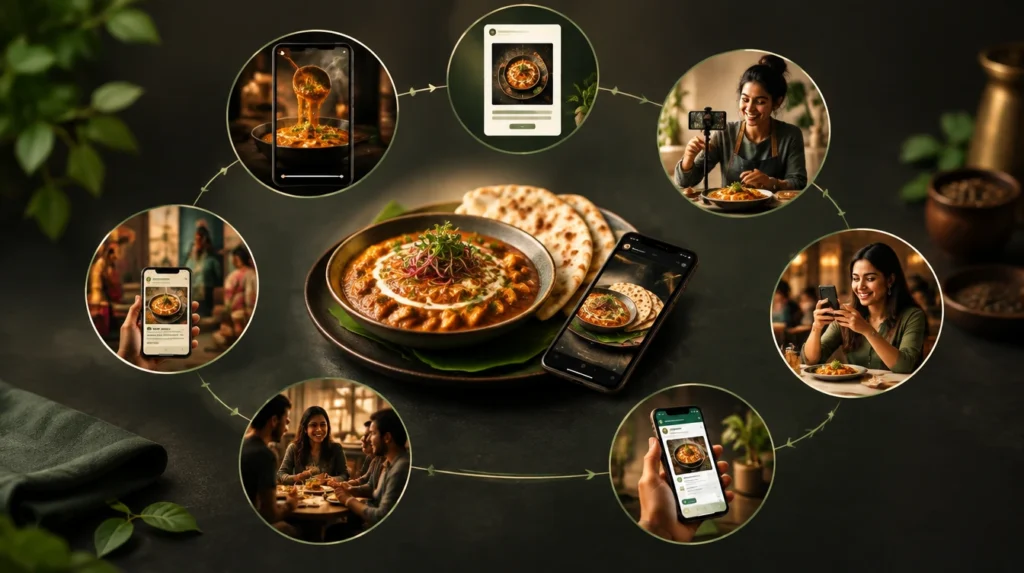
Seven strategies consistently produce measurable results for Indian F&B brands across restaurants, cafes, cloud kitchens, and D2C food businesses. In our own social media and content work with food and beverage clients at Morphiaas, a performance marketing and creative agency serving India and the US, these are the seven strategies we combine when helping F&B brands build discovery, direct orders, and repeat customer volume.
1. Short-form vertical video as the primary content engine
Short-form vertical video now drives the majority of new customer discovery for Indian F&B brands, and organic reach in this format remains meaningful. Publish 3 to 5 short videos per week: food preparation with satisfying close-ups and sound, plating and dish reveals, staff introductions with genuine personality, behind-the-scenes kitchen moments, ingredient sourcing stories, and honest customer reactions. Consistency matters more than production polish. A phone-shot video with good lighting and honest content outperforms a scripted studio shoot for F&B specifically. Post at consistent times, respond to comments within 2 hours, and let successful formats guide the following month’s content calendar.
2. Paid social with catalog integration for delivery and D2C
Paid social remains the highest-volume acquisition channel for Indian F&B. For D2C food and beverage brands, use catalog-integrated shopping ads pulling product data from your e-commerce store, dynamic product ads for retargeting warmed audiences, and lead generation forms for higher-consideration purchases. For restaurants and cafes, use reservation-focused campaigns with click-to-WhatsApp CTAs, event promotion for weekend and festive drives, and store-visit optimization for footfall. F&B CPLs in India typically run ₹150 to ₹600 for delivery-focused campaigns and ₹300 to ₹1,200 for reservation and event campaigns.
3. Micro food creator partnerships (10,000 to 100,000 followers)
Micro food creators with genuine category engagement consistently outperform mega influencers on ROI for Indian F&B brands. Two to three long-term partnerships with authentic creators in your city and cuisine category beat dozens of one-off paid promotions. Structure partnerships around honest food reviews, real dining experiences, or recipe collaborations rather than scripted promotional content. Look for creators whose comment sections show real diner questions (“where is this?”, “how much does it cost?”) rather than generic emoji reactions. The former converts. The latter does not.
4. User-generated content (UGC) and diner story amplification
Diners who post about their meal are producing free marketing content for your brand. Systematize UGC capture: encourage tagging with signage inside the restaurant, create a branded hashtag, ask diners to tag your handle on their story or post, and reshare the best UGC with permission. UGC signals authenticity in a way branded content cannot. It also drives organic reach on platforms that increasingly favor content shared by real users over polished brand posts. For D2C food brands, unboxing content and recipe-with-product content from real customers is one of the highest-converting content types available.
5. WhatsApp as the retention and repeat purchase layer
Social media drives discovery. WhatsApp drives retention. Enable click-to-message CTAs on your social profile, ad creative, and website. Use the free WhatsApp Business app under 1,000 opted-in contacts, upgrade to the WhatsApp Business API through Interakt, AiSensy, or Wati above that threshold. Broadcast weekly value-first updates to opted-in repeat customers (new menu items, chef’s specials, weekend events, member-only offers) with a 70/30 value-to-promotion mix. Handle reservations, private dining enquiries, and direct delivery orders through WhatsApp to skip aggregator commission entirely. This is where the compounding margin lives.
6. Community building through Broadcast Channels and close-friend segmentation
Private communities of 300 to 3,000 loyal customers typically produce more repeat revenue than 30,000 casual followers. Use platform-native features (Broadcast Channels, Close Friends lists, private groups) to segment your best customers and give them early access, insider content, and community moments. For Indian F&B specifically, this taps into cultural preference for group belonging and family recommendation dynamics. A tightly-managed community of repeat diners drives referrals, sustains repeat purchase, and produces market feedback no other channel gives you at that quality.
7. Regional language content for Tier-2 and Tier-3 expansion
English-only social media content leaves majority-India audiences unclaimed. Publish 30 to 40% of your social content in Hindi plus one regional language matched to your buyer geography (Tamil, Telugu, Marathi, Bengali, Gujarati, Kannada, or Malayalam). Vernacular content faces significantly less competition, drives higher engagement rates, and reaches Tier-2 and Tier-3 buyer segments that pure English content cannot. For F&B brands expanding beyond metro cities, this is one of the highest-ROI content opportunities most competitors ignore.
How Does F&B Social Media Compare to Alternative Growth Channels?
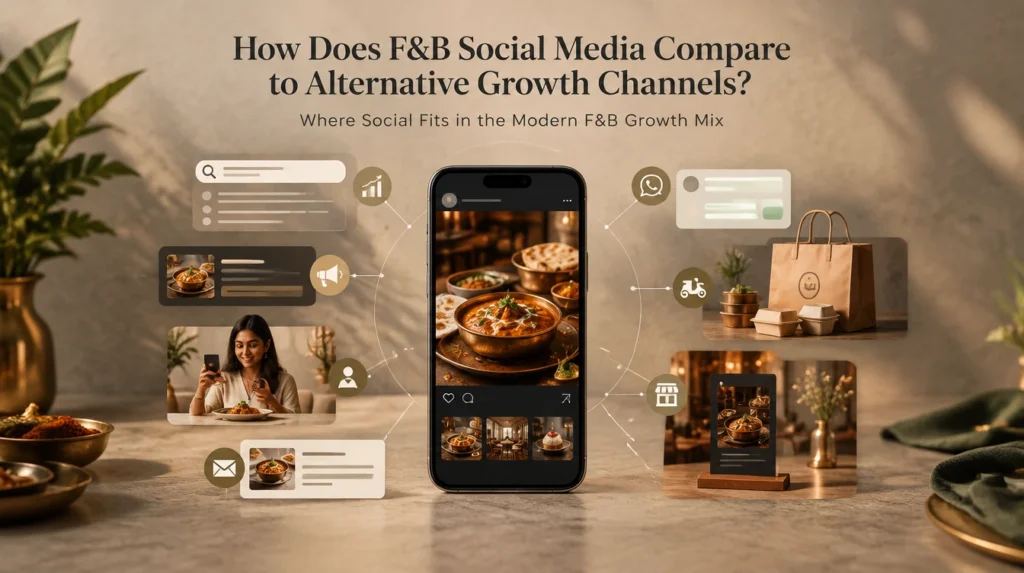
Honest comparison across the four channels most Indian F&B brands consider:
- Social media vs local SEO: Social produces immediate discovery and momentum but requires continuous content investment. Local SEO produces evergreen discovery over 6 to 12 months. Best answer: both. Social for daily brand presence and reach, SEO for compounding foundation.
- Social media vs aggregator paid promotion: Aggregator promotions boost visibility inside the app for that day. Social builds owned audience that continues generating orders permanently. Aggregator commission is a recurring tax on every order. Social-sourced orders arrive commission-free.
- Social media vs traditional PR: PR builds credibility signals and reach in short bursts. Social builds daily audience engagement and community. Best answer: coordinated. PR feeds social credibility, social captures the audience PR generates.
- Social media vs event marketing and pop-ups: Events produce spikes lasting days and require significant operational lift. Social produces steady daily discovery. For most Indian F&B brands, one event per quarter amplified through social outperforms four events per quarter without amplification.
For most Indian F&B brands, the highest-ROI mix over 24 months is short-form video as the daily discovery engine, paid social for scale amplification, micro creator partnerships for authentic reach, WhatsApp for retention, and community programs for loyalty. Aggregators remain a distribution layer to optimize, not the strategic centerpiece.
What Results Should F&B Brands Expect from Social Media?
In our own social media work with F&B clients at Morphiaas, results follow a predictable pattern for brands that commit to consistent execution across the seven strategies. Directional ranges from our observations:
- Months 1 to 2: Follower growth typically climbs 30 to 60% after consistent posting begins. Short-form video reach doubles or triples baseline. Engagement rates on posts improve as the algorithm learns your content. Comments and DMs increase as diner discovery grows.
- Months 3 to 6: Direct traffic from social to reservations, WhatsApp, or product pages becomes measurable. Micro creator partnerships (if started in month 1) begin producing attributable orders. UGC capture starts feeding organic discovery through diner shares.
- Months 6 to 12: Direct-order share typically climbs 15 to 30% from baseline. Community members (broadcast channel or close friends segments) drive repeat purchase measurably higher than general followers. Aggregator commission as a percentage of revenue drops correspondingly for restaurants and cafes.
- Months 12 to 24: Social becomes a compounding brand asset. Blended cost per new customer drops as organic reach and community referrals grow. Retained customers from month 6 continue generating repeat revenue through WhatsApp broadcasts and community engagement at near-zero incremental cost.
These are directional ranges from our own client observations, not guarantees. Actual results depend heavily on category, cuisine, price band, city, and execution discipline. Brands that stop after month 3 typically see none of the compounding.
How Should F&B Brands Sequence This Social Media Work?
Do not launch all seven strategies simultaneously. Sequence based on your current baseline. Weeks 1 to 4: establish content foundation (3 to 5 short-form videos per week, messaging channel setup, complete profile optimization). Weeks 4 to 8: launch paid social with catalog integration for D2C or reservation ads for restaurants. Months 2 to 4: identify and onboard 2 to 3 micro creator partnerships. Months 3 onward: build UGC capture systems and community broadcast channels. Months 4 onward: expand into Hindi and one regional language content for Tier-2 and Tier-3 buyer segments.
Budget: single-location F&B brands typically allocate ₹40,000 to ₹1,25,000 per month across content production, paid social spend, WhatsApp Business tooling, and micro creator partnerships. Multi-location brands and D2C food companies scale to ₹1,50,000 to ₹5,00,000 per month. Add one-time investment of ₹75,000 to ₹2,50,000 for initial photography, video production setup, and creator brief development. Judge results at 90 and 180-day marks, not weekly. Social media compounds over quarters when executed consistently.
Common Social Media Mistakes F&B Brands Make
- Posting inconsistently. Three posts in one week and silence for a month kills algorithmic momentum and follower retention. Consistency beats volume in bursts.
- Prioritizing polish over authenticity. Over-produced content underperforms honest phone-shot content for F&B specifically. Diners want to see real food, real staff, real moments.
- Chasing mega influencers instead of micro creators. Mega influencer campaigns produce spikes with poor conversion. Micro creators with genuine category engagement deliver measurable ROI at a fraction of the cost.
- Ignoring UGC and diner-shared content. Real diners posting about your food are producing free marketing. Not amplifying it leaves the highest-authenticity content type unused.
- Treating WhatsApp as customer support only. WhatsApp is the retention layer that compounds social discovery into repeat revenue. Using it only for enquiries leaves the biggest owned-channel lever untouched.
- Publishing English-only content in Tier-2 and Tier-3 markets. Regional language content faces less competition and drives higher engagement. English-only leaves majority-India audiences unclaimed.
- Measuring only weekly ROAS on paid social. Weekly ROAS tells you nothing about community growth, retention, or brand equity. Monthly business reviews with LTV, direct-order share, and repeat purchase rate tell the real F&B social story.
Get a Free 48-Hour F&B Social Media Audit
If you want an honest read on where your F&B brand’s social media currently sits against these seven strategies, book a 30-minute call with us at Morphiaas. We will audit your posting consistency, content mix, paid social performance, creator partnerships, and WhatsApp integration. Within 48 hours you will get a specific priority list of the three highest-ROI social media moves for your business, delivered by email. No pitch. You can execute the recommendations yourself or bring us in to run them through our paid media practice. This audit is aimed at F&B brands with existing revenue ready to reduce aggregator dependence, not at pre-launch operators. If you fit, book a call here. To see how we work with Indian F&B brands more broadly, this is our food and beverage marketing page.
Frequently Asked Questions
How do we know if social media marketing is right for our F&B brand?
If you have visually appealing food or beverage products, existing monthly revenue you want to protect from margin compression, and can commit ₹40,000 minimum per month for 3 to 6 months of consistent content production, F&B social media is likely one of the highest-ROI acquisition investments available. If you cannot commit to weekly posting or you are pre-launch, delay social investment until you have that capacity.
What does F&B social media marketing cost in India?
Single-location F&B brands typically invest ₹40,000 to ₹1,25,000 per month across content production, paid social, WhatsApp tooling, and creator partnerships. Multi-location brands and D2C food companies scale to ₹1,50,000 to ₹5,00,000 per month. One-time investment of ₹75,000 to ₹2,50,000 covers initial photography, video production setup, and creator brief development.
Should we work with mega influencers or micro creators?
Micro creators (10,000 to 100,000 followers) with genuine engagement in food content consistently outperform mega influencers on ROI for Indian F&B brands. Two to three long-term partnerships with authentic micro creators typically deliver better attributable orders than dozens of one-off mega influencer campaigns. Prioritize category relevance and comment quality over follower count.
How is social media marketing different from paid ads alone?
Paid ads produce leads within 30 days but stop when spend stops. Organic social builds owned audience that continues generating discovery and orders permanently. Paid amplification of organic content typically outperforms pure paid ads for F&B because authentic organic content signals credibility that pure ads cannot manufacture. Best answer: use paid to amplify your best organic content, not as a standalone channel.
How long until we see business results from F&B social media?
Paid social produces measurable orders within 30 days. Organic follower growth and engagement lift takes 60 to 90 days of consistent posting. Direct-order share meaningfully shifts from aggregators to direct channels in months 6 to 12 as WhatsApp retention and community programs compound. Judge quarterly, not weekly.