

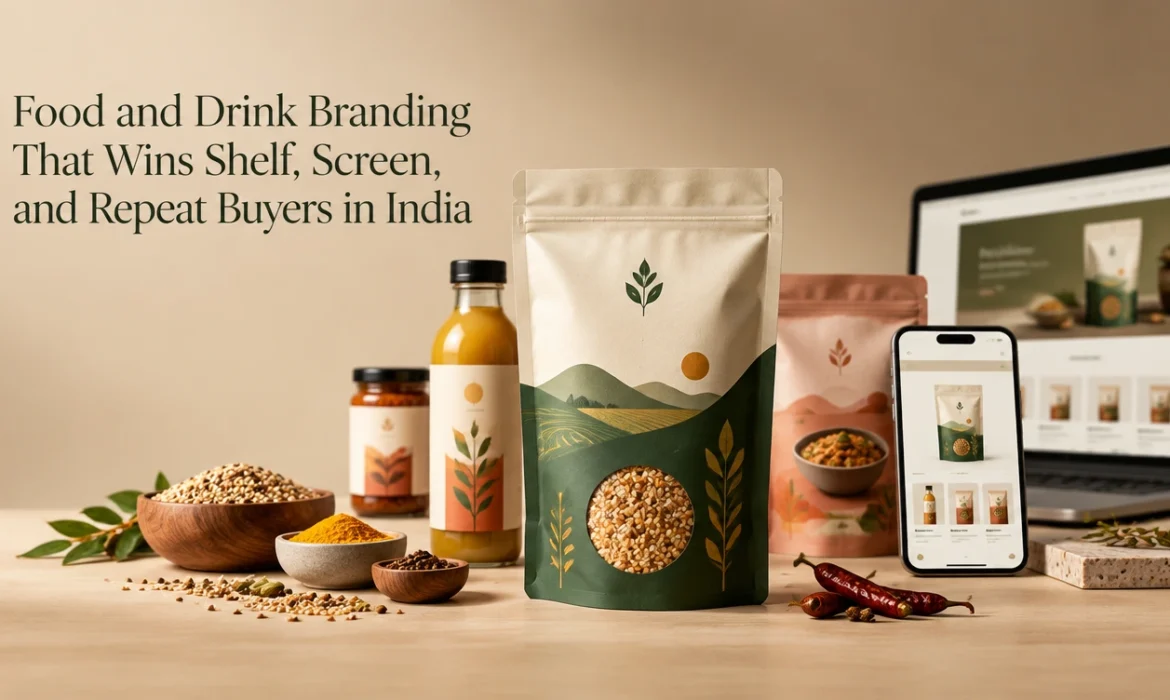
Food and drink branding in India decides more revenue than most founders realise. Products with weaker taste often outsell competitors because their positioning is sharper. Taste opens the first sale. Meaning earns the second.
This guide is a tactical playbook for Indian F&B founders in packaged food, beverages, cloud kitchens, and cafes. It walks through building a brand that survives quick commerce thumbnails, general trade shelves, and D2C attention wars. You’ll get 7 proven strategies with real Indian context. Also INR budget bands, and where each strategy actually moves recall, retention, and margin.
Key takeaways
- Food and drink branding is a business discipline, not an aesthetics job. Brands that survive rising CAC and quick commerce compression made positioning decisions before design decisions.
- 7 proven strategies carry the weight. Positioning, verbal identity, visual identity, packaging, cultural storytelling, price architecture, and consistency systems as the brand scales.
- Budget bands in INR run four routes: founder-driven DIY ₹0 to ₹1L, freelancer with junior studio ₹2L to ₹5L, full brand system ₹5L to ₹15L, established F&B specialist agency ₹15L to ₹40L or more.
- Indian F&B brands face three shelves now, not one. Physical general trade, quick commerce thumbnails on delivery apps, and D2C storefronts. Each demands different design decisions.
- Consistency beats creativity on execution timelines longer than 12 months. Brand systems that scale are the ones that make future decisions easier, not harder.
What food and drink branding actually means in 2026
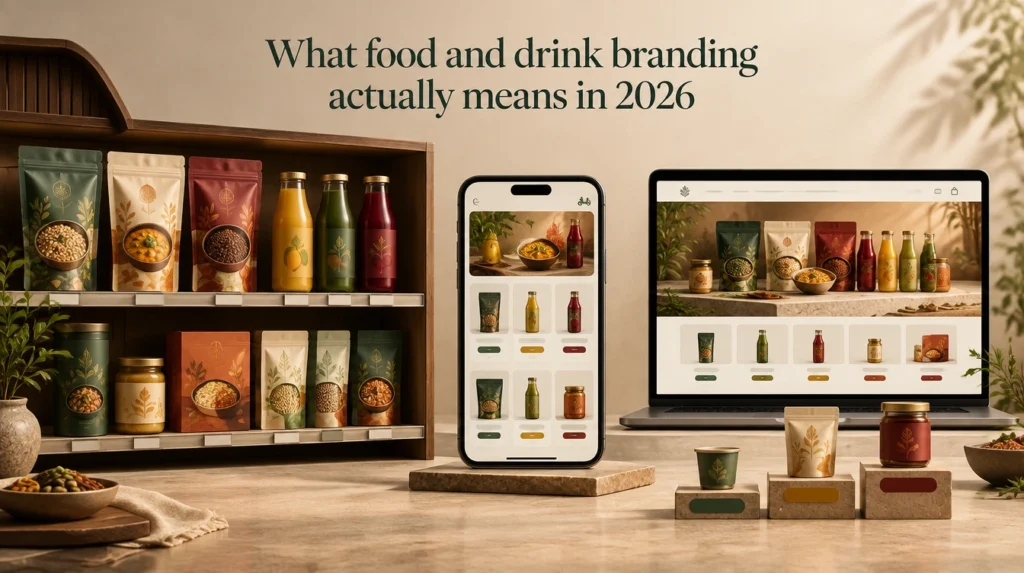
Food and drink branding is the alignment of positioning, visual identity, verbal identity, packaging, and price architecture. It works when a customer chooses your product in under 3 seconds and comes back for the second purchase.
Taste and convenience used to carry brands. In 2026, they’re table stakes. Every brand claims premium ingredients, clean labels, and superior taste. Meaning does the differentiation work now.
The Indian F&B market compresses attention harder than most. Quick commerce dark stores reduce the buying decision to a 200 by 200 pixel thumbnail. Physical general trade fights for eye-level facing. D2C sites compete against Instagram scroll speed. All three demand instant recognition and instant meaning.
Strong branding lowers customer acquisition cost, raises willingness-to-pay, and compounds repeat rate over 6 to 12 month windows. Brands without it live in a discount spiral, buying transactions instead of building loyalty.
Who this is for and who should fix product first
Three F&B founder profiles benefit from investing in branding now. Packaged product brands with proven repeat purchase but flat growth curves. D2C food brands hitting a ceiling on paid acquisition costs. Multi-outlet restaurants or cafes where inconsistent brand execution across outlets confuses customers.
Skip branding investment for now if any of these apply. Under 30 percent repeat purchase rate means the product itself isn’t earning return visits, and branding won’t fix that. Pre-revenue founders without validated product-market fit have nothing to brand yet. Operators whose brand system needs to change every quarter should stabilise product first, brand second.
Here’s the one honest test to run. If 100 customers who tried your product last month can name what you stand for beyond “it tastes good”, you’re ready to invest in branding. If not, fix product first.
The 7 proven strategies to build a stronger F&B brand in India
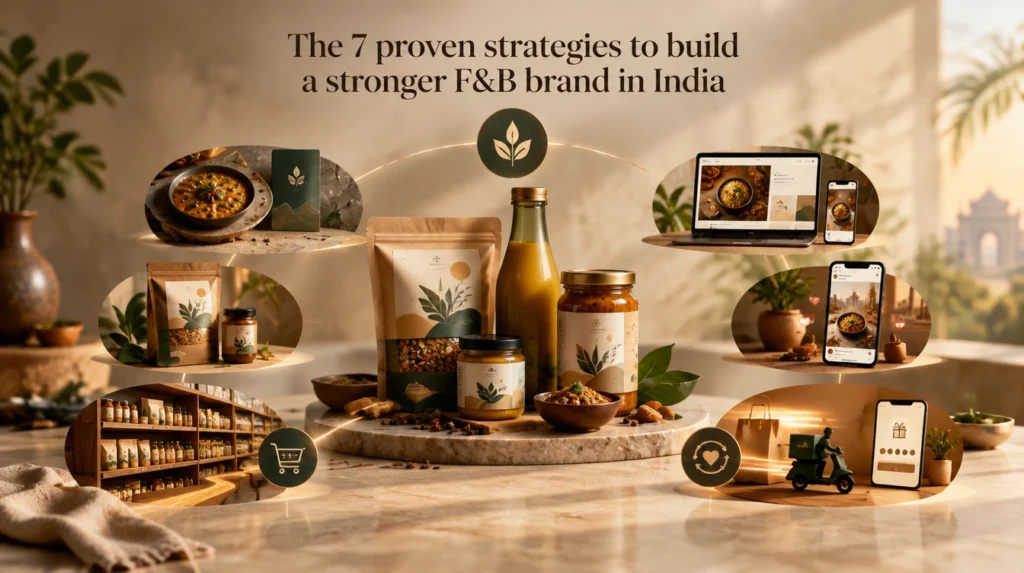
7 strategies carry the weight of a strong Indian F&B brand. Each earns its place by mapping to a business outcome. Recall, retention, willingness-to-pay, shelf velocity, or repeat rate. Skip any one and the brand system leaks at that specific gate. Order matters. Positioning first, everything else follows.
1. Position around one specific choice, not a category
Positioning is what you deliberately narrow to. Trying to be healthy, premium, and accessible at the same time makes a brand invisible. Sharp positioning names a single owned space in the customer’s mind. Ingredient transparency. Category discipline. Cultural rootedness. Functional performance. One owned space, held consistently, beats three claimed at once.
Kantar BrandZ India research consistently shows that brands with clear single-attribute positioning command 15 to 30 percent price premium over category average. The gap widens further in packaged food, where consumers can’t taste before buying and rely entirely on brand signals.
Test your positioning by writing down what your brand is not for. If the list is empty, positioning isn’t sharp enough yet. A brand for everyone converts nobody at premium.
The P&L link is direct. Sharp positioning lowers CAC by narrowing paid targeting and reducing conversion friction. Every rupee of ad spend works harder when the message fits the audience it reaches.
2. Build a verbal identity that survives thumbnails, feeds, and voice search
Most F&B branding budgets go to visual identity. Verbal identity (naming, tone of voice, packaging copy, social captions, product descriptions) does 40 to 50 percent of the actual brand recall work in a digital-first India.
Four elements matter. Brand name (short, phonetically distinct, works in Hindi and English). Tone of voice (honest-direct or warm-relatable, pick one). Packaging copy (front-of-pack promise in under 8 words). Content voice (recipe stories, founder notes, ingredient breakdowns).
Run the India-specific name test aloud in three settings. Say it to a rickshaw driver and see if they hear it right the first time. Send it as a WhatsApp forward and see if the recipient asks how to spell it. Say it to a voice assistant and see if the search results include your brand. If any of the three fails, the name fails.
Voice choices should be consistent across every touchpoint. Radical directness works. Maternal warmth works. Functional confidence works. Mixing all three destroys recall. Pick the voice, document 8 to 10 example phrases and 5 to 8 banned words, and hold the line across packaging, social, and website copy.
3. Design a visual identity that reads at 200 pixels
Visual identity in 2026 solves a dual-environment problem. Physical shelf competes for eye-level facing at 3 to 5 feet distance. Quick commerce thumbnails compete at 200 by 200 pixels on a phone. Instagram feeds compete at scroll speed. All three demand the same identity to work.
Set the technical bar clearly. 1 to 2 dominant colour cues (not a palette of 6). Typography readable at thumbnail scale. Logo that scales from 40px to 400px without losing recognition. Packaging silhouette distinct enough to identify without reading the label.
Indian packaging carries mandatory compliance elements. FSSAI license number, GST-inclusive MRP, and net weight sit on every pack. Design the layout to accommodate these clearly without letting compliance crowd out brand cues. A cluttered pack loses at thumbnail scale first.
Identities that scale across thumbnail and shelf compound impressions across every channel. Fragmented identities force paid re-recognition at every touchpoint, and the CAC pays for it.
4. Make packaging carry the strategy, not just decorate the product
Packaging is where brand strategy meets reality. It’s the last touchpoint before purchase and the first touchpoint after opening. Both matter, and both compound recall.
Three layers do the work. Structural packaging (form factor that differentiates on shelf). Primary visual layer (colour blocking and hero graphic). Secondary information layer (ingredients, story, usage occasions on the back or sides).
The India-specific reality shapes design decisions. Quick commerce packaging must survive 200 by 200 pixel thumbnails and cheap warehouse handling. General trade packaging must survive dust, humidity, and stacking pressure. Design for both worst cases, not for the studio product photo.
Never start packaging design before positioning is locked. Start with what the brand stands for, then design the pack that expresses it. The reverse produces beautiful packaging that doesn’t sell, and rebuilds cost more than the original build.
5. Tell a story rooted in Indian context, not translated from global
Indian F&B consumers respond to brands that reference familiar food culture. Regional cuisines. Family occasions. Festival contexts. Health traditions like Ayurveda where the reference is genuine. Global brand stories translated into Indian marketing feel hollow, and repeat rates show it.
Culturally rooted brands earn adoption because they extend existing routines rather than replacing them. A brand that modernises millets for young families works because millets are already familiar. A brand that positions itself around a global superfood most Indian households have never cooked with faces a steeper adoption curve.
Build cultural stories with a specific framework. Name the cultural insight (regional cuisine gap, family occasion, health tradition, generational shift). State your product’s role in it. Design packaging and content around that specific insight, not around aspirational global equivalents.
Retention follows cultural fit. Brands that integrate into existing routines earn higher repeat rates. Brands that require behaviour change earn trial but struggle with second purchase, and the CAC math breaks over 6 to 12 month windows.
6. Set price architecture that matches your positioning
Price is a positioning signal, not just a margin decision. A premium brand priced at mass-market MRP confuses the customer. A mass brand priced above the category ceiling loses trial. Alignment matters more than absolute number.
Build a three-tier ladder. Entry SKU (trial pack, single serving, ₹20 to ₹50 for snacks, ₹80 to ₹150 for beverages). Core SKU (regular pack for repeat purchase, ₹80 to ₹200 snacks, ₹150 to ₹350 beverages). Premium SKU (family pack, gift pack, subscription, ₹250 to ₹800 snacks, ₹400 to ₹1200 beverages).
GST-inclusive MRP is mandatory on Indian F&B packaging. Price bands should be legible without requiring the customer to calculate the tax hit at checkout. Clear ladders help trial buyers self-select upward as they build category confidence.
Packaging cues should match price tiers. Material weight, colour density, typography weight, and finish quality all signal price band before the sticker does. Mismatched cues (premium claims on entry-tier packaging or vice versa) destroy trust across the SKU range.
7. Build consistency systems that survive scale
As F&B brands grow past ₹5Cr revenue, different teams handle packaging, social, photography, retail, and D2C. Without a shared system, each touchpoint drifts. Customers see a fragmented brand, and recall stops compounding.
Three system components hold the brand together. Brand guidelines document (positioning, voice, visual rules, do’s and don’ts). Template libraries (packaging templates, social templates, product photography style guide). Approval workflows (who signs off on what, in what order, before it goes live).
Indian F&B brand systems carry extra requirements. Multilingual content (Hindi, English, regional language variants for tier 2 and tier 3 markets). Festival-specific creative overlays (Diwali, Onam, Eid, Christmas, Pongal). Quick commerce format constraints (thumbnail sizes, catalogue image standards, listing copy limits). Build the system to accommodate these from day one.
Consistency isn’t about locking creativity. It’s about making future decisions easier as teams grow. The system pays back over 3 to 5 year windows through faster launches, cheaper agency briefs, and cleaner brand recall.
Food and drink branding costs in India, four real budget routes
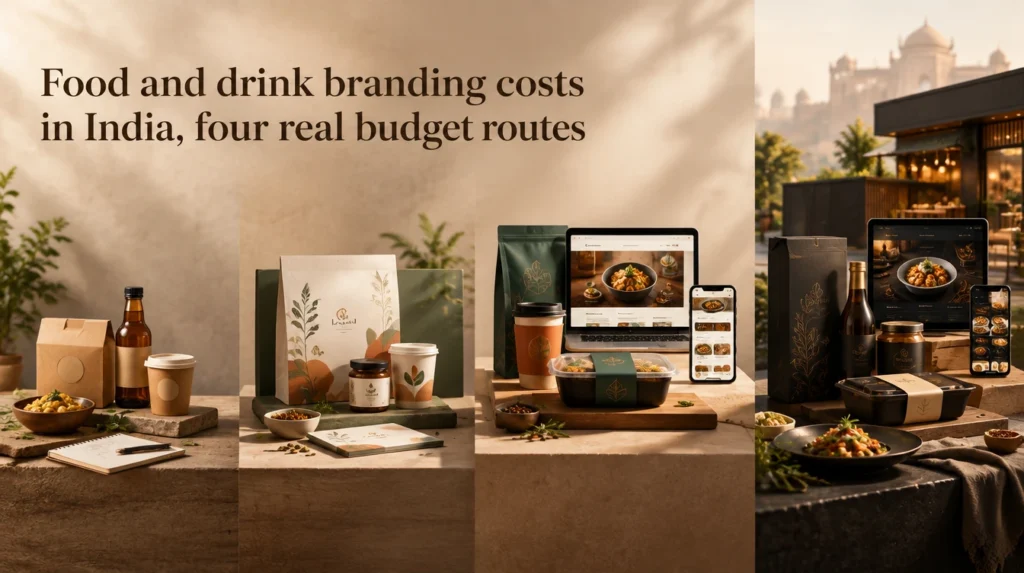
Four routes cover the practical options for building an F&B brand system in India. Each has its own budget band, timeline, and best-fit business stage.
Route 1: Founder-driven DIY. Year 1 total ₹0 to ₹1,00,000. Free design tools, template packaging, founder-written copy, self-directed photography. Best for pre-revenue brands testing product-market fit and MVPs where speed of iteration matters more than brand polish. Tradeoff: brand quality patchy, scaling forces a rebuild.
Route 2: Freelancer with junior design studio. Year 1 total ₹2,00,000 to ₹5,00,000. Includes basic logo, packaging design for 2 to 3 SKUs, single-line brand positioning, initial photography. Best for early-stage F&B brands with product-market fit but pre-funding, doing under ₹1Cr revenue. Tradeoff: strategy layer thin, packaging often needs redesign at scale.
Route 3: Full brand system with F&B specialist studio. Year 1 total ₹5,00,000 to ₹15,00,000. Includes brand strategy (positioning, voice, personality), visual identity system, packaging design for the full SKU range, photography direction, launch collateral. Best for funded F&B brands scaling from ₹1Cr to ₹10Cr revenue, or restaurant chains opening 3 or more outlets. Tradeoff: 3 to 6 month build timeline, ongoing retainer for evolution.
Route 4: Established branding agency retainer. Year 1 total ₹15,00,000 to ₹40,00,000 or more. Includes strategic partnership, full brand system, packaging system, campaign work, ongoing evolution, category insights, quarterly strategic reviews. Best for growth-stage F&B brands at ₹10Cr+ revenue, multi-brand F&B groups, or brands entering new categories. Tradeoff: long-term commitment, high burn if brand isn’t ready to leverage the depth.
Brand investment ROI shows up in CAC reduction, willingness-to-pay lift, and repeat rate over 12 to 24 month windows. A brand spending ₹8L on a proper system that reduces CAC by 20 percent and lifts repeat rate by 15 percent recovers the investment inside 6 months on any decent revenue base.
The 7 strategies at a glance
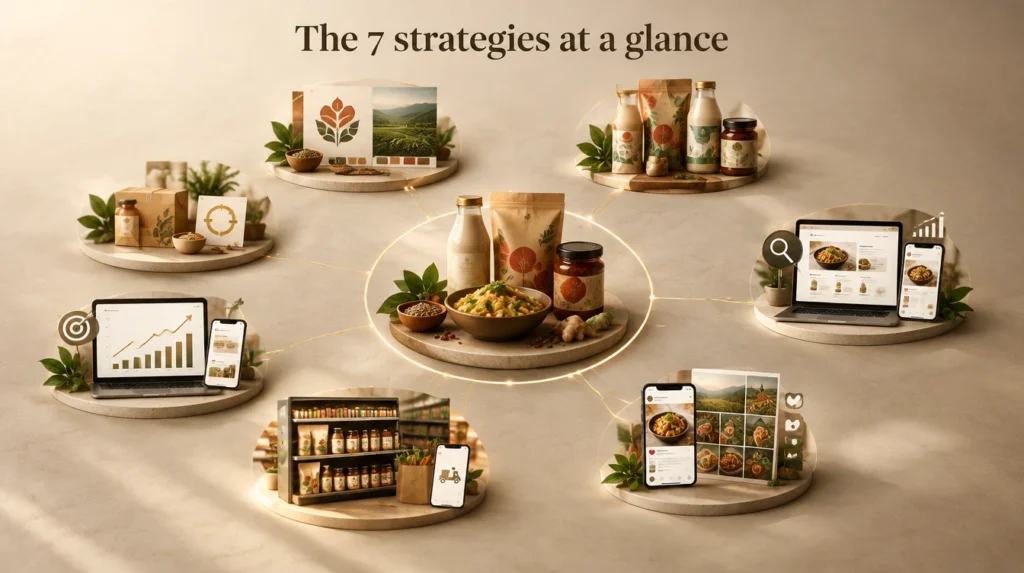
Each strategy earns its place by mapping to a specific business outcome. Sequence matters more than which one gets the biggest budget.
Positioning. One-word owned space (transparency, discipline, culture, function). Outcome: 15 to 30 percent price premium over category average.
Verbal identity. Name, tone, packaging copy, content voice. Outcome: recall compounds across digital-first touchpoints.
Visual identity. Colour, type, logo, silhouette that reads at 200 pixels. Outcome: recognition survives every channel.
Packaging. Structural, visual, and information layers that survive shelf, thumbnail, and dust. Outcome: shelf velocity holds against cheaper alternatives.
Cultural storytelling. Rooted in regional cuisine, family occasion, or health tradition. Outcome: retention lift through routine integration.
Price architecture. Three-tier ladder with packaging cues matching each tier. Outcome: trust holds across SKU range, trade-up path opens.
Consistency systems. Guidelines, templates, approval workflows. Outcome: brand survives scale without fragmenting.
Order matters. Positioning first, then verbal and visual identity in parallel, then packaging, then storytelling and price architecture, then systems as the brand scales past ₹5Cr revenue.
Six mistakes that quietly kill Indian F&B brands
Six mistakes account for most of the wasted branding spend on Indian F&B brands.
Starting design before strategy is locked. Founders jump to logo and packaging before positioning is defined. Result: beautiful packaging that doesn’t sell. Fix: lock the one-word positioning before any design brief goes out.
Copying global brand playbooks without adaptation. US or UK CPG playbooks assume different retail dynamics, different consumer behaviours, and different regulatory contexts. Result: brands that feel imported and don’t build trust. Fix: root every brand decision in Indian F&B context, then borrow tactics.
Ignoring quick commerce as a distinct shelf. Delivery apps have become the primary discovery channel for urban Indian F&B in metros. Result: brands designed for physical shelf lose in a market that’s moved to 200 by 200 pixel thumbnails. Fix: design for both environments from day one.
Weak or unmemorable brand name. Names that don’t work across Hindi and English, or that sound like every other brand in the category, cap growth. Result: paid acquisition never compounds into organic recall. Fix: name test aloud in three settings (rickshaw driver, WhatsApp forward, voice assistant) before locking.
No verbal identity system. Packaging copy, social captions, and website copy sound different because they’re written by different people at different times. Result: brand feels fragmented and recall stops compounding. Fix: document tone of voice with 8 to 10 example phrases and 5 to 8 banned words.
Rebuilding the brand every 18 months. Constant refresh kills recall compound and confuses loyal customers. Result: brand equity resets every cycle. Fix: define the brand system once properly, then evolve at 3 to 5 year intervals, not annually.
What to do this week
If your F&B brand is running on inherited assets, or if you’re planning a launch and haven’t locked positioning yet, start with a diagnostic before writing any specs.
Morphiaas runs a Food & Drink Brand Diagnostic for Indian F&B founders. The diagnostic runs a 45-minute Loom walkthrough of your current brand system or founding materials. It scores your brand against the 7 strategies. Packaging thumbnail tests run at 200 pixels on real phones. The final output is a prioritised list of the three fixes that will move recall, retention, or trial rate fastest.
The diagnostic is free. Execution is paid, and we’re transparent about that from the first call. If you want to see how our team approaches F&B branding work, our branding team has built brand systems across packaged food, beverages, cafes, and restaurant chains. If you want the broader picture on how branding fits into your F&B marketing setup, our food and drink industry page lays out the full stack.
Book your diagnostic and we’ll deliver the walkthrough within 5 working days.
Frequently asked questions
How much should an Indian F&B brand spend on branding?
Four real budget bands cover the options. Founder-driven DIY runs ₹0 to ₹1,00,000 for pre-revenue MVPs. Freelancer with junior studio runs ₹2,00,000 to ₹5,00,000 for early-stage brands under ₹1Cr revenue. Full brand system with F&B specialist studio runs ₹5,00,000 to ₹15,00,000 for funded brands scaling to ₹10Cr. Established branding agency retainer runs ₹15,00,000 to ₹40,00,000 or more for growth-stage brands. Match the route to revenue stage and business complexity.
What’s the difference between food branding and food marketing?
Branding is the strategic foundation that decides why customers pick you. Positioning, identity, promise. Marketing activates that foundation across paid, organic, and retail channels. Branding decisions compound over years. Marketing decisions play out in weeks. Both matter, but branding decides how far marketing carries. Weak branding forces marketing to work harder and pay more for the same result.
How long does it take to build a proper F&B brand?
The timeline depends on which route you take. DIY takes 2 to 4 weeks with limited depth. Freelancer route takes 6 to 10 weeks for basic brand and packaging work. Specialist studio full brand system takes 3 to 6 months for strategy, identity, and packaging system. Ongoing agency partnership takes 12 or more months of evolution. Full brand recall compound curves show meaningful lift at 18 to 24 months post-launch.
Should new F&B brands prioritise brand or product first?
Product first, until you have proven repeat purchase. Branding without a product that customers come back to is expensive theatre. Once repeat rate hits 30 percent or higher, branding investment starts compounding because you’re spending on retention amplification, not trial acquisition. Pre-repeat-purchase branding spend rarely pays back inside 12 months.
Is packaging the most important part of F&B branding?
Packaging is the most visible, but not the most important. Positioning is. Packaging without positioning is decoration. Positioning without packaging still competes. In a category where 60 percent of decisions happen at the shelf or thumbnail, packaging carries the visible weight, but positioning decides whether that weight is worth carrying. Design the positioning first, then design the packaging that expresses it.