

Food and drink e-commerce marketing is the system that turns product discovery into direct online orders through SEO, paid media, retention, and conversion-focused site design. Seven strategies carry the revenue: first-party data, high-converting product pages, retention loops, paid media allocation, UGC, quick commerce discipline, and measurement that separates new from returning customers.
Key takeaways
- Food and drink e-commerce lives or dies on repeat rate. 30% repeat purchase rate is the health threshold below which paid acquisition stops making sense.
- First-party data (email, SMS, loyalty) is the single most undervalued asset in Indian and US F&B DTC.
- Mobile product pages that load slower than 3 seconds lose a measurable share of traffic before anyone sees the add-to-cart button.
- Retention economics beat acquisition economics after month 6 in most F&B categories. Budget allocation should shift accordingly.
- Quick commerce is a distribution channel, not a marketing one. Design for it, don’t depend on it.
What is food and drink e-commerce marketing exactly?
Food and drink e-commerce marketing is the full system that gets a packaged F&B product from search or scroll into a direct online order on the brand’s own storefront. It covers SEO, paid media, email and SMS retention, UGC, conversion-focused product pages, and the measurement layer that ties every rupee or dollar spent to new or returning customer revenue.
The discipline matters because F&B DTC runs on margins thinner than most categories. Winning here is less about acquisition creativity and more about operational discipline across the full funnel.
Why does food and drink e-commerce marketing matter in 2026?
It matters because food and drink is one of the few categories where repeat purchase decides unit economics inside 6 months. A new customer acquired at a loss can turn into a profitable one by month 3 if retention works, or sink the P&L entirely if it doesn’t. Platform rents (aggregator commissions, marketplace fees) have climbed, pushing direct channels from “nice-to-have” to margin-critical.
Morphiaas, a performance marketing agency serving India and the US, works with F&B DTC brands where the gap between well-run and poorly-run e-commerce is often 2x revenue at the same ad spend. The difference isn’t creative talent. It’s which strategies get resourced and in what order.
What are the 7 strategies that lift food and drink online sales?
Seven strategies carry the weight of a food and drink e-commerce operation that actually grows profitably. Each maps to a measurable business outcome: new customer CAC, repeat purchase rate, average order value, or contribution margin. Skip any one and the funnel leaks at that gate.
1. How do food and drink brands build first-party data without discounting themselves to death?
First-party data gets built through value exchanges that don’t erode margin. Offer recipe guides, early access to limited drops, free shipping on first order, or quiz-based personalization. Those earn email and SMS consent at ₹30 to ₹80 or $0.50 to $2 per subscriber depending on channel.
Discounting as the only lead magnet trains customers to wait for the next sale and attracts the lowest-value cohort. Side-by-side welcome flows we’ve tested (one discount-led, one content-led) show the content-led list produces higher 90-day repeat rates every time.
2. What makes a product page actually convert for food and drink e-commerce?
A product page converts when it answers four questions in the first scroll: what’s in it, who it’s for, when it ships, and why anyone should trust it. Add real product photography, ingredient transparency, dietary icons, honest reviews, and a tap-to-add button that doesn’t move. Load under 3 seconds on 4G or lose traffic before anyone sees the price.
Baymard Institute tracks average online cart abandonment at roughly 70%. F&B runs higher because trust friction is category-specific. The product page is where you earn back abandoners before they ever hit the cart.
3. Which retention channels pay back for a food and drink brand?
Email, SMS, and WhatsApp Business carry the retention weight for F&B DTC. Email handles educational and seasonal flows. SMS handles time-sensitive drops and restock alerts. WhatsApp handles conversational retention. Loyalty programs tied to purchase frequency add a fourth layer that compounds past month 6.
The mix shifts by region. US brands lean harder on email and SMS. Indian brands lean harder on WhatsApp. Both benefit from a sequence: email first, SMS at purchase intent, WhatsApp at post-purchase and reorder windows.
4. How much should a food and drink e-commerce brand spend on paid media?
Spend should be set against blended CAC and 90-day customer value, not gross ROAS. For most F&B DTC brands under ₹10Cr or $1M revenue, a workable allocation looks like 50% paid social, 25% Google Shopping and paid search, 15% retention channel costs, 10% creator and UGC partnerships. Scale paid social only when 90-day repeat trends up.
The counter-intuitive move most F&B brands miss: budget flows to campaigns acquiring the right cohort, not the ones with highest first-order ROAS. A 2.5x ROAS campaign producing repeat buyers beats a 4x ROAS campaign full of one-time discount hunters.
5. What role does user-generated content play in food and drink online sales?
UGC does the trust work brand-created content can’t. Food and drink buyers want real plates, real pours, real reactions before they commit a card. Creator partnerships and permission-licensed customer content outperform studio-shot creative on cold Meta campaigns in most F&B categories we’ve tested.
And UGC pays back twice. Once as paid-social creative with better CTR and lower CPM. Again as organic social and product-page content that lifts conversion rate. Same shoot, two channels.
6. How should food and drink brands handle quick commerce versus their own site?
Quick commerce works as distribution and discovery, not a replacement for DTC marketing. Delivery aggregators take 18 to 25 percent commission plus discount-share. Direct site orders keep full margin and build first-party data. Run both, with aggregators sized to real demand and the owned site treated as the margin engine.
Design packaging and listings for both environments. A 200×200 thumbnail on a quick commerce app needs different creative choices than a Shopify product page. Distinct surfaces, same brand system behind them.
7. Which measurement setup actually tells a food and drink brand what’s working?
The measurement stack needs to separate new customer revenue from returning customer revenue at the channel level. Default Shopify or GA4 setups blend these together and give misleading ROAS. Set up a new-vs-returning view, tag every campaign with intent (prospecting, retargeting, retention), and track 30-day and 90-day repeat rates by acquisition cohort.
Google’s GA4 documentation covers the audience and acquisition reports needed. Most F&B brands skip the cohort layer and over-invest in channels that look good on paper but acquire the wrong buyer.
Which platform should a food and drink brand build its e-commerce on?
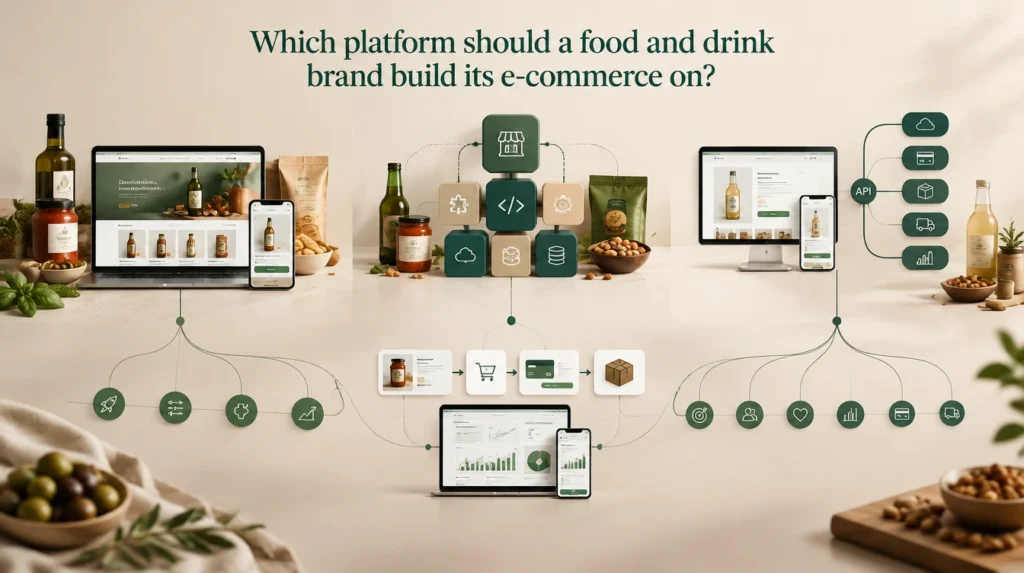
The platform choice shapes speed to launch, long-term flexibility, and the kind of integrations available. For most Indian and US F&B DTC brands under ₹10Cr or $1M revenue, Shopify wins on time-to-launch and ecosystem depth. WooCommerce wins on cost and WordPress integration. Headless commerce wins on performance and customization but costs more to build and maintain.
The table below compares the three for a typical food and drink DTC brand.
| Capability | Shopify | WooCommerce | Headless commerce |
|---|---|---|---|
| Time to launch | 2 to 4 weeks | 4 to 8 weeks | 10 to 20 weeks |
| Monthly cost (year 1) | ₹3K to ₹25K | ₹2K to ₹15K | ₹25K to ₹1L+ |
| Payment and checkout | Shopify Payments, native | Plugin-dependent | Custom integration |
| Subscription support | Native + apps | Plugin-based | Custom build |
| Mobile performance | Theme-dependent, good baseline | Theme and plugin-dependent, variable | Highest ceiling |
| Best fit | Most F&B DTC brands under ₹10Cr | Budget-focused, WordPress-centric brands | Growth-stage brands past ₹10Cr |
Shopify is the default answer for a reason. The app ecosystem (Klaviyo, Judge.me, Bold Subscriptions, Rebuy) covers 90% of F&B DTC needs without custom development. We learned this the expensive way on a Delhi cafe brand’s migration from a custom build back to Shopify, trading three months of lost roadmap for stability. For a deeper look at platform choice and build approach, our e-commerce team walks DTC founders through the trade-offs end-to-end.
How do you measure food and drink e-commerce performance properly?
You measure it by splitting revenue into new-customer and returning-customer streams, then tracking the metrics that matter in each. New-customer: CAC, first-order AOV, 30-day repeat probability. Returning-customer: 90-day repeat rate, average order frequency, net revenue retention, loyalty tier distribution.
Over-weighted metrics: blended ROAS, follower count, email open rate. Under-weighted metrics: cohort LTV at 90 and 180 days, contribution margin per order after shipping and ad cost, repeat purchase rate by acquisition channel.
Set weekly reviews on three numbers: blended CAC trailing 30 days, repeat purchase rate for the cohort acquired 90 days ago, and contribution margin per order. Those three tell you more about business health than any dashboard with 40 widgets.
What mistakes quietly kill food and drink e-commerce brands?
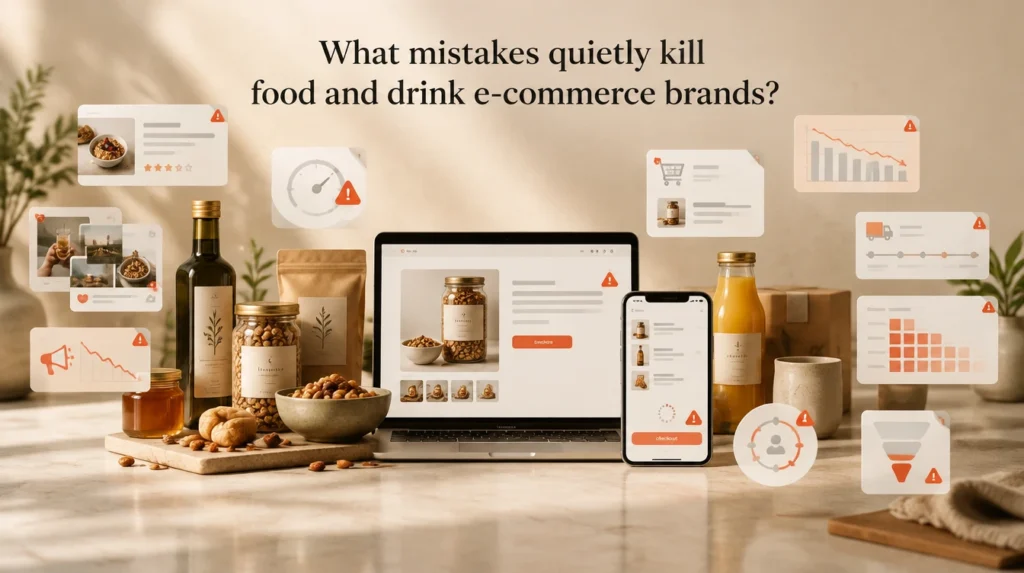
Six mistakes account for most of the preventable damage in food and drink e-commerce. Each maps to measurable revenue loss that compounds over months.
Discount-first growth. Trains the lowest-value cohort and anchors the brand at a price it can’t walk back. Boosted posts and spray-and-pray discount codes are a tax on margin dressed up as a growth strategy.
Measuring blended ROAS only. Hides which campaigns bring repeat buyers versus one-time coupon users. The cohort split takes 15 minutes to set up in GA4 and changes paid media decisions immediately.
Slow product pages. Pages over 3 seconds on 4G lose traffic Search Console won’t flag until bounce rates spike. Image compression and lean app usage fix most of it in a weekend.
No retention sequence past the welcome email. Most F&B DTC brands build a welcome flow and stop. Post-purchase, replenishment, winback, and VIP sequences carry more revenue over 180 days than any welcome ever will.
Treating UGC as a nice-to-have. UGC isn’t content strategy, it’s acquisition strategy. Brands that systematize collection (post-purchase prompts, creator seeding, loyalty rewards for video reviews) outperform brands that treat it as sporadic.
Over-depending on quick commerce. Volume comes, margin leaves. Brands with quick commerce above 60% of revenue end up hostage to commission changes they can’t negotiate. Diversify early.
What should a food and drink brand do this week?
If your F&B e-commerce brand is leaking at any of the gates above, start with a diagnostic before changing the plan. Morphiaas runs a Food & Drink E-Commerce Diagnostic for Indian and US DTC founders. It covers a 60-minute Loom walkthrough of your current site, retention stack, paid media account, and measurement setup. The output is a prioritised list of the three fixes that will move repeat rate, CAC, or contribution margin fastest.
Book your diagnostic and we’ll deliver the walkthrough within 5 working days. For the broader picture on how our team approaches F&B marketing, our food and drink industry page lays out the full stack. If you’ve landed here from a paid media context, our paid media team works specifically on the acquisition and retention channels above.
Frequently asked questions
How long does it take for a food and drink e-commerce brand to become profitable?
Most F&B DTC brands that survive hit contribution margin profitability on returning customers inside 6 to 9 months, then full P&L profitability by month 18 to 24. The timeline depends almost entirely on repeat rate. Brands under 25% rarely cross over. Brands above 40% usually do, even with mediocre acquisition.
What’s a healthy repeat purchase rate for food and drink e-commerce?
30% is the floor for scaling paid acquisition profitably. 40% is where unit economics start compounding. Above 50%, the business becomes a retention operation and acquisition supplements. The threshold varies: beverages run higher repeat than condiments, which run higher than gift products.
Should food and drink brands sell on marketplaces or only direct?
Both, with discipline. Marketplaces bring discovery and liquidity. Direct brings margin and customer data. The common failure is depending on marketplaces for over 70% of revenue, which hands pricing control to platforms whose incentives aren’t aligned with yours.
How much should a food and drink DTC brand budget for e-commerce marketing?
A workable starting band is 20 to 35% of gross revenue in year 1, trending down to 12 to 20% as retention compounds. Early-stage brands spend heavier on acquisition. Growth-stage brands shift budget to retention and loyalty as 90-day repeat trends up.
Is email marketing still worth it for food and drink e-commerce in 2026?
Yes. Email remains the highest-margin retention channel for F&B DTC in both India and the US. What’s changed is inbox competition, so segmentation and content quality matter more than list size. A 10,000-subscriber list with proper flows beats a 50,000-subscriber list on batch-and-blast every time.