

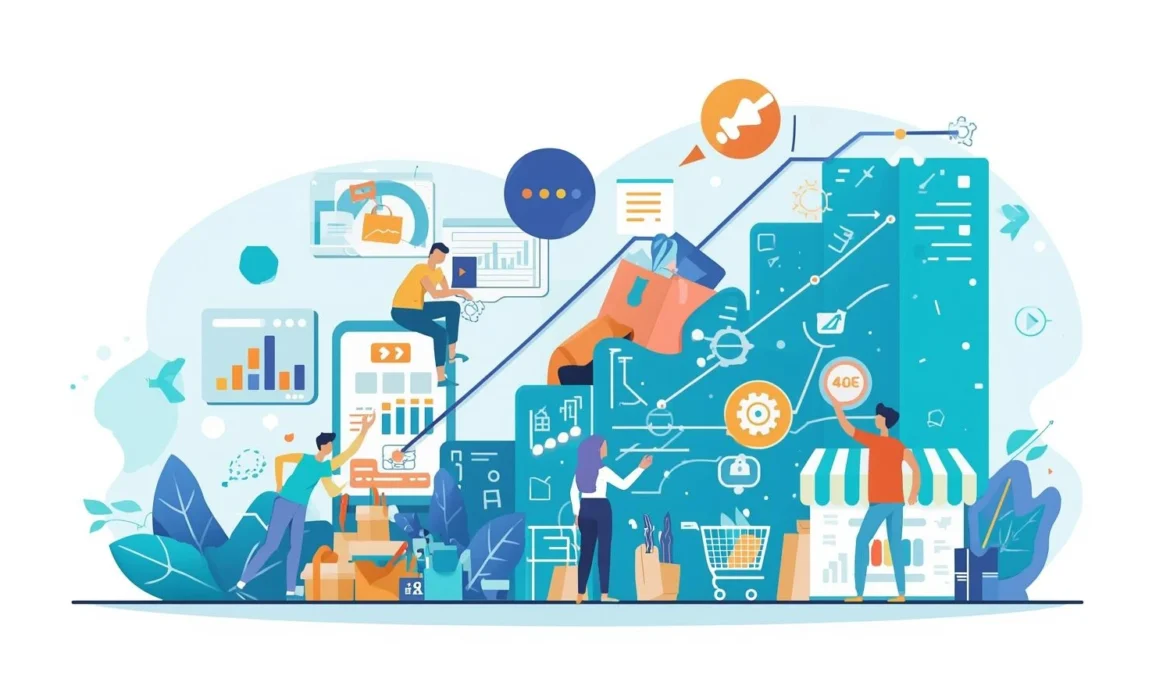
Brick-and-click strategy is now the single most important growth play for Indian retailers who already own physical stores and want to build a working ecommerce presence alongside them. Standalone offline retail is losing share to online-only competitors. Standalone ecommerce cannot match the trust and instant fulfillment physical stores provide. The retailers winning share in 2026 are the ones that combine both channels into a single integrated customer experience. This guide covers seven proven ways to build a brick-and-click strategy that grows revenue, deepens customer relationships, and creates competitive advantages pure-play retailers cannot match.
Key takeaways
- India’s e-retail market reached roughly $65 to 66 billion in 2025, with 62% of new online shoppers coming from Tier-2 and Tier-3 cities, per the Bain-Flipkart “How India Shops Online 2026” report. Brick-and-click retailers are positioned to capture both metro and non-metro growth simultaneously.
- A working brick-and-click strategy typically combines unified inventory, BOPIS (Buy Online Pickup In Store), WhatsApp store staff enablement, Google Business Profile, Meta Ads with store-visit optimization, unified loyalty, and content that connects the two channels.
- Indian retailers running integrated brick-and-click programs typically see repeat purchase rates 30 to 50% higher than pure-play ecommerce competitors, because physical store trust converts online browsing to committed purchase behavior faster.
- India has over 500 million WhatsApp users. For brick-and-click retailers, WhatsApp is the bridge that lets store staff nurture online buyers and online buyers coordinate store visits, at higher conversion rates than any other channel.
- The single biggest brick-and-click mistake Indian retailers make is running the two channels in silos, with separate teams, separate inventory systems, separate loyalty programs, and separate customer data. Integration is where the compounding value lives.
What Is a Brick-and-Click Strategy?
A brick-and-click strategy (also called click-and-mortar or omnichannel retail) is the deliberate integration of physical retail stores with an ecommerce presence so that customers experience one brand across every touchpoint, with inventory, pricing, promotions, loyalty, and customer data flowing between the two channels. The physical store handles trust-building, trial, fulfillment, and community. The online channel handles discovery, convenience, and scale. Together they produce revenue and customer lifetime value that neither channel can generate alone.
For Indian retailers specifically, a brick-and-click strategy is not just an ecommerce site added to a physical store. It is the operational integration of both channels: real-time inventory visibility, unified loyalty programs, WhatsApp coordination between staff and customers, Google Business Profile optimization that drives both online and offline sales, and Meta Ads campaigns that convert at every touchpoint. The retailers building this integration are outperforming both pure-play offline and pure-play online competitors on repeat purchase and customer lifetime value.
Add Your Heading Text Why Does a Brick-and-Click Strategy Matter for Indian Retailers in 2026?
Because four shifts have made the brick-and-click strategy the highest-leverage growth play available to Indian retailers with physical stores. First, Indian buyers now research online and buy in-store as often as they research in-store and buy online, requiring easy movement between channels. Second, Tier-2 and Tier-3 buyers (62% of new online shoppers) still trust physical stores substantially more than pure ecommerce, giving brick-and-click retailers a natural credibility advantage. Third, WhatsApp Business has made staff-to-customer coordination possible at scale, opening a channel pure-play ecommerce competitors cannot replicate. Fourth, Google Business Profile now drives both online purchases and physical footfall from the same map-pack impression.
The commercial case is clear. A brick-and-click retailer captures customers researching in either channel, converts them in whichever channel closes the sale fastest, and retains them through unified loyalty and communication. Pure-play retailers on either side leave revenue and retention on the table with every customer who prefers the other channel.
What Are the 7 Proven Ways to Build a Brick-and-Click Strategy?
Seven tactics consistently produce measurable results for Indian retailers building an integrated brick-and-click program. In our own retail marketing work with clients at Morphiaas, a performance marketing and creative agency serving India and the US, these are the seven levers we prioritize when helping retailers integrate physical and online operations into a coherent growth engine.
1. Unified inventory visibility across store and online
Every SKU should have a single source of truth for stock levels visible to both online buyers and store staff. Real-time inventory visibility lets online buyers know what is actually available, prevents overselling on ecommerce when a product just sold in-store, and lets store staff answer product-availability questions on WhatsApp without checking a separate system. Use POS-plus-ecommerce integrations like Shopify POS, Vyapar, Zoho Inventory, or GoFrugal for smaller retailers, and Increff or Unicommerce for larger multi-store operations.
2. BOPIS and click-and-collect
Buy Online Pickup In Store (BOPIS) is one of the highest-ROI brick-and-click tactics. Customers order online, pay online, and pick up from the store at their convenience. The retailer skips shipping cost and time, the customer skips delivery uncertainty and gets instant fulfillment, and store visits increase in-store add-on purchases. For Indian retail, BOPIS works particularly well for apparel, footwear, electronics, and beauty, where fit-check and warranty inspection at pickup improve customer satisfaction. Add a WhatsApp confirmation when the order is ready for pickup.
3. WhatsApp Business as the bridge between store staff and online buyers
WhatsApp is the connective tissue of Indian brick-and-click retail. Give store staff verified WhatsApp Business accounts to nurture regular customers with new arrivals, size availability, and personalized recommendations. Use WhatsApp broadcasts to store-linked customer lists for weekly value-first updates. Layer WhatsApp Business API through Interakt, AiSensy, or Wati for automated order confirmations, delivery updates, and BOPIS pickup notifications. India’s 500 million WhatsApp users make this channel a first-class marketing asset, not customer support.
4. Google Business Profile as an ecommerce driver
Google Business Profile (GBP) is the highest-return free channel for any Indian retailer with a physical location. Complete every field for each store location, upload weekly product photos, respond to every review, and post weekly offers. GBP now supports product listings, which drive both online purchases and physical footfall from the same map-pack impression. Local search results for “clothing store near me” or “electronics store in Vasant Vihar” now include GBP-listed products, giving retailers who invest in GBP a genuine visibility edge over competitors who leave profiles incomplete.
5. Meta Ads with store-visit optimization and local extensions
Meta Ads Manager supports store-visit optimization campaigns and local awareness ads that drive both online conversion and physical footfall from a single ad set. Use Advantage+ Shopping Campaigns pulling from the product catalog for online conversion, and store-visit campaigns for footfall-focused seasonal drives (festive sales, new store launches, weekend promotions). Add local ad extensions showing nearest store address and hours in the ad itself. For Indian retail, Reels ads featuring in-store experience content (store tours, staff introductions, product demonstrations) outperform generic product ads for brick-and-click brands specifically.
6. Loyalty programs that work identically across store and online
A loyalty program that only rewards online purchases pushes offline-preferring customers away. A program that only rewards in-store purchases leaves online purchase behavior unrewarded. Unified loyalty (points earned and redeemed in either channel, tier benefits applied everywhere, a single customer view across both) is the retention layer that keeps brick-and-click retailers ahead of pure-play competitors. Use platforms like Loyalty Plus, LoyaltyLion, Smile.io, or Zoho CRM with loyalty modules that integrate POS and ecommerce data.
7. Content that ties offline experience to online purchase and vice versa
Content marketing for brick-and-click retailers should explicitly bridge the two channels. Publish store tour videos on Instagram Reels and YouTube. Feature store staff as product experts in tutorial content. Show BOPIS pickup experiences. Include store location tags on Instagram posts. Highlight customer stories that mention both channels. This content works double duty: it converts online browsers to store visitors, and it converts store visitors into online repeat customers who remember the brand between visits.
How Should Indian Retailers Sequence a Brick-and-Click Rollout?
Do not attempt all seven tactics simultaneously. Sequence them based on your current baseline and operational readiness. The workable ordering for most Indian retailers is: nail the foundation first (Google Business Profile, WhatsApp Business, basic ecommerce site), then integrate inventory (unified POS-plus-ecommerce), then launch BOPIS, then add Meta Ads with store-visit optimization, then build unified loyalty, and only then invest in cross-channel content marketing at scale.
Budget guidance: Indian retailers building a brick-and-click strategy typically allocate ₹75,000 to ₹3 lakh per month across ecommerce operations, POS-ecommerce integration tools, WhatsApp Business API subscription, Google Business Profile management, Meta Ads, and content production, scaling with store count and revenue. Add one-time setup costs of ₹1 to ₹5 lakh for POS integrations and loyalty program deployment. Judge results quarterly, not monthly, because the compounding value shows up in retention and repeat purchase rates over 6 to 12 months, not week-to-week revenue.
How Do You Measure Brick-and-Click Strategy Performance?
Measure a brick-and-click strategy across five buckets: cross-channel discovery (how many buyers researched in one channel and purchased in the other), unified customer view (single customer profile across store and online), retention metrics (repeat purchase rate, customer lifetime value, cross-channel purchase frequency), integrated inventory efficiency (stockout rates, inventory turnover across both channels), and blended business outcomes (total revenue growth, blended CAC, gross margin trend).
A practical stack: Shopify POS, Vyapar, or GoFrugal for unified store-plus-online inventory and sales data, Google Business Profile insights for local search performance and offline attribution, Meta Ads Manager for store-visit and online conversion campaigns, a CRM (Zoho, HubSpot, Salesforce, or industry-specific like Perfitt for apparel retail) for unified customer profiles, and a monthly retail scorecard aggregating store-level plus online data into one leadership view.
If you can state your cross-channel repeat purchase rate, blended customer lifetime value, and inventory turnover across both channels for the last quarter, your measurement is working. If you can only report store-level and online revenue separately, you cannot see where the brick-and-click integration is actually producing value.
Common Mistakes Indian Retailers Make With Brick-and-Click Strategy
- Running store and online as separate businesses. Separate inventory systems, separate teams, separate loyalty programs, and separate customer data leave every compounding brick-and-click advantage unused.
- Skipping unified inventory integration. Overselling online because stock just sold in-store, or refusing online orders that store staff could have fulfilled, destroys trust and revenue simultaneously.
- Not enabling store staff on WhatsApp. Store staff are the highest-trust brand asset most retailers own. Not equipping them with verified WhatsApp Business accounts leaves the biggest single retention lever untouched.
- Ignoring Google Business Profile. GBP now drives both online purchases and physical footfall. Leaving it incomplete cedes local search visibility to competitors every month.
- Building loyalty that only works in one channel. Points earned in-store but only redeemable online (or vice versa) frustrate customers and hide the brand from cross-channel behavior data.
- Treating BOPIS as a nice-to-have rather than a growth engine. BOPIS reduces shipping cost, increases in-store visits, and produces measurably higher customer lifetime values. Retailers who skip it leave real revenue on the table.
- Publishing English-only content in Tier-2 and Tier-3 markets. Nine out of ten new Indian internet users prefer content in an Indian language. English-only brick-and-click content leaves majority-India audiences unclaimed.
- Measuring channels separately instead of blended. Weekly store revenue and weekly online revenue tell you nothing about cross-channel behavior. Blended metrics with unified customer views tell the actual brick-and-click story.
Build a Brick-and-Click Strategy That Turns Physical Stores into a Real Growth Advantage
If you want your brick-and-click strategy to work as a genuinely integrated growth engine rather than a physical store with a disconnected website, that is exactly the kind of program we build for Indian retailers at Morphiaas. We combine ecommerce marketing with Meta and Google paid media, WhatsApp automation, and integrated loyalty programs tailored specifically for Indian retail brands across categories. Book a call and we will audit where your current store-plus-online integration stands and map the highest-leverage next steps.
Frequently Asked Questions
How much does it cost to implement a brick-and-click strategy in India?
Indian retailers typically allocate ₹75,000 to ₹3 lakh per month for ongoing brick-and-click operations, plus a one-time ₹1 to ₹5 lakh for POS-ecommerce integration and loyalty program setup. Cost scales with store count and revenue. Retailers with fewer than 5 stores can start with lighter integrations (Shopify POS, WhatsApp Business app) and scale as revenue grows.
How long does a brick-and-click strategy take to show results?
Expect 30 to 60 days for Google Business Profile and Meta Ads to produce measurable footfall and online conversions, 90 to 180 days for BOPIS and WhatsApp broadcasts to lift repeat purchase rates, and 6 to 12 months for unified loyalty to compound into meaningful customer lifetime value increases. Judge quarterly, not weekly.
Which POS or inventory system is best for brick-and-click in India?
Depends on scale. Small retailers (1 to 3 stores) can start with Shopify POS, Vyapar, or GoFrugal integrated with a Shopify or WooCommerce ecommerce site. Larger multi-store operations benefit from Increff, Unicommerce, or Ginesys, which handle complex multi-location inventory. The right choice depends on SKU count, store count, and existing ecommerce platform.
Is BOPIS worth setting up for small Indian retailers?
Yes, particularly for apparel, footwear, electronics, and beauty categories where customers value trial or warranty inspection. BOPIS reduces shipping costs, increases in-store visits (with typical 15 to 30% add-on purchase rates at pickup), and improves customer satisfaction. Even single-store retailers can implement basic BOPIS through Shopify POS or WooCommerce plugins in 1 to 2 weeks.
Can pure-play ecommerce brands add physical stores to become brick-and-click?
Yes, and increasingly they should. Nykaa, Sugar Cosmetics, boAt, and many other Indian D2C brands started online and added physical stores because offline presence builds trust, expands geography, and captures customer segments who prefer physical retail. Adding stores to an existing ecommerce brand is often easier than adding ecommerce to an existing store network.