

Google Ads for restaurants in India get set up like insurance campaigns, and that leaks money by the week. Most restaurants running paid search today burn ₹500 to ₹1,000 a day and see almost none of it come back. The playbook is different in India. Numbers only work when you build for your kitchen, your catchment area, and your aggregator commissions.
This guide is a tactical playbook for restaurant owners, cloud kitchen operators, and cafe founders running or thinking about running paid search. It covers when Google Ads earn back their spend, when they don’t, and how to run them without leaking budget.
Key takeaways
- Restaurant search CPCs in India sit at ₹15 to ₹40, not the $1.50 to $3 US benchmark most guides quote. Expected CPL falls in ₹80 to ₹250 depending on cuisine and city.
- Google Ads work as a companion to Google Business Profile and food aggregators, not a replacement for either.
- The metric that matters is cost per booked cover against average bill size and return-visit rate, not raw CPC.
- Sequence your campaigns Search first, Performance Max after 30 conversions, remarketing once you have website and GBP visitor lists.
- Paid ads amplify what already exists. They don’t fix bad food, weak reviews, or a poor location.
Who this is for and who should skip Google Ads
Three restaurant profiles see paid search pay back inside 90 days. Standalone dine-in restaurants with a Google Business Profile rating of 4.0 or higher. Cloud kitchens with delivery zones tighter than 6 km. Cafes and bakeries in areas where competitors already bid on the same searches.
Three profiles should skip paid search and fix other channels first. Restaurants with under 30 reviews or a rating under 3.8 stars, because paid clicks land on a profile diners immediately distrust. High-volume aggregator-dependent operators whose margin maths already break without adding ad spend on top. Pre-opening restaurants that have not yet set up conversion tracking, a Google Business Profile, or a website capable of receiving traffic.
Here’s the one honest test. If you can name your average bill size and your return-visit rate off the top of your head, you’re ready to run Google Ads. If not, fix that first.
Why Google Ads still works for Indian restaurants in 2026
Restaurant search happens inside a hunger moment. A diner types “restaurants near me open now” at 9:15 PM on a Saturday, and the decision window is 45 minutes. There is no 60-day consideration cycle. The restaurant that shows up first with the right offer captures the cover.
WordStream’s 2026 Google Ads benchmarks place the restaurant and food category among the lowest cost-per-lead verticals across all Google Ads. High intent plus short consideration cycles keep CPLs down. Indian restaurant search is even more concentrated on mobile and same-day intent than the global average.
Compare the maths against a food aggregator. A delivery aggregator takes 18 to 25 percent commission on every delivered order, plus discount-share deductions. Google Ads bring a dine-in cover for ₹40 to ₹120 that pays back at first visit and compounds on return. The aggregator earns you volume. Paid search earns you margin.
This split matters more in 2026 than it did in 2022. Aggregator commissions have climbed, organic reach from Google Business Profile alone has flattened, and paid search is now the third channel in the trio, not the first.
What restaurant Google Ads look like in India
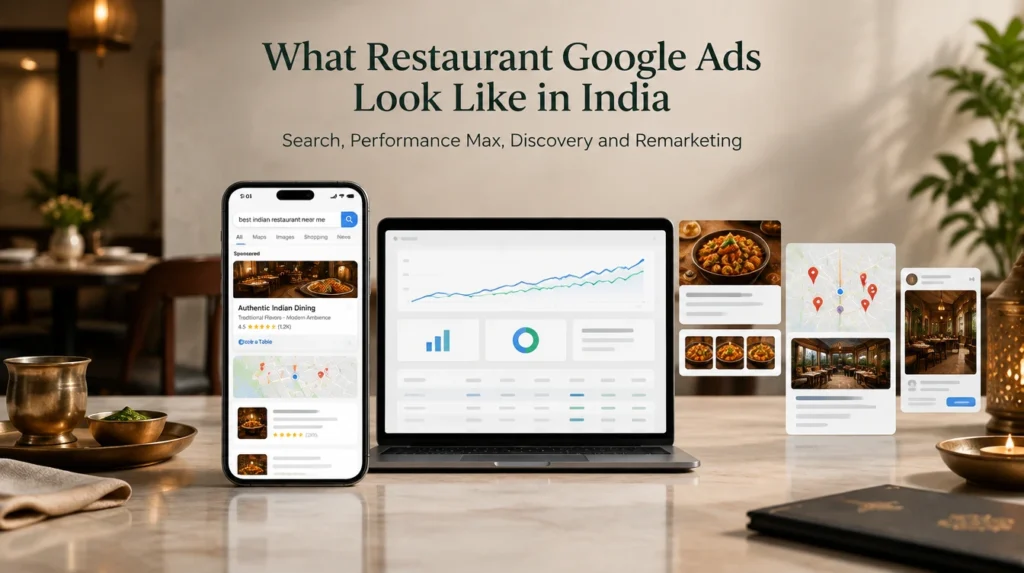
Indian restaurants should know four Google Ads campaign types, and ignore one that other guides push. The four that work are Search, Performance Max, Discovery, and Remarketing.
Search campaigns capture people typing “biryani near me Sector 29” in Gurugram or “brunch place Bandra” in Mumbai. Performance Max pushes weekend brunch discovery across YouTube, Maps, and Discover. Discovery campaigns show weekend-getaway cafe visuals to diners planning ahead. Remarketing puts your ad back in front of GBP and website visitors who dropped off without booking.
Ignore Google Local Services Ads for now. As of September 2026, the format has not rolled out to India for the dining category. Any US-market post telling you to run Local Services Ads for your restaurant does not apply here yet.
Budget reality in INR terms. A single-location dine-in restaurant should start at ₹15,000 to ₹30,000 per month across campaigns. A small chain of 3 to 5 outlets runs at ₹60,000 to ₹1,20,000 per month. Anything under ₹500 a day rarely gives Google’s Smart Bidding enough conversion volume to learn from.
One India-specific note nobody covers. Google Ads spend attracts 18 percent GST in India, and it’s input-tax-credit eligible for GST-registered restaurants. Your effective spend after ITC recovery is 18 percent lower than your gross ad spend. Build that into your P&L calculation.
Seven Google Ads plays that fill Indian restaurants
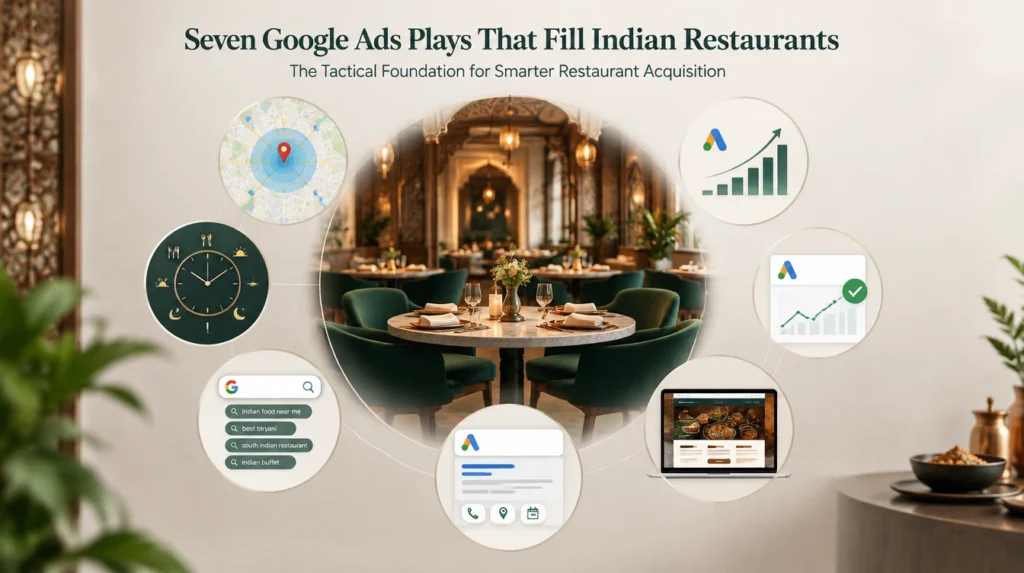
Seven plays cover the tactical work most Indian restaurants get wrong. Each pays back in a different way, and each stacks on top of the last.
Set a tight geo radius that matches how far diners actually travel
Diners rarely drive further than the neighbourhood next door for a casual meal. Set your radius by restaurant type. Casual dine-in restaurants target a 3 to 5 km radius. Mid-range restaurants stretch to 5 to 8 km. Fine dining and destination restaurants can push to 10 to 15 km. Cloud kitchens use exact GPS boundaries matching their delivery zone.
Use “presence only” targeting inside Google Ads location settings. The default “presence or interest” setting shows your ad to people planning a trip from other cities, and those clicks almost never convert into tonight’s cover.
The single most common radius mistake is setting a 25 km catchment because more reach feels better. It dilutes your budget across zones your kitchen won’t serve, and CPL climbs while conversions fall.
Time your bids to meal service windows
Restaurant search is a daypart game. Bid higher during lunch (11:30 AM to 1:30 PM) and dinner (6:30 PM to 9:30 PM), and pause or bid down during closed hours. A workable starting point is a 40 percent bid uplift during lunch, 60 percent during dinner, and a 50 percent bid cut or full pause during closed hours.
Weekend patterns flip for some formats. Brunch spots concentrate 70 percent of weekend budget on Saturday and Sunday 9 AM to 1 PM. Late-night eateries reverse the schedule and put most spend into 10 PM to 2 AM windows.
Daypart bidding only starts working once Google has enough data. That means at least 30 conversions in the last 30 days per campaign. Below that threshold, manual CPC control gives better results.
Build keyword clusters by cuisine, intent, and area
Restaurant campaigns need four keyword clusters, not one bucket of terms. Branded terms carry your own restaurant name and menu items. Cuisine plus area terms carry “north Indian restaurant Vasant Kunj” or “cafe HSR Layout”. Intent-driven terms carry “best pizza near me” or “restaurants open now”. Competitor terms carry variants of nearby restaurants, used sparingly and only with clear differentiation.
Add negative keywords aggressively from day one. A working India starter list looks like this. Recipe, home delivery jobs, franchise, wholesale, catering enquiry, DIY, salary, and menu PDF download. Every one of these attracts clicks that never book a table.
Match type sequencing matters too. Start with phrase match to control relevance while you learn what converts. Layer exact match on your best performing keywords once you have data. Only add broad match after 90 days of conversion history, and only under Smart Bidding.
Stack every ad extension Google offers you
Restaurant ads without extensions look thin next to competitors who stack them properly. Six extensions matter for Indian restaurants. Location extensions pull your address and distance directly into the ad. Call extensions add a tap-to-call button that can route to your WhatsApp Business number.
Sitelinks carry four fixed pages, and menu, book table, directions, and current offers work best for restaurants. Callouts add short attributes like family-friendly seating, live music on weekends, and current opening hours. Structured snippets list the cuisines you serve. Image extensions attach photos of your food and space directly to the ad.
Google’s own benchmarks show location and call extensions alone lift CTR by 10 to 15 percent. For an Indian restaurant, the single highest-impact extension is a call button routed to WhatsApp Business, because most diners prefer to WhatsApp a booking or an enquiry rather than call.
Send clicks to a purpose-built landing page, not your homepage
Homepages fail as landing pages for restaurant PPC. Bounce rates run at 65 percent or higher because homepages carry navigation, brand story, chef bios, and multiple conversion actions. A diner deciding where to eat in the next hour needs less, not more.
A purpose-built restaurant landing page needs five elements. Menu visible above the fold or one tap away. A tap-to-call or WhatsApp button large enough for a thumb. Embedded Google Business Profile map showing location and hours. Clear price band (“starters ₹200 to ₹400, mains ₹350 to ₹800”). One conversion action, either book, call, or order, never three offered together.
Mobile-first matters more than most operators realise. Roughly 78 percent of Indian restaurant searches happen on mobile, and anything that requires pinch-zoom or waits more than 3 seconds to load loses the click.
Track every conversion type separately
Restaurant conversions are not one thing. They are five separate actions, each carrying different value. Set up conversion tracking for WhatsApp clicks (via Google Tag Manager events), direct phone calls (through Google’s call reporting), form fills for booking, direction requests from Google Maps, and menu page views as a micro-conversion.
Lumping all five into a single conversion bucket hurts optimisation. The algorithm treats a menu view (weak signal) the same as a booked table (strong signal) and spreads budget across low-value clicks. Assign different conversion values to each action so Smart Bidding learns what actually earns money.
WhatsApp clicks deserve special attention for Indian restaurants. They are often the highest-intent conversion action, and they get ignored because they happen outside Google’s default tracking. Fix that first.
Add Performance Max only after Search has proven itself
Performance Max sounds appealing because Google markets it as one campaign that runs everywhere. In practice, it burns budget on low-intent audiences unless you feed it clean conversion data.
Set a threshold before turning it on. At least 30 conversions from Search in the last 30 days, at a stable CPL, before Performance Max joins the mix. Below that, PMax lacks the signal to optimise well and spreads spend across audiences that were never going to book.
Once your restaurant meets the threshold, Performance Max pulls in customers browsing YouTube, Maps, Discover, and Gmail with visual-first assets. Menu photos, ambience shots, and review snippets do the work. Audit the asset report weekly and pull underperforming creative fast, because PMax runs autonomously by design.
Google Ads versus aggregators, where the maths actually land
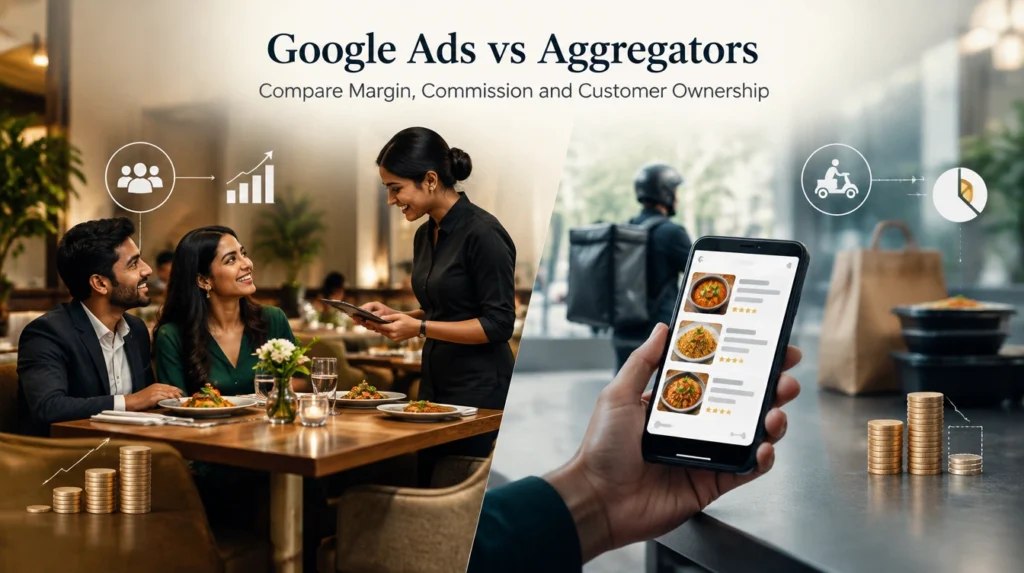
Restaurant owners already know the tension. Food aggregators bring volume but take a commission on every order. Google Ads carry upfront CPC risk but pay back at full margin. The maths on both sides look like this.
A typical aggregator delivered order runs at ₹500 average value. The aggregator takes ₹110 commission (about 22 percent) and adds ₹50 as its share of discount funding. Net to the restaurant sits at ₹340, and the effective cost per order works out to around ₹160.
A Google Ads dine-in cover looks different. Cost per lead sits at ₹40 to ₹120 depending on cuisine and city. Average bill per cover runs at ₹800 for a casual restaurant, with gross margin around 30 percent, so gross contribution is ₹250 per cover. Net contribution after ad cost lands at ₹130 to ₹210.
The qualitative layer changes the maths too. Aggregator orders don’t generate return-visit data or customer-owned relationships. Google Ads orders do. The diner ends up in your Google Business Profile visit data, your remarketing list, and often your WhatsApp Business contacts.
The honest verdict is that Google Ads make sense for dine-in-heavy restaurants with a strong Google Business Profile. Aggregators still make sense for pure-delivery brands or discovery-phase restaurants that need volume before they build brand recall. Most restaurants need both channels running at once, not one instead of the other.
What Indian restaurants can expect after 90 days
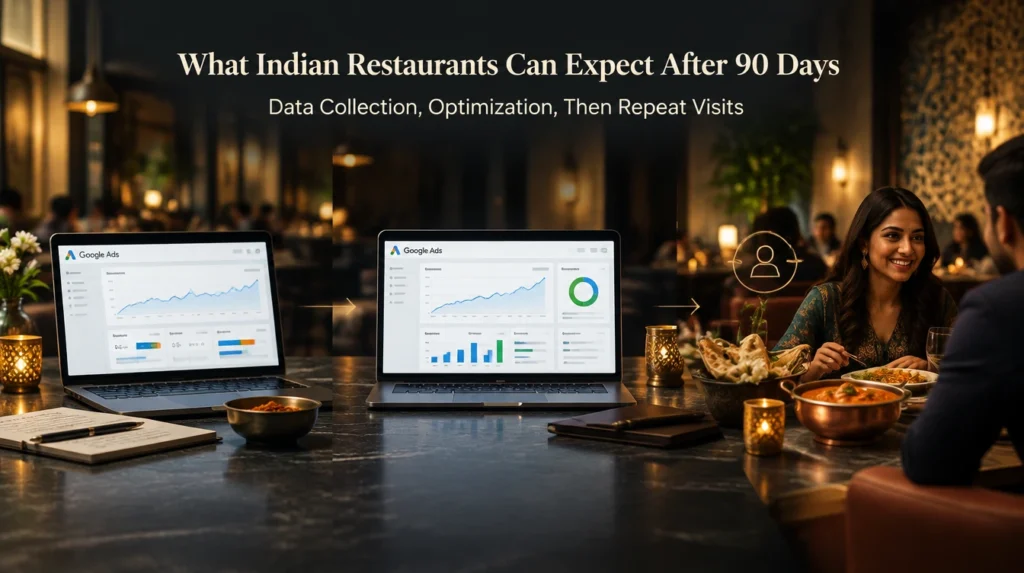
Ninety-day outcomes look different by restaurant format. These ranges come from Morphiaas F&B campaign observations, and they set direction, not guarantees.
Standalone dine-in restaurants typically see cost per booked cover settle between ₹40 and ₹120 by month 3. Cloud kitchens see cost per delivered order settle between ₹80 and ₹200 in the same window. Cafes and bakeries with steady footfall land somewhere in between.
The ramp curve is predictable. Month 1 is data collection, with higher CPLs because Smart Bidding has not yet learned who converts. Month 2 is optimisation, with CPLs dropping as negative keywords, dayparting, and landing page fixes compound. Month 3 is where remarketing kicks in, and cost per return-visit customer drops sharply.
If by month 3 the CPL has not moved from its month 1 range, the issue is almost never the ad spend. Check the landing page conversion rate first, then Google Business Profile review quality, then conversion tracking accuracy. In our F&B campaign work at Morphiaas, we see all three account for far more variance than budget size.
The number that actually matters over 6 months is cost per return-visit customer, not first-click CPL. A ₹120 CPL that produces a customer who returns 3 times a year at ₹800 each generates ₹2,400 in revenue against ₹120 in ad cost. That’s the real ROAS calculation.
How to sequence your first ₹30,000 in Google Ads spend
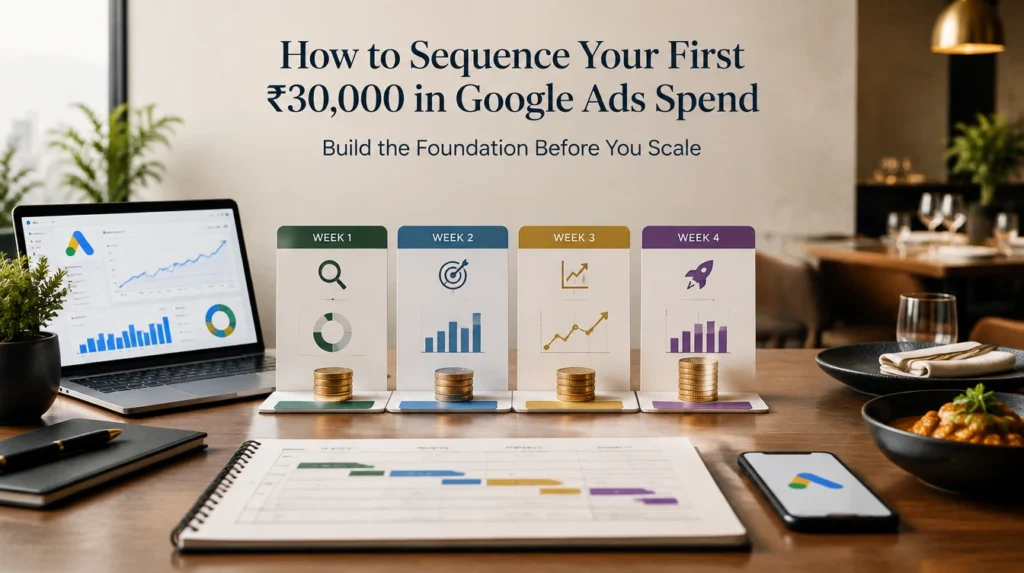
A ₹30,000 first-month budget spreads best across four weekly phases, not a flat daily spend.
Week 1 (₹5,000 non-ad work). Audit your Google Business Profile. Fix category selection, upload 15 to 20 recent photos, respond to every review from the last 60 days, correct opening hours. Set up conversion tracking for WhatsApp clicks, phone calls, direction requests, and form fills. Build or fix your landing page. No ad spend in week 1.
Week 2 (₹8,000 ad spend). Launch a single Search campaign with phrase-match keywords on cuisine plus area terms. Manual CPC bidding to keep control. Run through peak meal windows only. Collect conversion data.
Week 3 (₹8,000 ad spend). Add daypart bidding modifiers, prune negative keywords aggressively from search term reports, stack all ad extensions. Expect CTR to climb from 4 to 5 percent up to 7 to 8 percent as the ad becomes richer.
Week 4 (₹9,000 ad spend). Add remarketing to GBP and website visitors. Refine the landing page based on real drop-off data. If you have 30 conversions logged, switch Search to Target CPA bidding.
Checkpoint metrics tell you whether to scale or fix. CTR above 6 percent, CVR above 4 percent, cost per WhatsApp click under ₹80 for the average casual dine-in. If your numbers hit those benchmarks by end of week 4, scale spend in month 2. If they don’t, fix the weak link before adding budget.
The sequencing principle. Don’t add Performance Max, don’t scale spend, don’t touch new campaign types until the base Search campaign produces conversions at a stable CPL. Every additional layer needs a working foundation underneath.
Six mistakes that quietly kill restaurant Google Ads
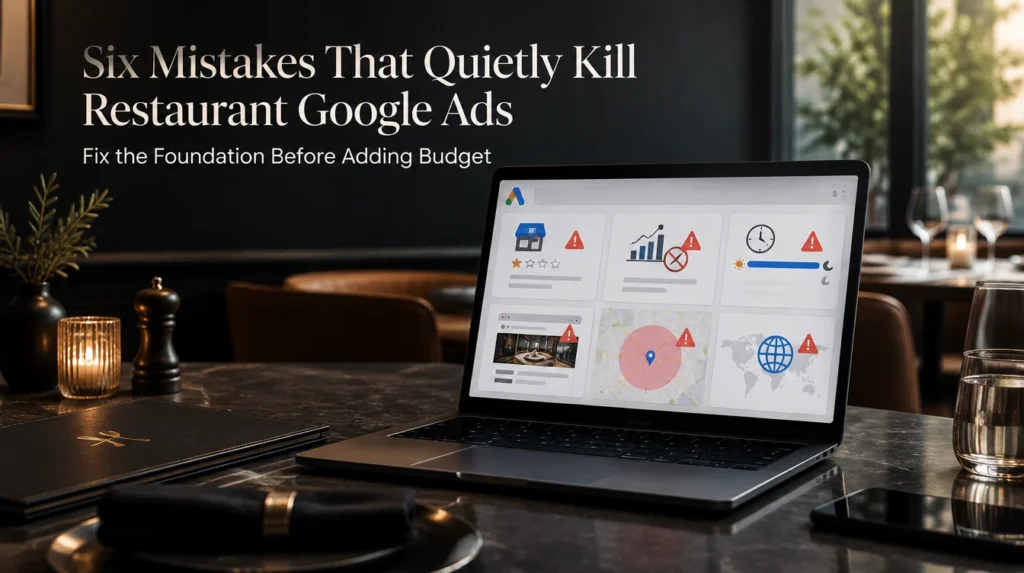
Six mistakes account for most of the wasted spend we see in Indian restaurant campaigns.
Running ads with a weak Google Business Profile. Under 30 reviews or under 4.0 stars means paid clicks land on a page diners immediately distrust. GBP quality is the compounding multiplier on paid spend. Fix the profile first, run ads second.
No conversion tracking on WhatsApp or phone. Without event tracking on WhatsApp clicks and call reporting on phone conversions, Smart Bidding optimises toward landing page views. That wastes 40 to 60 percent of budget on clicks that never turn into bookings.
Same ad running all day. A dinner restaurant bidding at 10 AM burns spend on clicks that will not return by 8 PM. Dayparting cuts wasted spend by 30 to 50 percent for most restaurant campaigns.
Homepage as landing page. Homepage bounce rates for restaurant PPC average 65 percent or higher. Purpose-built landing pages settle at 40 to 45 percent. That gap alone can double conversion rate at the same spend.
Radius too wide. Setting a 20 km radius for a dine-in restaurant delivers clicks from people who will not drive that far. Tight radius, tight budget, better CPL.
Copy-pasting US or global playbooks. US benchmarks anchor at $1.50 to $3 CPC and reservation platforms built for the US market. Indian restaurants need ₹15 to ₹40 CPC context, WhatsApp integration, and awareness of aggregator commission maths. Global guides ignore all three.
What to do this week
If your restaurant is running Google Ads and something feels off, or if you’re thinking about launching for the first time, take the 20-minute audit route before spending more.
Morphiaas runs a Restaurant Google Ads 20-minute audit for Indian restaurants. It covers a Loom walkthrough of your current campaign structure (or how to set one up from scratch if you’re not live yet), a Google Business Profile health check, gaps in conversion tracking, and one week of tactical fixes prioritised by impact.
The audit is free. Execution is paid, and we are transparent about that from the first call. If you want deeper support running your paid media across Google Ads and beyond, our paid media team works with restaurants across Delhi NCR, Mumbai, Bengaluru, and Hyderabad. If you want the broader picture on how paid channels fit into a full restaurant marketing setup, our food and drink industry page lays out the full stack.
Book your 20-minute audit and we’ll send the walkthrough within 3 working days.
Frequently asked questions
How much should an Indian restaurant spend on Google Ads?
Single-location dine-in restaurants should start at ₹15,000 to ₹30,000 per month across campaigns. Small chains of 3 to 5 outlets should budget ₹60,000 to ₹1,20,000 per month. Anything under ₹500 a day rarely produces enough conversion volume for Google’s Smart Bidding to optimise well, and the first month is data collection, not scale.
Are Google Ads better than food aggregators?
Neither is better on its own. Aggregators earn you volume at a 20 to 25 percent commission cost. Google Ads earn you margin at a ₹40 to ₹120 CPL, keep the customer relationship in your data, and build return visits over time. Most restaurants need both. Google Ads for dine-in and margin, aggregators for pure delivery and discovery.
What is the average CPC for restaurant search in India?
Restaurant search CPCs in India run at ₹15 to ₹40 for most cuisine and city combinations. Metro cities like Mumbai and Bengaluru sit at the higher end, tier 2 cities at the lower end. Fine dining and premium cuisine keywords push CPCs to ₹50 to ₹80 in competitive catchments.
Should new restaurants run Google Ads before opening?
No. Spend the pre-launch budget on Google Business Profile setup, review generation from soft launch guests, and conversion tracking infrastructure. Google Ads amplify what is already there. A pre-launch restaurant has nothing to amplify, and paid clicks land on an empty profile that erodes trust.
Can Google Ads work for pure delivery cloud kitchens?
Yes, with a specific caveat. Delivery zone targeting must match your kitchen’s actual GPS delivery boundary, and the conversion action must be online order completion (not phone call, not WhatsApp). Cloud kitchens see cost per delivered order settle between ₹80 and ₹200 in a healthy campaign.