

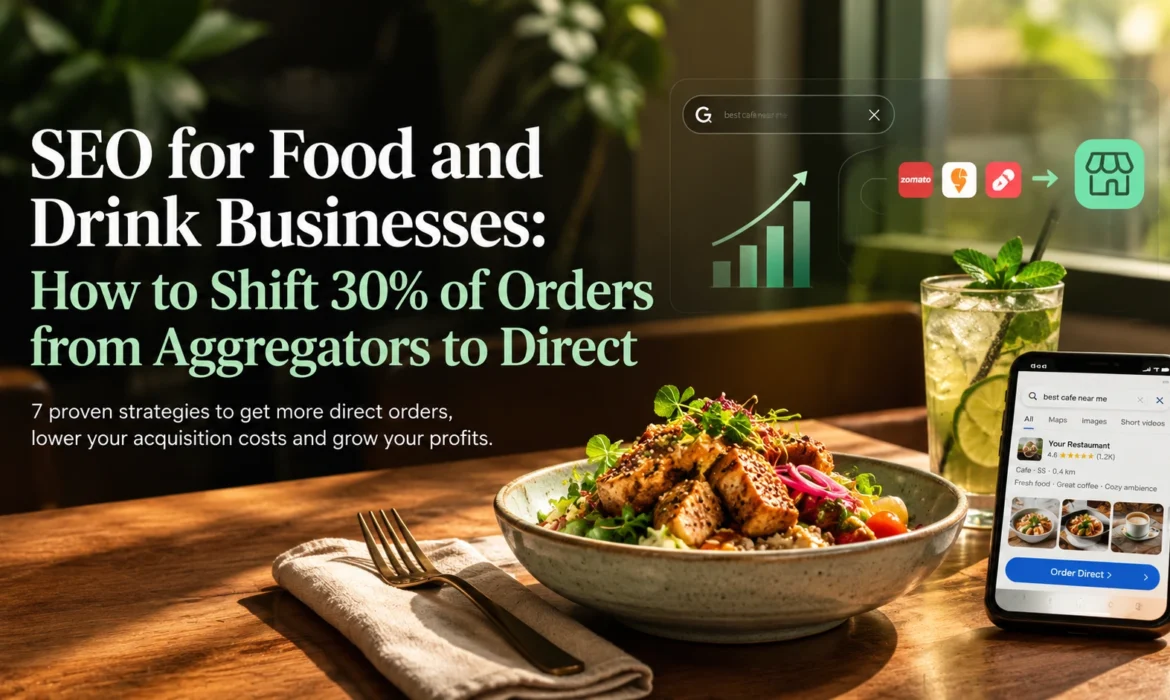
SEO for food and drink businesses is the single most reliable path to shift 30 to 40% of your orders from food aggregators to direct channels within 6 to 12 months. This is for Indian F&B operators paying 18 to 25% aggregator commission on every delivery who want organic customer acquisition that compounds instead of dying with each ad budget cut. This guide covers the seven SEO tactics that actually move the needle, in the order to execute them.
Key takeaways
- A working SEO program for food and drink businesses can shift 20 to 40% of orders from food aggregators to direct channels within 6 to 12 months, materially improving unit economics as aggregator commissions run 18 to 25% on delivery and 5 to 12% on reservations.
- A complete local search profile is the single highest-return free channel for any F&B business with a physical location. Businesses with actively managed profiles typically see 3 to 7x more direction requests, calls, and website clicks than incomplete ones.
- AI-generated search summaries now appear on roughly 48% of Google Search queries in 2026, up from 6.5% a year earlier. F&B SEO must now optimize for both traditional rankings and AI search citations.
- India is now the world’s second-largest generative AI search market at ~160 million monthly active users, per the Bain-Flipkart “How India Shops Online 2026” report. F&B buyers ask AI tools for shortlists before opening delivery apps.
- Vernacular SEO in Hindi and regional languages is one of the highest-ROI SEO opportunities most Indian F&B brands ignore. Per KPMG-Google research, nine out of ten new Indian internet users prefer content in an Indian language.
Who This Guide Is For (and Who It Is Not For)
This is for: F&B operators (restaurants, cafes, cloud kitchens, D2C food brands) with existing revenue paying 18 to 25% aggregator commission on delivery orders, currently dependent on third-party food aggregators for 60% or more of orders, with at least ₹40,000 per month available to invest in organic acquisition. You already have a menu or product catalog, an active business, and revenue you want to protect from margin compression.
This is NOT for: Pre-launch F&B brands still finalizing menu or location, single-owner home kitchens without formal business registration, or operators wanting overnight results. SEO compounds over 6 to 12 months, not weeks. If you need leads in 30 days, run paid social ads first and come back to SEO once you have runway to invest in the compounding channel.
What Does F&B SEO Actually Do for Your P&L?
SEO for food and drink businesses moves three specific P&L levers: it shifts orders from commissioned aggregator channels (18 to 25% cost) to direct channels (near-zero marginal cost), it reduces paid media dependence (paid social and search CPMs in India have climbed 20 to 40% over two years), and it builds evergreen discovery that continues producing customers years after the initial content investment.
The math is not close. A paid ads campaign stops when spend stops. An aggregator listing pays commission on every rupee earned. An SEO-optimized local search profile, locality landing pages, and menu schema continue driving direct reservations and orders every month at near-zero incremental cost. Over a 24 month horizon, the SEO channel almost always produces the lowest blended acquisition cost of any option available to Indian F&B brands.
What Are the 7 Proven SEO Strategies for Food and Drink Businesses?
Seven tactics consistently move the needle for Indian F&B brands serious about reducing aggregator dependence. In our own SEO work with food and beverage clients at Morphiaas, a performance marketing and creative agency serving India and the US, these are the seven tactics we prioritize in this exact order.
1. Local SEO and Google Business Profile (start here)
For any F&B business with a physical location, a complete local search profile is the highest-return SEO investment available. Complete every field, upload professional food and interior photography weekly, respond to every review within 24 hours, and post weekly updates about specials and events. Optimize for hyper-local queries (locality plus cuisine plus intent) rather than fighting broad city-level terms aggregators own. Add locality-specific website pages for each neighborhood your brand serves. This tactic alone typically produces the first meaningful shift in direct order volume within 60 to 90 days.
2. Restaurant, Menu, and Product schema markup
Structured data helps search engines and AI systems understand exactly what your F&B business offers. Implement Restaurant schema (address, hours, cuisine, price range, accepts reservations, has menu), LocalBusiness schema, Menu schema with items and prices where practical, Product schema for D2C food brands, and FAQPage schema for question-heavy content. Structured data is one of the highest-ROI technical tasks available and most Indian F&B brands are not doing it properly.
3. Content SEO on buyer-intent food queries
Publish content that targets what buyers actually search when they are ready to eat, order, or purchase. For restaurants: locality guides, cuisine explainers, dietary content (vegetarian, Jain, vegan, gluten-free), reservation and buffet content. For D2C food brands: recipe content using your products, ingredient explainers, nutrition content, comparison guides. For cloud kitchens: delivery area content, cuisine-specific pages, meal-plan content. Long-form content targeting buyer-intent long-tail queries consistently outranks generic homepage content and captures traffic aggregators cannot serve.
4. Video SEO for food videos and recipe content
India is the world’s largest video streaming market, and food content dominates Indian video consumption. Publish full recipe videos, restaurant walkthrough tours, chef interviews, honest food reviews, and ingredient education content on major video platforms. Optimize titles with buyer-intent long-tail phrases, use complete descriptions with timestamps, and link back to your website or product pages. Videos also appear in search results for food queries, doubling the SEO surface for each video published. This is one of the highest-leverage organic channels for Indian F&B brands.
5. AI search visibility (Generative Engine Optimization)
Indian F&B buyers increasingly ask AI tools for restaurant shortlists, cuisine recommendations, and D2C food brand comparisons before opening a delivery app. There is no formula that guarantees AI citations. What consistently helps is publishing genuinely useful factually-accurate content with clear question-form headings, direct answers, credible source citations, strong entity signals (verified reviews, third-party press mentions, consistent business information), and appropriate structured data. This is the newest SEO surface for F&B and the one where competition remains thinnest.
6. Vernacular SEO for Tier-2 and Tier-3 F&B customers
Nine out of ten new Indian internet users prefer content in an Indian language. For F&B brands (particularly D2C food, regional cuisine restaurants, and cloud kitchens expanding beyond metros), Hindi plus one regional language matched to buyer geography opens significant SEO opportunity where competition is thin. Start with Hindi plus one regional language (Tamil, Telugu, Marathi, Bengali, Gujarati, Kannada, or Malayalam), use hreflang tags correctly, and expect vernacular content to face far less competition than English equivalents.
7. Technical SEO for D2C food brand websites
D2C food brands run e-commerce websites, and website technical health decides how well every other SEO strategy performs. Optimize Core Web Vitals (LCP under 2.5 seconds, INP under 200ms, CLS under 0.1), mobile UX (74% of Indian F&B research happens on mobile), image compression, structured data, and internal linking. Fix broken links, canonicalize duplicates, and ensure the entire site is crawlable. Technical SEO is the foundation on which content and local SEO compound. Ignoring it caps the ROI of every other investment.
How Does F&B SEO Compare to Alternative Growth Channels?
Honest comparison across the four channels most Indian F&B brands consider:
- SEO vs paid social ads: Paid social produces leads within 30 days but stops when spend stops. SEO produces nothing for 90 days then compounds indefinitely at near-zero marginal cost. Best answer: both. Paid social for immediate revenue, SEO for compounding acquisition that lasts.
- SEO vs aggregator paid promotion: Aggregator promotions boost visibility inside the app for that day. SEO builds visibility outside the app permanently. Aggregator commission (18 to 25%) is a recurring tax on every order. SEO orders arrive commission-free after the initial content investment.
- SEO vs influencer marketing: Influencer campaigns produce spikes lasting days. SEO produces steady evergreen traffic. Micro-influencers cost ₹15,000 to ₹75,000 per campaign for one-time reach. The equivalent SEO investment builds compounding assets.
- SEO vs PR: PR builds credibility signals that support SEO (backlinks, mentions, entity strength). Best answer: coordinated. PR feeds SEO’s E-E-A-T signals, SEO captures the search demand PR creates.
For most Indian F&B brands, the highest-ROI mix over 24 months is SEO as the compounding foundation, paid social for immediate revenue, and selective micro-influencer partnerships for creative amplification. Aggregators remain a distribution channel to optimize, not the strategic centerpiece.
What Results Should You Expect from F&B SEO?
In our own SEO work with F&B clients at Morphiaas, results follow a predictable pattern for brands that commit to consistent execution across the seven tactics above. Directional ranges from our observations:
- Months 1 to 2: Local search profile impressions typically climb 40 to 80% after complete optimization. Direction requests and calls trend up in the same range. Search Console starts showing early ranking movement on locality plus cuisine queries.
- Months 3 to 6: Locality landing pages start ranking on long-tail buyer queries. Direct order share (reservations plus website orders) typically rises from a baseline of 10 to 20% to 20 to 30% of total order volume. Video content views begin compounding.
- Months 6 to 12: Direct order share typically reaches 30 to 40% of total volume for brands executing consistently. Aggregator commission as a percentage of revenue drops correspondingly. Content assets published in earlier months begin ranking for AI search citations. Vernacular content (where implemented) starts producing meaningful Tier-2 and Tier-3 traffic.
- Months 12 to 24: Compounding compounds. SEO becomes the lowest-cost acquisition channel in the mix. Blended CAC drops materially. Brands that maintain discipline continue seeing gains for years.
These are directional ranges from our own client observations, not guarantees. Actual results depend heavily on category, competition, geography, and execution discipline. Brands that stop investing at month 3 usually see none of the compounding.
How Should F&B Brands Sequence This Work?
For restaurants, cafes, and cloud kitchens with physical locations: local search profile first (weeks 1 to 4), Restaurant and Menu schema (weeks 4 to 8), locality content (months 2 to 6), video SEO (months 3 onward), AI search visibility work (months 4 onward), vernacular content (months 6 onward). For D2C food brands: technical SEO foundation first (weeks 1 to 6), Product schema (weeks 4 to 8), content SEO on recipe and ingredient queries (months 2 onward), video content (months 3 onward), AI search visibility (months 4 onward), vernacular expansion (months 6 onward).
Budget: single-location F&B brands typically allocate ₹40,000 to ₹1,00,000 per month across profile management, reviews, content, schema, and technical work. Multi-location brands and D2C food companies scale to ₹1 to ₹4 lakh per month. One-time investment of ₹75,000 to ₹2,00,000 covers initial technical audit, schema implementation, and locality landing page builds. Judge results at 90 and 180-day marks.
Common SEO Mistakes Food and Drink Businesses Make
- Ignoring the local search profile entirely. Cedes the highest-return free channel available every month.
- Chasing broad city-level terms. Fighting “restaurants in Mumbai” is a losing battle against aggregators. Hyper-local locality-plus-cuisine long-tail is where F&B brands actually rank.
- No schema markup on menus or products. Makes retrieval harder for search systems that are increasingly working with structured data.
- Publishing thin content copying menu descriptions. Recycled listing text earns no rankings. Original recipes, area guides, and buying content do.
- Skipping video SEO. Misses India’s largest organic video opportunity for the food category.
- English-only content in Tier-2 and Tier-3 markets. Vernacular SEO is a genuine growth channel most brands ignore.
- Cutting SEO investment at month 3. SEO compounds over 6 to 12 months. Cutting it before then means quitting right before the payoff.
Get a Free 48-Hour F&B SEO Audit
If you want an honest read on where your F&B business currently sits against these seven tactics, book a 30-minute call with us at Morphiaas. We will audit your local search profile, current schema implementation, top locality queries, and aggregator dependence ratio. Within 48 hours you will get a specific priority list of the three highest-ROI moves for your business, delivered by email. No pitch. You can execute the recommendations yourself or bring us in to run them through our SEO practice. This audit is aimed at F&B brands with existing revenue ready to reduce aggregator dependence, not at pre-launch operators. If you fit, book a call here. If you want to see how we work with Indian F&B brands more broadly, this is our food and beverage marketing page.
Frequently Asked Questions
How do we know if F&B SEO is right for our business?
If you pay 18% or more in aggregator commissions, have existing monthly revenue you want to protect from margin compression, and can commit ₹40,000 minimum per month for 6 to 12 months, F&B SEO is likely the highest-ROI acquisition investment available. If you need leads within 30 days or you are pre-launch, SEO is not the right first move. Paid social ads or aggregator promotion fits better for those scenarios.
What does F&B SEO actually cost?
Single-location restaurants and cafes typically invest ₹40,000 to ₹1,00,000 per month across profile management, reviews, content, schema, and technical work. Multi-location brands and D2C food companies scale to ₹1 to ₹4 lakh per month. One-time investment of ₹75,000 to ₹2,00,000 covers initial audit, schema, and locality landing pages. Compare against monthly aggregator commission spend to see the payback horizon (usually 6 to 12 months).
Should we hire an agency or do this in-house?
Depends on team capacity. Profile updates, review responses, and basic content can be handled in-house by a marketing coordinator if you have one. Schema implementation, technical SEO, video optimization, and AI search visibility work usually require specialized expertise agencies bring more efficiently. Most Indian F&B brands run a hybrid: in-house for profile and content updates, agency for technical work and strategic direction.
How is this different from just running paid ads?
Paid ads produce leads within 30 days but stop when spend stops. Every rupee spent produces one rupee’s worth of results. SEO produces nothing for 90 days then compounds indefinitely. Content published in month 1 is still producing traffic in month 24 at near-zero incremental cost. For F&B brands with 12 month plus horizons, SEO is the lower-cost acquisition channel. For 90 day horizons, paid ads win.
When will we see aggregator commission drop?
Direct order share typically starts moving in months 3 to 6 (from a baseline of 10 to 20% up to 20 to 30% of total volume), reaching 30 to 40% of orders in months 6 to 12 for brands executing consistently. Aggregator commission as a percentage of revenue drops correspondingly. Not guaranteed, and depends heavily on category, competition, and execution discipline. Brands that stop investing at month 3 usually see none of this shift.