

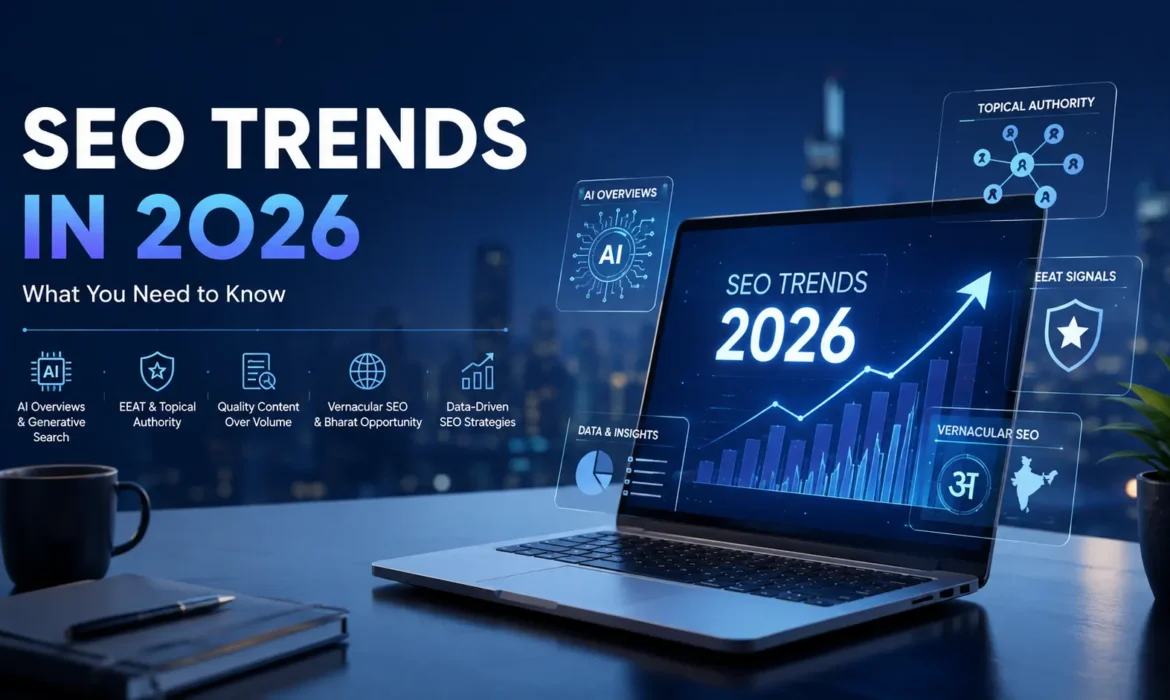
SEO trends in 2026 are being reshaped more decisively than in any prior year by four converging forces: Google’s AI Overviews now appearing on nearly half of all searches, the mainstreaming of AI-powered discovery through ChatGPT and Perplexity, tightening EEAT and topical authority requirements from Google’s core updates, and the shift from ranking pages to being cited by AI systems. This guide covers seven SEO trends every Indian brand should understand in 2026, plus what still works, what no longer does, and how to adapt without chasing every trend at once.
Key takeaways
- Google’s AI Overviews now appear on roughly 48% of Google Search queries in 2026, up from 6.5% a year earlier. AI-powered search is now mainstream, not experimental.
- India is now the world’s second-largest ChatGPT market at ~160 million monthly active users, per the Bain-Flipkart “How India Shops Online 2026” report. Buyer research increasingly starts in AI tools.
- Google’s EEAT signals (Experience, Expertise, Authoritativeness, Trust) and topical authority now matter more than individual keyword optimization for durable rankings.
- Content quality over content volume is now decisive. Google’s Helpful Content principles, integrated into core algorithm updates, actively demote thin AI-generated content published without expertise or editing.
- For Indian brands, vernacular SEO in Hindi and regional languages remains one of the highest-return SEO opportunities most competitors ignore. Per KPMG-Google research, nine out of ten new Indian internet users prefer content in an Indian language.
What Are the Biggest SEO Trends Reshaping 2026?
The biggest SEO trends of 2026 are all downstream of one central shift: search is no longer just about ranking a page in a list of blue links. It is about being retrievable, citable, and referenced across a fragmenting search ecosystem that now includes Google Search, Google AI Overviews, ChatGPT, Perplexity, Gemini, YouTube, and vertical-specific search surfaces. Every SEO trend that matters in 2026 traces back to this fragmentation and to Google’s response through EEAT, topical authority, and helpful content signals.
The practical implication for Indian brands: single-page keyword targeting is no longer enough. Building topical depth, EEAT credibility, and content that both search engines and AI systems can retrieve and reference is now the durable strategy. Chasing individual algorithm updates and keyword tricks is increasingly the losing one.
Why Are SEO Trends in 2026 Different from Previous Years?
Because three trends that were emerging in 2023 and 2024 have now become mainstream operating reality in 2026. Google AI Overviews graduated from Search Labs experiment to appearing on nearly half of all queries. AI-powered discovery through ChatGPT, Perplexity, and Gemini has become a serious pre-purchase research channel for Indian buyers. And Google’s core algorithm updates have made EEAT and topical authority decisive rather than nice-to-have.
The pace matters. SEO changes that would have taken 3 to 5 years to compound now compound in 12 to 18 months. Brands that built strong content foundations and EEAT signals over the last 24 months are now seeing outsized rankings gains. Brands that stuck with thin content, keyword-stuffed pages, and low-effort AI-generated posts are quietly losing rankings on the same core queries they used to own.
What Are the 7 SEO Trends Every Indian Brand Should Know in 2026?
Seven SEO trends will decide which Indian brands gain search share in 2026 and which lose it. In our own SEO and content work with Indian brands at Morphiaas, a performance marketing and creative agency serving India and the US, these are the trends we prioritize when helping clients build durable search visibility that survives algorithm updates.
1. AI Overviews and generative search becoming primary discovery
Google AI Overviews now appear on approximately 48% of Google Search queries in 2026, up from 6.5% a year earlier. AI Overviews summarize answers directly at the top of results with citations, meaning brands that get cited capture visibility even when users do not click through. Perplexity and ChatGPT now serve similar functions for Indian buyers researching brands, products, and services. Ranking on Google matters less every quarter. Being cited by AI systems matters more.
2. Topical authority over single-page keyword optimization
Google increasingly rewards brands that demonstrate depth across a topic cluster rather than optimizing one page to rank on one keyword. Instead of publishing three isolated blog posts, Indian brands should build interconnected content clusters covering 10 to 30 related topics with clear internal linking and pillar pages. This is how brands become the authoritative source in a category, both for Google and for AI systems.
3. EEAT signals (Experience, Expertise, Authoritativeness, Trust)
Google’s EEAT framework, particularly the “Experience” component added in December 2022, is now decisive for content ranking. First-hand experience with the topic (real examples, case studies, honest observations), named authors with credentials, transparent About and Contact pages, verifiable business information, and credible third-party mentions all strengthen EEAT. Anonymous content farms and AI-generated content published without expertise now consistently underperform expert content on the same queries.
4. Content quality over content volume
Google’s Helpful Content principles, now integrated into core algorithm updates, actively demote thin content. Publishing more articles is no longer the SEO strategy it was in 2020. Publishing genuinely useful, depth-first content that answers real buyer questions completely is now the strategy. One 2,500-word article with original insight, real examples, and expert framing outperforms 10 shallow 800-word posts on adjacent topics.
5. Video and multimedia as first-class SEO surfaces
Google Search increasingly returns video results (YouTube carousels, video snippets, watch pages) for how-to, product, and category queries. India is YouTube’s largest market. Brands with strong YouTube presence now appear in Google Search results as well as YouTube’s own algorithm, doubling the SEO surface. Product demos, walkthroughs, category education, and honest reviews on YouTube compound alongside written content into a broader search visibility play.
6. Local plus vernacular SEO for Bharat’s internet
Nine out of ten new Indian internet users prefer content in an Indian language, per the KPMG-Google “Indian Languages” study, and Google has expanded AI Search Live and Gemini Live to Hindi plus eight regional Indian languages. Publishing Hindi plus one regional language content variants (Tamil, Bengali, Marathi, Telugu, or Gujarati matched to your buyer geography) opens ranking opportunities where competition is genuinely thin. Add Google Business Profile optimization for local search dominance.
7. Zero-click search and citation-first SEO strategy
A growing share of Google searches now end without a click because AI Overviews answered the question directly. This changes the SEO objective from “rank number one and get the click” to “be the source AI systems cite when they answer”. Structured content with clear question-form headings, direct answers near the top of each section, credible source citations, and schema markup improves the odds of being the cited source. The traffic model shifts, but the brand visibility remains, often larger than before.
What SEO Practices Are No Longer Effective in 2026?
Some SEO practices that worked in 2020 are actively counterproductive in 2026. Recognize and drop these before they damage rankings:
- Keyword-stuffed thin content. Google’s Helpful Content updates now demote pages that read as written for search engines rather than humans.
- Unedited AI-generated blog posts published at volume. AI systems and Google both increasingly detect and demote low-effort AI content that lacks original insight or human editing.
- Buying low-quality backlinks from PBNs or link farms. Google’s link algorithms are now sophisticated enough that most cheap backlink tactics produce negative rather than positive effects.
- Exact-match anchor text repetition. Once considered strong SEO, now flagged as manipulation. Vary anchor text naturally across internal and external links.
- Chasing every Google algorithm update tactically. Playing to specific updates instead of building foundational content quality produces short-term gains and long-term volatility.
- Ignoring EEAT signals like author credentials and business transparency. These now matter for ranking, not just user trust.
- Assuming meta keywords tag matters. Google has confirmed it is unused. Any tool suggesting meta keywords optimization is out of date.
How Should Indian Brands Adapt Their SEO Strategy to These Trends?
Adapt through four principles. First, invest in topical depth. Build interconnected content clusters covering 10 to 30 related topics with strong internal linking rather than isolated blog posts. Second, prioritize EEAT signals. Named authors with credentials, first-hand experience content, transparent business information, and credible third-party mentions. Third, optimize for both traditional search and AI citation. Question-form headings, direct answers, credible source citations, and structured data help both surfaces. Fourth, extend into video and vernacular content. YouTube presence and Hindi plus regional language content variants open ranking opportunities most competitors ignore.
Budget guidance: most Indian brands with a serious SEO program spend ₹75,000 to ₹4 lakh per month across content, technical work, Google Business Profile management, and video production. Judge results quarterly, not weekly. SEO in 2026 rewards patience and quality more than any prior period, and the compounding gains are substantial for brands willing to sustain investment over 12 to 24 months.
Common SEO Mistakes Brands Are Making in 2026
- Publishing AI-generated content without human editing or expertise. Google and AI systems increasingly detect low-effort AI output. Publishing it degrades site quality signals across every page on the domain.
- Ignoring AI search visibility. Focusing only on Google organic rankings while AI Overviews appear on 48% of searches leaves substantial visibility on the table. Content strategy should serve both surfaces.
- Chasing keyword volume without topical depth. Ranking on isolated keywords without underlying topical authority produces unstable rankings that vanish with the next algorithm update.
- Not showing EEAT signals prominently. Anonymous content, missing author bios, thin About pages, and no third-party mentions all limit ranking potential regardless of on-page optimization.
- Skipping vernacular SEO for Tier-2 and Tier-3 buyers. Regional language content in India is a genuine growth opportunity most brands ignore, leaving the majority-India audience uncontested.
- Believing in AI search citation guarantees. No file, schema, or template guarantees ChatGPT, Perplexity, or Google AI Overviews citation. Anyone selling a guaranteed AI-citation formula is guessing.
- Cutting SEO investment when budgets tighten. SEO is the channel with the highest long-term ROI and longest payoff horizon. Cutting it first is exactly backwards for durable growth.
- Judging SEO performance in the first 90 days. SEO in 2026 rewards 12 to 24 month patience more than any prior period. Judging early usually means quitting right before the compounding kicks in.
Build an SEO Program Tuned to How Search Actually Works in 2026
If you want your SEO to actually track the trends reshaping search in 2026 rather than chasing outdated tactics, that is exactly the kind of program we build at Morphiaas. We combine technical and content SEO foundations with performant website builds, tailored for Indian brands across retail and other industries, including AI search optimization, topical authority development, and EEAT-focused content programs. Book a call and we will audit where your site stands on the 2026 trends and map the highest-leverage next steps.
Frequently Asked Questions
What is the single biggest SEO trend in 2026?
The mainstreaming of AI-powered search. Google AI Overviews now appear on roughly 48% of searches, and buyers increasingly use ChatGPT, Perplexity, and Gemini as pre-purchase research tools. Every other SEO trend in 2026 flows downstream of this one shift.
Should Indian brands still invest in SEO in the age of AI search?
Yes, more than ever. AI search draws on the same web content that Google indexes for traditional search. Strong SEO fundamentals (helpful content, EEAT signals, topical authority, crawlability) are now the primary input to both Google rankings and AI citations. SEO investment produces double the visibility surface it did five years ago.
Is content marketing still important for SEO in 2026?
Yes, and quality now matters far more than volume. One 2,500-word article with original insight, real examples, expert framing, and clear structure outperforms 10 shallow blog posts. Google’s Helpful Content principles actively demote thin content published for search engines rather than humans.
What does EEAT mean for Indian SEO in 2026?
EEAT stands for Experience, Expertise, Authoritativeness, and Trust. For Indian SEO, EEAT means showing named authors with credentials, publishing first-hand experience content, maintaining transparent business information (including RERA where applicable), collecting verified reviews, and earning credible third-party mentions in Indian publications and directories. All of these now materially affect rankings.
How long does it take to see SEO results in 2026?
Expect 3 to 6 months for long-tail queries and Google Business Profile results, 6 to 12 months for competitive queries, and 12 to 24 months for meaningful topical authority to compound. SEO in 2026 rewards patience more than any prior period. Brands that quit at month 6 usually stop right before the results would have arrived.