

Restaurant website design in India gets outsourced to cousins, general web developers, and cheap template shops. The result is a digital brochure that converts almost nothing. Most Indian restaurants have a website. Almost none are built for how diners actually decide, book, and order.
This guide is a tactical playbook for Indian restaurant owners, cloud kitchen operators, and cafe founders. It walks through how to build a website that turns search into WhatsApp bookings, phone calls, and direct orders. You’ll get the 12 features that matter, INR budget bands for three build routes, and where design choices actually move revenue.
Key takeaways
- Restaurant website design in India is a conversion job, not an aesthetics job. The best sites remove maximum friction between a hungry search and a WhatsApp message.
- 12 non-negotiable features carry the weight, from mobile-first performance to FSSAI trust signals to the reservation and ordering flow. Skip one and the funnel leaks.
- Budget bands in INR: DIY builders ₹50K to ₹1.2L year 1, done-for-you restaurant platforms ₹1.5L to ₹3L year 1, custom agency builds ₹3L to ₹8L+ year 1.
- WhatsApp Business is the highest-converting reservation and enquiry channel for Indian restaurants. Most sites don’t route to it. Fix that and conversion jumps.
- Launch fast on 12 essentials, then iterate on real diner behaviour data. A slow perfect launch loses to a fast good launch every time.
Who this is for and who should skip building a new website
Three restaurant profiles benefit from a new website build inside 90 days. Standalone dine-in restaurants running Google Ads or SEO who don’t have a purpose-built landing experience. Cloud kitchens dependent on aggregators with weak brand recall. Cafes and bakeries with strong walk-in but weak digital discovery.
Skip a new build for now if any of these apply. Under 30 Google Business Profile reviews or a rating below 3.8 stars means paid or organic traffic lands on a profile diners already distrust. No menu photography or FSSAI license yet means there’s no content to build around. Undecided on whether you’ll accept online orders means the site structure changes fundamentally by the answer.
Here’s the one honest test to run. If your website’s job is only to look nice, don’t spend on it. If its job is to convert search into revenue, invest properly.
Why restaurant website design matters more than most Indian operators realise
An Indian diner searching “restaurants near me open now” or “cafe in Koramangala” at 9 PM Saturday isn’t browsing. They’re 45 minutes from a decision, and the restaurant that shows up first with the right offer captures the booking.
78 percent of Indian restaurant searches happen on mobile, and Google’s Web Vitals treat mobile load time under 2.5 seconds as the effective ranking floor. Restaurants that miss that threshold don’t just annoy diners. They fall down the search results, so the traffic that would have arrived never does. See Google’s own Core Web Vitals guidance for the exact thresholds.
The P&L consequence is simple to see. A diner who lands on your site and can’t find the menu, tap-to-call button, or WhatsApp click in 5 seconds bounces to your competitor. That’s a lost booking at zero acquisition cost, which is the worst unit economics in the business.
Unlike an aggregator listing, your own website keeps the customer relationship in your CRM. Every reservation captured through your site can be remarketed for a repeat visit. A WhatsApp click starts a conversation you own.
The 12 features that make a restaurant website convert in India
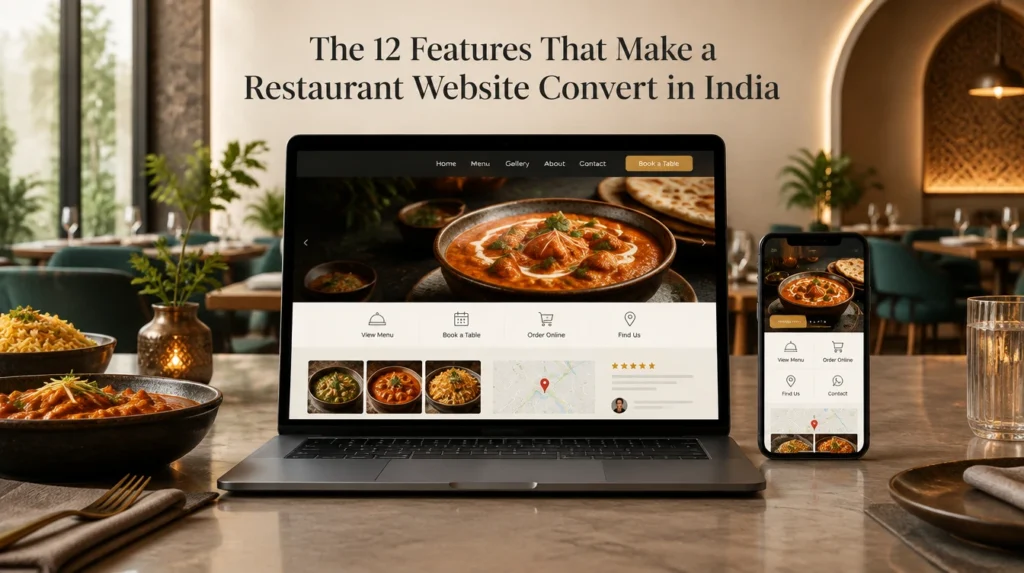
12 features carry the entire conversion weight of a restaurant website in India. Not aesthetic opinion, not template padding, not what looks nice on a design mood board. Each of the 12 maps directly to how Indian diners actually decide, book, and order. Skip any one and the funnel loses at that specific gate.
1. Mobile-first performance under 3 seconds on 4G
Most Indian restaurant searches happen on 4G phones in variable network conditions, not desktop. A site that loads in 2 seconds in a Mumbai studio can take 6-8 seconds on a Guwahati commuter phone. Every extra second increases restaurant booking abandonment by 7-10 percent.
Set the technical bar. Largest Contentful Paint under 2.5 seconds on 4G, tap targets minimum 44 by 44 pixels, font sizes 16 pixels or larger. Image weights compressed with modern formats, lazy-loaded below the fold. A CDN routes assets from the closest edge server.
2. Menu accessible in one tap, never a PDF
PDF menus fail on Indian mobile for four reasons. 89 percent of users struggle to read them on phones. Search engines don’t index them at all. Every update requires a reprint cycle. Loading times crawl on 3G and 4G networks.
The alternative is a properly built HTML menu. Categories with clear labels, dietary icons for veg, non-veg, jain, egg, and vegan preferences, inline photography of top sellers. Set prices GST-inclusive on the menu. Descriptions that sell the dish, not just label it.
Menu pages carry 60-70 percent of all page views on a typical Indian restaurant website. Design them as second-most important after the homepage, and treat them as conversion assets in their own right.
3. WhatsApp Business click-to-chat as primary conversion action
WhatsApp does 70-80 percent of Indian restaurant reservations and enquiries. It’s the app diners are already in, and it removes the friction of switching to a phone call or a web form.
The implementation has three parts. Add a floating WhatsApp button that stays visible on every page. Set tap-to-chat to open with a pre-filled message like “Hi, I’d like to book a table for 4 tonight at 8pm”. Route it to your WhatsApp Business number, not a personal number.
Track the WhatsApp click as a first-party conversion event in Google Analytics and Google Ads. Without that tracking, Smart Bidding optimises away from the very action that closes bookings. Every WhatsApp click deserves a value assignment in the conversion actions dashboard.
4. FSSAI license visible on the footer and about page
FSSAI number displayed on the footer signals regulatory compliance to Indian diners in a way stars and reviews don’t. Trust-conscious diners planning family orders or health-focused meals look for it before booking.
Place it in small text on the footer of every page. Expand it on the About page with the FSSAI license number and validity date. If your kitchen holds certifications beyond FSSAI (organic, halal, jain-certified), name those there too.
The signal matters most for cloud kitchens and delivery-focused operators, where the diner never sees the physical restaurant. For dine-in restaurants, it’s a smaller lift but still worth doing.
5. Google Business Profile alignment above the fold
Name, address, phone number, and hours on the website must match your Google Business Profile exactly. Any drift between the two and your local search rankings drop.
Above the fold on every page, show restaurant name, clickable phone, today’s hours, and embedded Google Maps location. Mobile visitors should see this without scrolling. Desktop visitors get it in the header.
Schema markup for Restaurant, LocalBusiness, and Menu types should be implemented at the HTML level, not left to a generic WordPress plugin. Google reads schema faster than it reads copy, and correct schema is often the difference between showing up in a Local Pack search and being invisible.
6. High-quality food photography over stock
Menu items with photos get 70 percent more direct orders and 6.5 percent higher basket size compared to text-only menu listings. Diners buy with their eyes, and Indian diners are especially visual on unfamiliar dishes.
Shoot 15 to 20 top-selling dishes properly. Use natural light near a window, clean plates and simple backgrounds, a 45-degree angle for stacked items, and overhead framing for thalis and bowls. Focus on top sellers, not every item on the menu.
Skip stock food photography entirely. Diners spot it in 2 seconds and lose trust in the whole menu.
A competent one-day food photography shoot in most Indian metros costs ₹15,000 to ₹40,000 including basic editing. Cheaper than one lost month of ad spend on a website nobody trusts.
7. GST-inclusive pricing display on the menu
Menu prices should be displayed inclusive of GST for consumer clarity. Prices that don’t match the final bill kill trust and drive negative reviews.
The tax structure runs at 5 percent for non-AC restaurants, 5 percent for AC restaurants without alcohol, and 18 percent for restaurants serving alcohol. Whichever applies to your restaurant, build it into the menu prices you show.
Price bands on the homepage help diners self-qualify before clicking through. Something like “starters ₹200 to ₹400, mains ₹350 to ₹800” anchors expectations and pre-filters browsers from bookers. Diners who click through to your menu are already qualified on price.
8. Reservation and ordering flow that matches how Indians actually book
Indian diners book through three main paths. Dine-in reservations happen mostly through WhatsApp Business or a phone call. Premium restaurants also see reservations through dedicated booking platforms. Direct online orders happen through first-party ordering integrations for delivery-capable operators.
Pick your primary conversion action based on your business model, then design the site around it. A dine-in-heavy fine dining restaurant should optimise for the reservation flow. Cloud kitchens should optimise for the ordering flow. Cafes with mixed use should offer both with one clearly primary and one clearly secondary.
Never offer three CTAs at once. Diners forced to choose between call, WhatsApp, and online order often choose none of them. Pick the top one for your model, make it visually dominant, and let the others sit as smaller alternatives.
9. Reviews and social proof block near the top
Google Business Profile rating stars, review count, and 2-3 short recent reviews belong near the top of the homepage, not buried in a testimonials page. Rating stars near the hero increase click-through to menu by 15-20 percent, and click-through to booking by 25-30 percent.
Display live from Google Business Profile if possible, so the numbers stay current without manual updates. Fabricated or outdated reviews damage trust more than no reviews at all. Diners cross-check on Google before booking anyway.
Recent reviews with dish names work better than generic praise. “Best butter chicken in HSR Layout, went back three times last week” converts better than “Great food, will visit again”.
10. Location and hours in header and footer, no exceptions
44 percent of diners leave restaurant websites when they can’t find contact info quickly. Every second of hunting is a bounce risk you don’t need to take.
Show restaurant name, phone number, and today’s hours in the header. In the footer, add the full address, weekly hours, WhatsApp number, and embedded Google Maps. On mobile, add a sticky bottom bar with tap-to-call and tap-to-WhatsApp buttons for constant access.
The friction cost of hiding contact info is bigger than most operators realise. Every diner who bounces at that step is a lost booking with zero recovery path.
11. SEO structure that ranks for cuisine plus area queries
Indian diners search “north Indian restaurant Vasant Kunj”, “cafe HSR Layout”, or “biryani near me Bandra”. The site must be structured to rank for these long-tail cuisine-plus-area queries.
Set your H1 with cuisine and area terms. Meta title should follow the same pattern. Multi-outlet operators get location-specific pages, one per outlet, with unique content per page. Schema markup carries Restaurant type at minimum, with LocalBusiness and Menu schemas layered on top.
Internal linking closes the SEO loop. Homepage links to menu, menu links to booking flow, booking flow links back to homepage. Google reads site structure through internal links, and orphan pages get ignored.
A blog or content section carrying long-tail terms (recipes, food guides, cuisine explainers) adds topical authority that pushes the main pages up in rankings.
12. Analytics and conversion tracking that maps to real revenue
Most Indian restaurant sites track page views and treat that as success. Page views don’t pay rent. Actual conversion actions (WhatsApp clicks, phone calls, direction requests, menu page views) go unmeasured on most sites.
Set up Google Tag Manager for event tracking on every conversion action. Configure Google Analytics 4 for behaviour data. Register conversion actions for WhatsApp click, tap-to-call, form fill, direction request, and menu page view. Assign different conversion values to each so Smart Bidding learns what actually earns money.
Without conversion tracking, you don’t know which pages, campaigns, or channels drive revenue. Every marketing rupee flies blind, and the site’s contribution to the P&L stays invisible.
Restaurant website design costs in India, three real budget routes
Three routes cover the practical options for building a restaurant website in India. Each has its own budget band, timeline, and best-fit business model.
Route 1: DIY builders like Wix, Squarespace, or Shopify with F&B templates. Year 1 total lands at ₹50,000 to ₹1,20,000. Monthly platform fee ₹1,500 to ₹4,000, domain ₹800 to ₹1,500, food photography ₹15,000 to ₹40,000, ordering plugin ₹2,000 to ₹8,000 per month optional. Best for small standalone restaurants doing under 20 online orders per week. Tradeoff: time cost is high, mobile performance patchy, SEO limited without paid plugins.
Route 2: Done-for-you restaurant platforms and F&B agencies. Year 1 total lands at ₹1,50,000 to ₹3,00,000. Includes site build, food photography, menu integration, ordering setup, Google Business Profile alignment, and hosting for year 1. Best for multi-outlet restaurants, cloud kitchens, and cafes doing 20 to 200 online orders per week. Tradeoff: less design flexibility than custom, faster launch.
Route 3: Custom agency build. Year 1 total lands at ₹3,00,000 to ₹8,00,000 or more upfront, plus ₹15,000 to ₹40,000 per month maintenance retainer. Best for premium restaurants, multi-city chains, fine dining, and F&B groups where brand consistency and custom booking experience drive real revenue. Tradeoff: 8 to 16 weeks build time, ongoing retainer cost.
The ROI framing worth remembering. A restaurant losing 30 percent of ad-driven traffic to a slow PDF-menu site burns more in monthly ad waste than it would cost to build a converting site properly. The website isn’t a cost centre. It’s the primary conversion asset.
DIY versus done-for-you versus custom agency at a glance
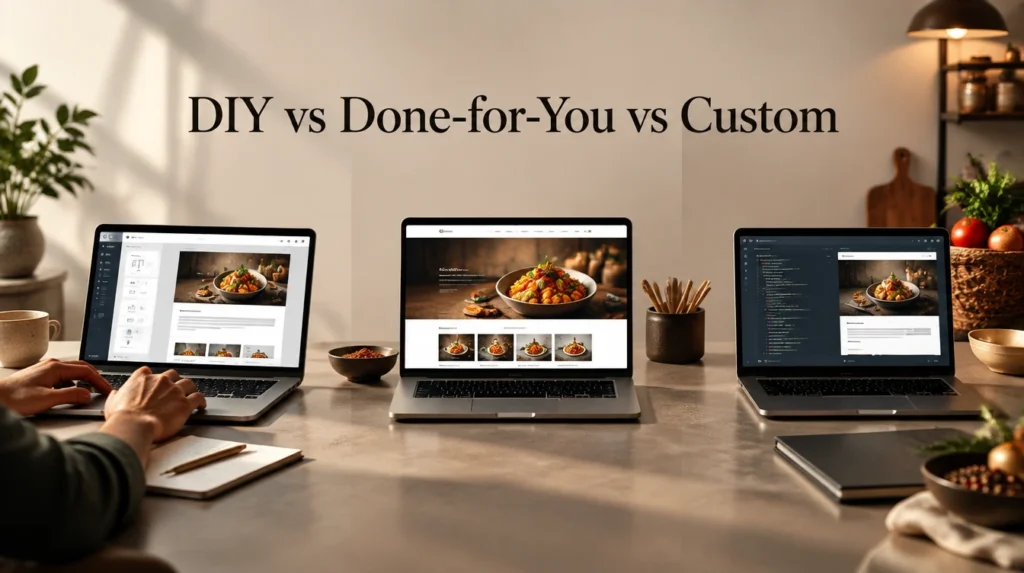
Six comparison points settle the choice. Match the route to your operational volume, not to your budget vanity.
Speed to launch. DIY takes 1 to 3 weeks if you’re focused. Done-for-you takes 2 to 4 weeks. Custom agency runs 8 to 16 weeks.
First-party ordering. DIY requires paid plugins to enable it. Done-for-you platforms include native ordering. Custom agency needs separate ordering integration built in.
Mobile performance. DIY performance depends on the template. Done-for-you is optimised by default. Custom agency depends on the agency’s technical bench.
SEO and schema. DIY offers limited SEO without plugins. Done-for-you carries standard schema out of the box. Custom agency depends on the agency’s SEO capability.
GST-inclusive pricing display. DIY requires manual setup for each menu item. Done-for-you often standardises it. Custom agency handles it as a build requirement.
Best fit. DIY suits restaurants doing under 20 orders per week with tight budget. Done-for-you suits growth-stage operators between 20 and 200 orders per week. Custom agency suits premium concepts and multi-outlet chains with brand-first positioning.
Match the route to the volume. A ₹5L custom build doesn’t help a restaurant doing 5 online orders per week. That money returns better on food quality, staff, or paid media in the first year.
Six mistakes that quietly kill restaurant website conversion
Six mistakes account for most of the wasted spend and lost bookings on Indian restaurant websites.
PDF menu that opens in a new tab. 89 percent of users can’t read a PDF menu well on mobile. Menu-page bounces spike and direct orders drop. Fix: replace with an HTML menu carrying categories, dietary icons, and dish photos.
No WhatsApp Business click-to-chat button. 70 to 80 percent of Indian restaurant enquiries happen on WhatsApp. Without a button, diners give up and try a competitor. Fix: floating WhatsApp button on every page routing to a WhatsApp Business number.
Homepage that requires scrolling to find the menu link. Diners want the menu in the first tap. Every second of hunting costs conversions. Fix: menu link in the top navigation and hero section, plus a sticky mobile menu button.
Prices displayed exclusive of GST. Menu prices that don’t match the final bill kill trust and drive negative reviews. Fix: display all menu prices GST-inclusive with a small footnote explaining the tax structure.
Stock food photography instead of real dish shots. Diners spot stock in 2 seconds and lose trust in the whole menu. Fix: budget ₹15,000 to ₹40,000 for a proper one-day food photography shoot of your top 15-20 dishes.
No FSSAI license number visible. Trust-conscious diners look for it before booking family orders or health-focused meals. Absence signals to them the operator isn’t fully compliant. Fix: display FSSAI number on the footer of every page and expand it on the About page with validity date.
What to do this week
What is a good monthly ad budget for a retail store in India?
₹30,000–50,000 per month runs a meaningful single-location program covering Search, Meta, and WhatsApp ads. Below ₹20,000, spread across channels, budgets rarely generate the 50 weekly conversions Meta’s learning phase needs, so results stay erratic. Better to run one channel properly than three thinly.
Google Ads or Meta Ads: which is better for Indian retail?
Google captures people already searching for what you sell; Meta creates demand among people who weren’t. Retail with strong category search (electronics, furniture, appliances) leans Google first. Visual, impulse, and fashion retail leans Meta first. Most accounts end up running both, roughly balanced.
Do WhatsApp ads actually generate retail sales?
Yes, particularly for considered purchases where buyers have questions: jewellery, furniture, sarees and occasion wear, electronics. The click-to-message format turns ad interest into a conversation, and a staffed conversation closes at rates no landing page matches. The requirement is reply speed measured in minutes.
When should Indian retailers start Diwali ad campaigns?
Audience-building starts in August: cheap video views, engagement, and site traffic while CPMs are low. Conversion campaigns ramp from late September, retargeting the warm pools built earlier. Festive-window costs run up to triple baseline, so the retailers who pre-built audiences buy their Diwali sales at off-season prices.
Why are my retail ads getting clicks but no sales?
Usually the leak is after the click: slow mobile pages, missing prices, no COD or delivery clarity, or an offer that doesn’t match the ad. Check landing page speed and offer match before touching targeting. Improving CTR on a broken landing experience just buys more visitors to a leak.
If your restaurant website has been sitting unchanged for over a year, or if you’re considering a rebuild, start with a diagnostic before writing any specs.
Morphiaas runs a Restaurant Website Conversion Audit for Indian F&B operators. The audit walks through your current site or homepage mockup in a 30-minute Loom. It reviews the 12 features against your current setup. WhatsApp integration gets a specific check. Mobile performance runs on real 4G conditions. The final output is a prioritised list of the three fixes that will move revenue fastest.
The audit is free. Execution is paid, and we’re transparent about that from the first call. If you want to see how our team approaches restaurant website builds, our website development team has worked with F&B operators across Delhi NCR, Mumbai, Bengaluru, and Hyderabad. If you want the broader picture on how the website fits into your restaurant’s full marketing setup, our food and drink industry page lays out the full stack.
Book your audit and we’ll deliver the walkthrough within 5 working days.
Frequently asked questions
How much should an Indian restaurant spend on a website?
Three real budget bands cover the options. DIY builders run ₹50,000 to ₹1,20,000 total in year 1 for small standalone restaurants. Done-for-you restaurant platforms run ₹1,50,000 to ₹3,00,000 total for multi-outlet operators and cloud kitchens. Custom agency builds run ₹3,00,000 to ₹8,00,000 or more for premium restaurants and multi-city chains. Match the route to the volume of orders, not to your ambition.
Should my restaurant website accept online orders directly or route to aggregators?
Both, not one or the other. Direct ordering through your own site captures full margin and keeps the customer relationship in your data. Food aggregators bring discovery and delivery volume you couldn’t get on your own. Design the site so direct ordering is the easier path, then use aggregators for the customers who prefer them.
How important is food photography for a restaurant website?
One of the highest-ROI investments a restaurant website can make. Menu items with photos get 70 percent more direct orders and 6.5 percent higher basket size than text-only listings. A competent one-day food photography shoot in most Indian metros costs ₹15,000 to ₹40,000 including basic editing. Cheaper than one lost month of ad spend on a website nobody trusts.
Do I need a WhatsApp Business integration on my restaurant website?
Yes, for most Indian restaurants. 70 to 80 percent of restaurant reservations and enquiries in India happen through WhatsApp. A floating WhatsApp button with a pre-filled message and a WhatsApp Business number closes bookings that phone forms and web forms don’t. Track the WhatsApp click as a first-party conversion event so Smart Bidding optimises toward it.
How long does building a restaurant website take?
The build time depends on which route you take. DIY builders take 1 to 3 weeks if you’re focused. Done-for-you restaurant platforms take 2 to 4 weeks including menu photography and Google Business Profile alignment. Custom agency builds take 8 to 16 weeks for a proper design, build, integration, and testing cycle. Launch fast and iterate beats slow-perfect on almost every measurable outcome.