

Fashion branding strategy is the system that makes a brand recognizable, remembered, and chosen over cheaper alternatives. Seven moves build that recognition: positioning lock, a distinctive visual identity system, defined brand voice and story, founder narrative, repeatable content pillars, signature product silhouettes, and consistent brand codes across every touchpoint. Done well, it compounds. Done loosely, it erodes.
Key takeaways
- Consistent brand presentation across all platforms can lift revenue by up to 23 percent (Lucidpress/Marq research).
- Positioning is the single biggest branding lever. Everything else amplifies it or dilutes it.
- Signature product silhouettes do more for brand recall than most of the ad spend behind them.
- Founder-led fashion brands compound trust faster than faceless DTC brands in 2026.
- Brand recognition is measurable via aided and unaided recall surveys, not a vibe to argue about.
What is fashion branding strategy?
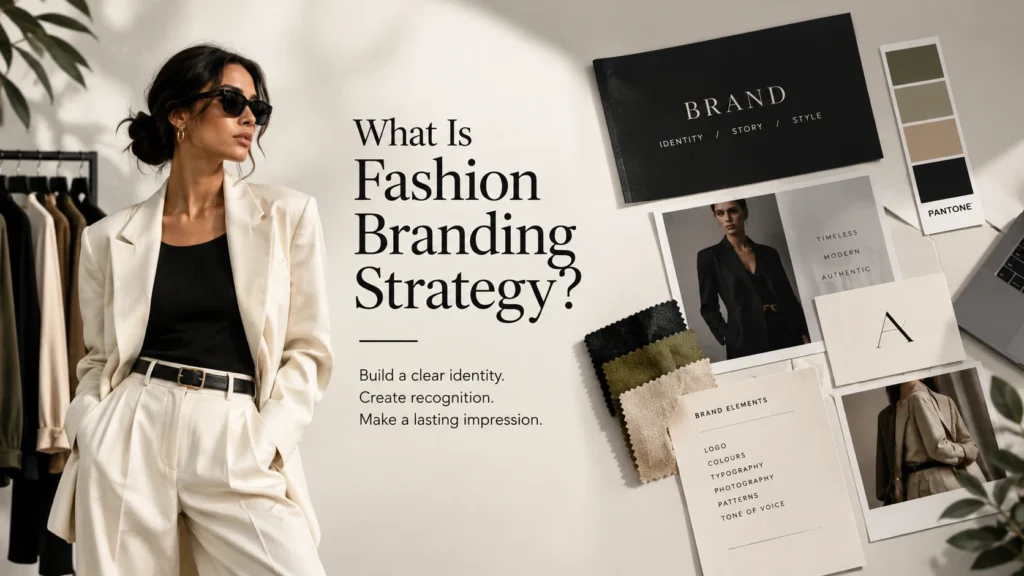
Fashion branding strategy is the deliberate set of decisions that defines what a fashion brand stands for, how it looks, how it sounds, and how it shows up across every touchpoint a buyer encounters. It covers positioning, visual identity, brand voice, founder narrative, content pillars, product design signatures, and the operational consistency that holds all of it together over years.
Branding is not a logo. A logo is one output of a branding strategy. The strategy itself is a document (or a shared understanding) that answers four questions: who we are, who we serve, what we stand for, and what makes us impossible to confuse with the brand next to us on the shelf or in the Instagram grid.
Why does fashion branding strategy matter in 2026?

It matters because fashion is one of the most crowded categories on the internet. Thousands of DTC brands launch every year in India and the US. The brands that survive aren’t the ones with the biggest ad budgets. They’re the ones buyers can describe in one sentence six months after seeing them.
Three shifts raised the stakes this year. Rising paid-media costs mean brands can’t buy recognition at scale anymore (Meta CPMs rose 15 to 25 percent year-over-year for most fashion sub-categories). AI-powered discovery (ChatGPT, Perplexity, Google AI Overviews) favors brands with clear identity signals in their content and schema. And buyer attention spans continue to tighten, which means a brand has roughly 2 to 3 seconds in a feed to be recognized before it’s scrolled past.
Morphiaas, a performance marketing agency serving India and the US, builds branding systems for fashion brands in both markets and runs an in-house men’s athleisure brand based in Houston. Shipping our own packaging, writing our own emails, and watching which brand codes travel back to customers through UGC changes how we design client systems. The brands growing in 2026 are the ones treating branding as compound interest, not a one-time rebrand project.
What are the 7 ways to build a recognizable fashion brand?
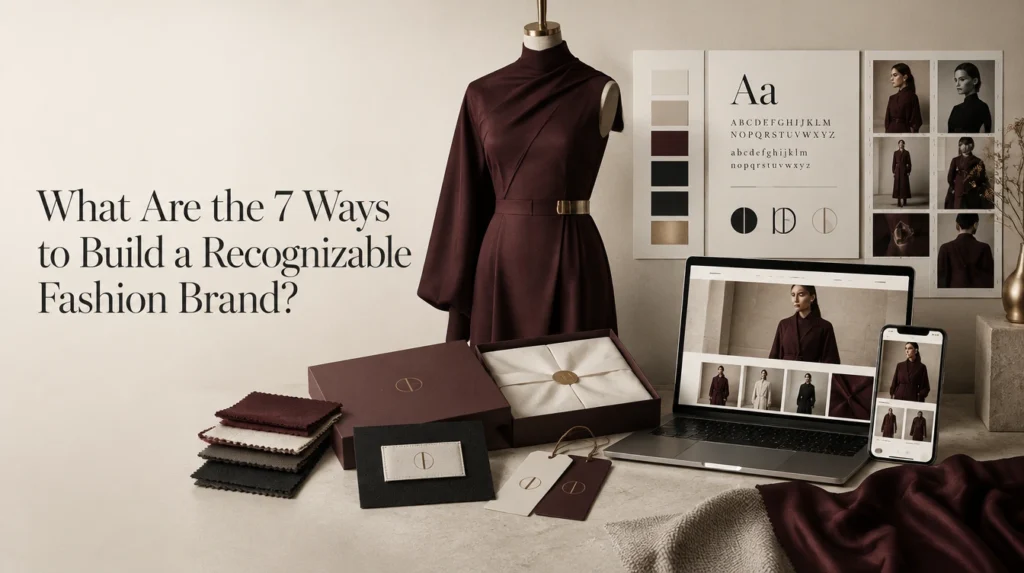
Seven moves carry the brand recognition weight for most fashion brands. Three are strategic (positioning, voice, founder narrative). Three are visual and product-led (identity system, content pillars, signature silhouettes). The seventh is operational discipline. In roughly that order of leverage, because a strong visual identity on top of weak positioning builds a pretty brand nobody remembers.
1. Lock positioning before touching anything visual
Positioning is one sentence: who you are, who you serve, and what you stand for that competitors can’t say. A fashion brand with sharp positioning will look recognizable even with amateur photography. A fashion brand with weak positioning won’t look recognizable even with a six-figure brand book. Do this first, redo it when the brand grows, never skip it.
The test: ask five people outside your team to describe your brand in one sentence after seeing your Instagram grid. If the sentences agree, positioning is clear. If they wander, positioning is weak. A new logo won’t fix a brand that has nothing distinctive to say.
2. Build a visual identity system, not just a logo
A visual identity system is a complete set of design assets: logo, color palette (3 to 5 colors with exact hex and Pantone values), typography (one display face, one body face), photography direction, iconography, pattern or texture library, and layout principles. Brands with a documented identity system see up to 23 percent revenue uplift from consistent presentation (per Marq’s brand consistency research).
Document it. Share it. Enforce it. The best identity systems fit on a 10-page PDF, not a 60-page brand bible nobody opens.
3. Define brand voice and a repeatable story
Brand voice is how the brand sounds when it writes an email, a product description, a founder’s story, a reply to a complaint. A recognizable fashion brand has a voice buyers would spot in a blind test. Define 3 to 5 voice attributes (warm, direct, slightly dry, never performative, no exclamation marks), and give writers 5 to 10 example sentences for each.
The brand story is the one paragraph that explains why the brand exists and keeps earning the right to exist. It belongs on the About page, in the first email, in the pitch to press, and in the founder’s LinkedIn bio. Write it once, refine it quarterly, repeat it everywhere.
4. Put the founder in the brand (or decide not to, deliberately)
Founder-led fashion brands compound trust faster than faceless DTC brands in 2026. A visible founder on Instagram, in emails, in behind-the-scenes content, and in press gives the brand a human anchor that algorithms, buyers, and AI retrieval all weight. If the founder is uncomfortable on camera, train them or hire someone to help, but don’t skip the decision.
The alternative (fully anonymous brand voice) can work for mass-market or category-leader positioning, but it’s harder and slower. Our deeper breakdown on personal branding for fashion founders covers how the founder’s own presence folds into brand recognition without overshadowing the product.
5. Run 3 to 5 consistent content pillars across every channel
Content pillars are the 3 to 5 recurring topics your brand owns across Instagram, TikTok, email, and the blog. For a fashion brand that might be: the product (how it’s made, worn, styled), the founder story, the customer community (UGC, reviews), the point of view (industry opinions), and behind-the-scenes operations. Pillars make content planning fast and brand presence predictable.
Buyers who follow a brand for 6 months should recognize its pillars without being told. That’s recognition compounding. Our broader take on fashion digital marketing strategy shows how pillars connect paid, organic, and SEO content.
6. Create signature product silhouettes buyers can identify at a glance
A signature silhouette is one product (or one product family) with a distinctive shape, detail, or construction that buyers can identify in a crowded feed. The Celine Triomphe bag. The Bottega Pouch. The Alo yoga legging ribbed waistband. These silhouettes do more for brand recall than most of the paid media behind them, because the product itself carries the brand code.
Early-stage fashion brands often skip this and launch 30 undifferentiated SKUs. We’d argue the opposite is the move: launch 3 to 5 silhouettes, make them unmistakable, let them become the thing buyers describe when they tell a friend about your brand. SKU expansion follows recognition, not the reverse.
7. Repeat brand codes across every single touchpoint
Brand codes are the repeatable signals that train buyer memory: a specific photo treatment, a signature caption format, a tagline that appears on every email, a packaging unboxing moment, a repeat font or color combination. The brands with highest recall repeat 5 to 10 brand codes relentlessly across packaging, email, website, store (if physical), ads, and organic social.
Consistency is harder than it sounds because it feels boring from the inside. From outside, it’s the entire reason buyers remember you. Boring internally, memorable externally. That trade is the job.
How much should a fashion brand spend on branding?
Most Indian DTC fashion brands should allocate 10 to 20 percent of total marketing budget to branding work (identity system, content production, brand consulting, photography, founder content). US brands often run similar. The one-time cost of building the system is higher; the ongoing cost of maintaining it is lower.
Practical starting bands:
- Early-stage DTC under ₹1Cr: ₹1.5L to ₹5L one-time for identity system + brand strategy, then ₹20K to ₹50K/month for ongoing brand content production.
- Growth-stage ₹1Cr to ₹10Cr: ₹5L to ₹15L one-time for a complete rebrand or system refresh, ₹50K to ₹2L/month ongoing for brand content, photography, and founder content programs.
- Scaling ₹10Cr+: ₹15L to ₹50L+ for a full brand system including campaign strategy, flagship brand films, and partner activations; dedicated in-house brand team plus specialist agency support.
Spending below the lower band often produces a logo and a one-page style guide, not a system. Spending above the upper band rarely helps a brand under ₹10Cr revenue; the money is better spent on paid media and product.
How is fashion branding different for DTC versus luxury?
DTC fashion branding builds recognition through founder story, product utility, community, and operational transparency. Luxury fashion branding builds recognition through heritage, scarcity, craftsmanship, and controlled distribution. Both require the same core (positioning, visual identity, voice, codes), but the levers they pull differ sharply.
| Dimension | DTC fashion | Luxury fashion |
|---|---|---|
| Core trust lever | Founder story + reviews | Heritage + craftsmanship |
| Pricing signal | Value for quality (transparent) | Scarcity + exclusivity |
| Primary channels | Instagram, TikTok, email, paid-social | Press, flagship stores, selective digital |
| Content tone | Approachable, direct, UGC-heavy | Aspirational, editorial, controlled |
| Launch cadence | Rapid, iterative drops | Seasonal collections, slow |
| Distribution | Owned (website, marketplaces) | Highly selective (owned stores, few partners) |
Hybrid positioning (accessible luxury, elevated DTC) exists but is the hardest to execute. Pick one lane, build recognition inside it, expand after you own that position.
What mistakes dilute fashion brand recognition?

Six mistakes account for most of the preventable brand damage in fashion.
Rebranding every 18 months. Brand recognition compounds through repetition. Rebranding resets the compounding. Minor refreshes (updated typography, refined color palette) are fine. Full rebrands should be rare and reasoned.
Chasing trends over owning a point of view. A brand that reinvents itself every season to match TikTok trends never builds recognition. Trends feed content, not identity. Have a point of view that outlasts trends.
Running inconsistent visuals across channels. The Instagram grid, the website, the packaging, and the email templates should feel like one brand. Many fashion brands look like three different brands depending on where you encounter them.
Hiding the founder. In 2026, a visible founder is a brand asset. Hiding behind “the brand” sacrifices the human anchor buyers increasingly expect from DTC fashion. Exceptions exist (mass-market, celebrity-brand) but they’re exceptions.
Over-expanding SKUs before owning silhouettes. Launching 50 products when nobody can name the brand’s signature piece dilutes recognition. Narrow before broad.
Treating branding as a one-time project. Branding is operational. If one person on the team can approve inconsistent assets, the system will erode. The brand lives in the daily discipline, not the brand book.
How do you measure fashion brand recognition?

Measure brand recognition across three tiers: unaided recall (percentage of target audience that names your brand when asked about your category), aided recall (percentage that recognizes your name when prompted with a list), and brand associations (what buyers say when asked to describe your brand). Run surveys quarterly through a panel service or a 500-respondent Instagram story poll.
Four numbers deserve quarterly review. Unaided recall score in your core category. Aided recall score. Brand association consistency (do descriptions agree?). Direct and organic traffic as a percentage of total site traffic. Rising direct traffic is a strong leading indicator of brand strength because it means buyers are typing your name instead of searching the category.
Most fashion brands measure follower count and call it brand strength. Followers are vanity. Recall is reality.
Ready to build a recognizable fashion brand?
If your fashion brand is losing to competitors with weaker product but stronger recognition, start with a branding diagnostic before investing in a rebrand. Morphiaas runs a Fashion Brand Diagnostic for Indian and US DTC fashion operators. It covers positioning audit, visual identity consistency review across every touchpoint, voice and content pillar assessment, founder presence analysis, signature silhouette evaluation, and a prioritised list of the three branding fixes that will move recall fastest.
Book your diagnostic and we’ll deliver the walkthrough within 5 working days.
Frequently asked questions
How long does it take to build a recognizable fashion brand?
Minimum 18 to 24 months of consistent brand expression before unaided recall meaningfully moves in a core audience. Early signals (direct traffic growth, UGC quality, press interest) show up at 6 to 12 months. Instant brand recognition is a myth outside of celebrity-launched brands with pre-existing audiences.
Can a small fashion brand build strong branding without a big budget?
Yes. The highest-leverage branding assets (positioning clarity, consistent voice, visible founder, 3 to 5 content pillars, signature silhouettes) are mostly free. What costs money is the visual identity system and ongoing content production. Many small Indian and US fashion brands build strong recognition on under ₹50K/month of ongoing branding spend if the strategy is sharp.
Should a fashion brand hire an in-house brand designer or an agency?
Depends on scale and brand complexity. Early-stage brands often work with an agency or specialist designer for the initial identity system, then move to a part-time or in-house designer for execution. Growth-stage brands running multiple campaigns per quarter usually need in-house brand ownership plus agency support for strategic moments (rebrand, flagship campaign, new category launch).
What’s the difference between brand strategy and marketing strategy?
Brand strategy decides what the brand stands for, how it looks, and how it sounds. Marketing strategy decides how to put that in front of buyers to drive sales. Brand strategy answers “who are we?” Marketing strategy answers “how do we reach the right people?” Both matter. Brand strategy comes first because marketing without clear brand positioning amplifies the wrong things.
How often should a fashion brand update its branding?
Full rebrands rarely, every 5 to 8 years at most, and only when the business has clearly outgrown the current identity. Minor refreshes (typography tune-up, color palette evolution, photography direction update) every 2 to 3 years keep the brand feeling current without resetting recognition. Content pillars and brand voice should evolve continuously but shift fundamentals rarely.