

Fashion paid media is the paid-ad spend across Meta, Google, TikTok, and Pinterest that drives measurable sales for fashion brands. Seven strategies improve advertising ROI consistently: creative diversity testing, Advantage+ Shopping setup, catalog ads with dynamic retargeting, first-party audience building, incrementality testing, platform-mix balance, and MMM-informed budget allocation.
Key takeaways
- Creative testing drives 60 to 80 percent of fashion paid media performance variance. Everything else is settings.
- Advantage+ Shopping Campaigns (ASC) beat manual campaign structures for most DTC fashion brands under $20K/month ad spend.
- Catalog ads with dynamic product retargeting typically deliver 4 to 8x ROAS versus 1.5 to 3x on cold prospecting campaigns.
- First-party audience data (CRM uploads, pixel events, server-side tracking) now matters more than lookalikes after iOS 14.5 and Chrome’s third-party cookie deprecation.
- Incrementality testing often shows platforms overclaim 30 to 50 percent of attributed revenue. If you’ve never tested, you’re probably overpaying.
What is fashion paid media?
Fashion paid media is the discipline of running paid advertising for fashion brands across Meta (Facebook and Instagram), Google (Search, Shopping, Performance Max), TikTok, Pinterest, and connected TV. It covers creative production, audience strategy, campaign structure, bidding, catalog setup, attribution, incrementality testing, and the measurement work that ties ad spend back to real sales.
Paid media sits apart from organic social and SEO. Paid media buys attention at scale. Organic social earns it slowly. SEO captures intent that already exists. A fashion brand needs all three, but paid media is usually the fastest lever on near-term revenue if creative and measurement are in order.
Why does fashion paid media matter for ROI in 2026?
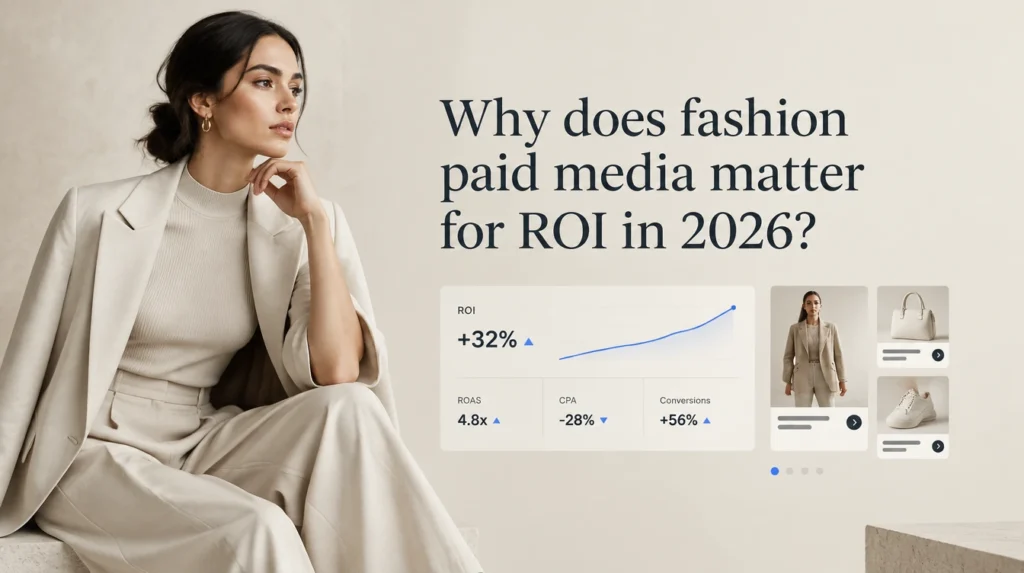
It matters because fashion is one of the most saturated and competitive paid-ad categories, and the brands that run paid media well compound ROI while brands that run it loosely bleed cash on untested creative and poor measurement. Platform costs rise year over year; the only durable edge is operational.
Three shifts drove the stakes higher this year. iOS tracking changes cut post-iOS 14.5 Meta attribution signal, so brands running without server-side tracking (Meta’s Conversions API, server-side GTM) now see 20 to 40 percent less data in-platform. Chrome’s third-party cookie deprecation (rolling through 2026) is doing the same to Google retargeting. And platform ad auctions keep getting more competitive, which means CPMs on Meta rose 15 to 25 percent year-over-year across most fashion sub-categories.
Morphiaas, a performance marketing agency serving India and the US, runs paid media for fashion brands in both markets and operates an in-house men’s athleisure brand based in Houston. Spending our own money on paid-social changes how we design client playbooks. The brands improving ROI in 2026 are the ones treating paid media as a measurement problem first and a creative problem second.
What are the 7 strategies to improve fashion paid media ROI?
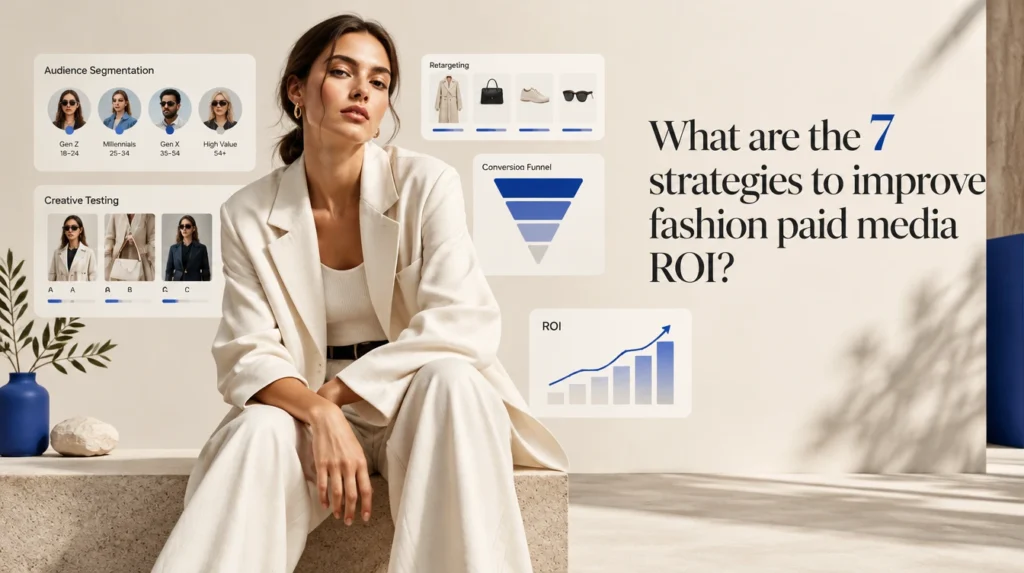
Seven strategies carry the ROI improvement weight for Indian and US fashion brands. The first three are creative and structure. The next three are measurement and audience. The seventh is budget decision-making. In that order, because creative problems can’t be fixed by better measurement, and measurement problems can’t be fixed by more spend.
1. Build a creative testing engine that ships 3 to 5 new concepts weekly
Creative drives 60 to 80 percent of fashion paid media performance variance. Audience, placement, and bidding are increasingly automated by Meta and Google algorithms. What you control is the input: how many ad concepts, how distinct, how often. Brands shipping 3 to 5 new tested concepts per week consistently outperform brands that run the same hero ad for 90 days.
A concept is not a variant. 10 color swaps on the same creative is one concept. A UGC testimonial, a studio product shot, a founder-piece-to-camera, and a lifestyle Reel are four concepts. Test the concept-level diversity. Our deeper breakdown on fashion Reels marketing strategy covers the short-form video formats that double as paid-social creative.
2. Run Advantage+ Shopping Campaigns (ASC) as the primary Meta structure
ASC is Meta’s black-box campaign type that automates audience targeting, placement, and creative selection. For most DTC fashion brands running under $20K/month on Meta, ASC outperforms manual campaign structures on ROAS by 15 to 35 percent. Above $50K/month, a hybrid structure (ASC plus one or two manual campaigns for brand or prospecting cold audiences) tends to beat ASC alone.
Set ASC up correctly: catalog connected, pixel plus Conversions API firing, 50-ad creative pool, 7-day click attribution window, bid cap only if you have reliable CAC math. Meta’s official Advantage+ Shopping documentation covers the setup requirements.
3. Set up catalog ads with dynamic product retargeting
Catalog ads with dynamic product retargeting (DPA on Meta, Shopping remarketing on Google) typically deliver 4 to 8x ROAS versus 1.5 to 3x for cold prospecting. The reason is simple: you’re showing the exact product a buyer already viewed back to them at the moment they’re most likely to convert. Every fashion brand with more than 20 SKUs should run catalog ads.
The setup matters. Clean product feed with high-quality images, correct categories, in-stock status, and GTINs where applicable. Exclude recent purchasers so you don’t retarget someone who just bought. We learned this the expensive way on a Delhi womenswear account that was spending ₹40K/month retargeting customers from the previous week.
4. Build first-party audience assets before you need them
First-party data (your CRM list, pixel events, server-side tracking) is now more valuable than lookalike audiences for fashion paid media. iOS 14.5 and Chrome cookie deprecation cut the signal platforms use to build lookalikes. Brands with clean CRM uploads, Conversions API firing server-side, and tagged pixel events run ads with better learning and lower CPAs.
Weekly CRM list uploads (purchasers, non-purchasers, high-LTV cohorts, cart abandoners), Conversions API via Shopify or GTM server-side, and pixel event taxonomy that distinguishes view-product from add-to-cart from initiate-checkout. Takes two weeks to set up, pays back for years.
5. Run incrementality tests quarterly
Attribution is not causation. Platforms claim credit for sales that would have happened anyway. Incrementality testing (geo holdouts, campaign pauses, matched market tests) shows the real incremental lift from a channel. Fashion brands that test consistently find Meta overclaims revenue by 25 to 50 percent and Google overclaims branded-search revenue by 50 to 80 percent.
Pause branded search for 2 weeks in one geo. Hold out one zip code or city from Meta spend for 30 days. Compare revenue versus a matched market. The gap is your real incremental ROAS. Most brands have never done this and are overpaying because of it.
6. Balance platform mix instead of concentrating everything in one channel
Fashion brands running 90 percent of paid spend on Meta are one algorithm change away from a bad quarter. Platform concentration is a performance risk. A balanced mix of Meta (acquisition and retargeting), Google (branded and non-branded search, Shopping, Performance Max), TikTok (short-form video acquisition), and Pinterest (high-intent discovery) reduces single-channel risk and improves portfolio ROAS.
Start with Meta plus Google. Add TikTok once you have creative capacity for native TikTok content (not repurposed Reels). Add Pinterest for aesthetic categories (womenswear, home, accessories) where high-intent discovery converts well. Our full fashion digital marketing strategy breakdown covers how paid, SEO, and content stack across the funnel.
7. Use MMM or geo-lift to allocate budget across channels
Last-click attribution lies. Platform-reported ROAS lies. Marketing Mix Modeling (MMM) or geo-lift testing is how growth-stage fashion brands make real budget allocation decisions in 2026. For brands under $100K/month ad spend, lightweight MMM (via Robyn, Meta’s open-source tool, or a quarterly geo-lift test) works well enough to shift budget rationally between channels.
Even a basic quarterly review (what happened to total revenue when we shifted $5K/month from Meta to Google) beats staring at the attribution dashboard. The brands scaling to $5M+ ARR in fashion are the ones that stopped trusting last-click two years ago.
How much should a fashion brand spend on paid media?
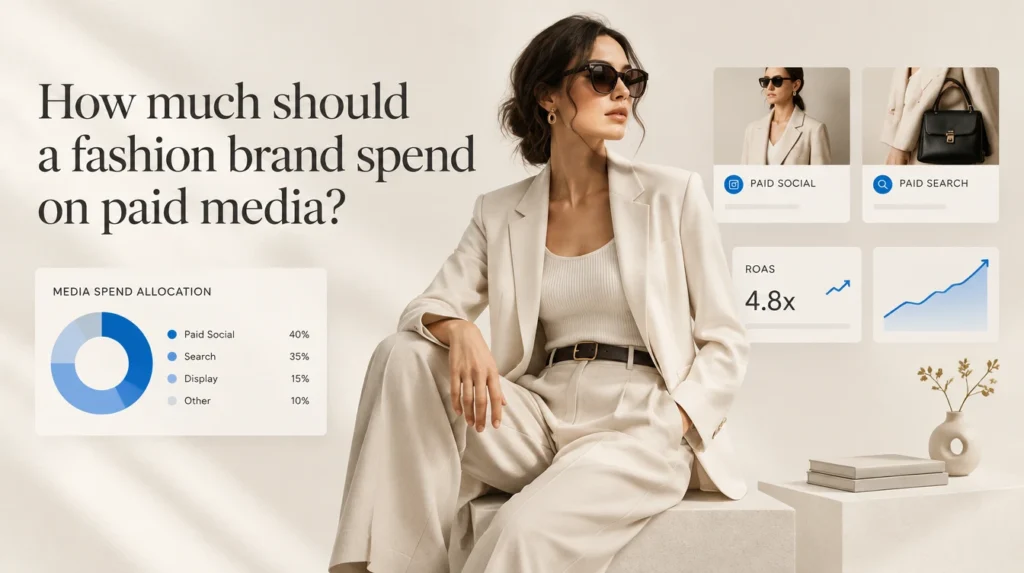
Most Indian DTC fashion brands should allocate 35 to 55 percent of total marketing budget to paid media. US brands often run higher (45 to 65 percent) because paid media is the dominant acquisition channel for US fashion DTC. The constraint isn’t the percentage; it’s whether your CAC-to-LTV math supports the spend level.
Practical starting bands:
- Early-stage DTC under ₹1Cr: ₹50K to ₹2L per month, mostly Meta ASC plus branded Google Search, 1 to 2 creator shoots per quarter feeding paid.
- Growth-stage ₹1Cr to ₹10Cr: ₹2L to ₹10L per month, Meta plus Google Shopping and non-branded Search, TikTok/Pinterest as test channels, weekly creative refresh.
- Scaling ₹10Cr+: ₹10L to ₹50L+ per month, full platform mix with incrementality testing, dedicated creative team producing 15+ concepts monthly.
Spending under ₹500 per day per campaign rarely produces enough signal for Meta’s learning phase to exit. The first month on any new campaign is data collection, not scale.
Which paid media platforms work best for fashion brands?
Meta carries most of the paid-media weight for fashion in both India and the US. Google Search and Shopping handle high-intent demand. TikTok is primary for US fashion acquisition and growing in India post-rollback. Pinterest matters disproportionately for aesthetic categories (womenswear, home, bridal, accessories). Snapchat and connected TV remain tertiary for most fashion brands under $5M ARR.
| Platform | Primary role for fashion | Typical ROAS band (DTC) | India weight | US weight |
|---|---|---|---|---|
| Meta (FB + IG) | Acquisition + retargeting | 2.0 to 4.5x blended | Primary | Primary |
| Google Search + Shopping | High-intent demand capture | 3.0 to 8.0x on branded; 1.5 to 3.5x non-branded | Primary | Primary |
| TikTok Ads | Short-form video acquisition | 1.5 to 3.5x | Growing | Primary |
| Pinterest Ads | High-intent aesthetic discovery | 2.0 to 4.0x | Secondary | Strong secondary |
| Snapchat Ads | Gen Z acquisition | 1.2 to 2.5x | Minor | Tertiary |
ROAS bands are blended across prospecting and retargeting at mid-funnel maturity. Early-stage brands run lower; brands with strong catalog ads and retargeting infrastructure run higher.
What mistakes kill fashion paid media ROI?
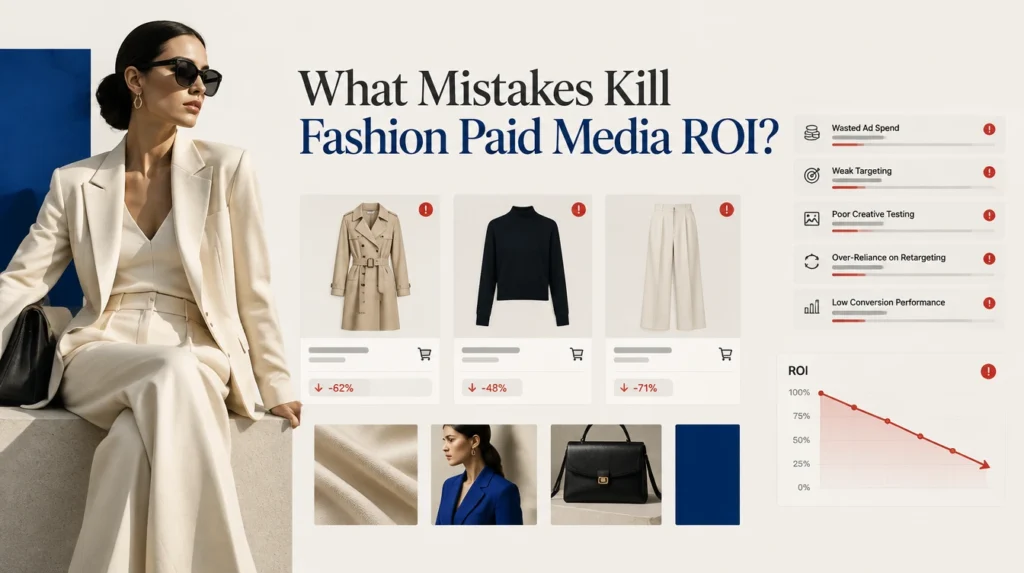
Six mistakes account for most of the preventable ROI damage in fashion paid media.
Boosting Instagram posts from the app. Boosted posts are a donation to Meta. You get no audience control, no proper optimization goal, no catalog, no retargeting integration. Use Ads Manager or hire someone who does.
Running one hero ad for 60+ days. Fashion creative decays fast. By week 4 most ads are losing 15 to 30 percent of their initial CTR. Fresh creative weekly keeps CPMs down and prevents the audience from banner-blind-ing your ads.
Trusting platform-reported ROAS without incrementality. Meta and Google both overclaim. If you haven’t tested incrementality, your real ROAS is likely 30 to 50 percent below what the dashboard shows.
Running without Conversions API or server-side tracking. Post-iOS 14.5, in-platform signal is weaker. Brands skipping CAPI (Meta’s Conversions API) see 20 to 40 percent less event data, which means worse optimization and higher CPAs.
Ignoring product feed quality. Catalog ads only work if the feed is clean. Missing images, wrong categories, out-of-stock items showing as in-stock, bad GTINs, these quietly tank performance before you notice.
Allocating budget by last-click revenue. Last-click credits the final touchpoint and ignores everything upstream. Shifting budget by last-click starves awareness channels that actually drive the pipeline.
How do you measure fashion paid media ROI accurately?
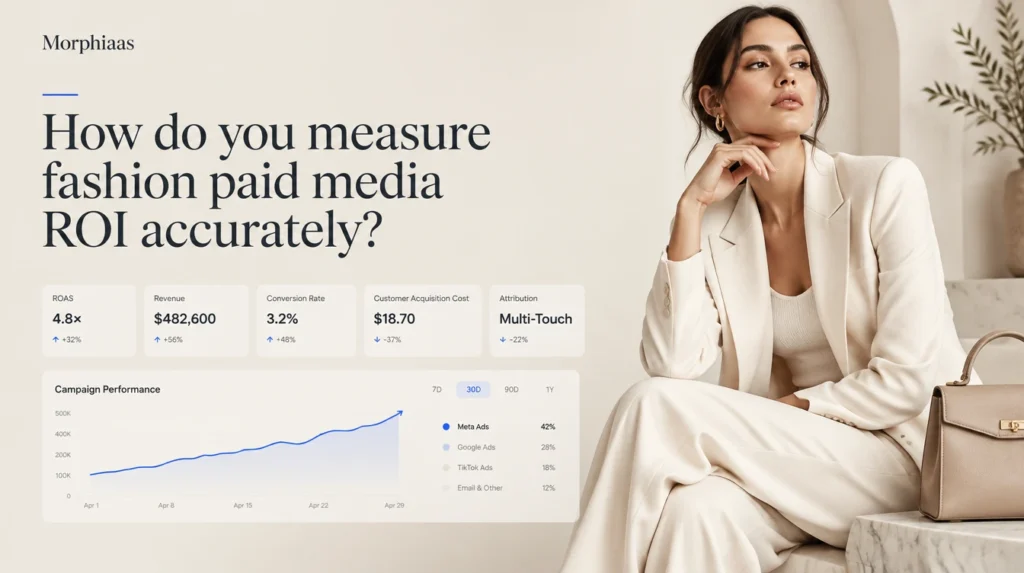
Measure fashion paid media across three tiers: platform-reported ROAS (what Meta or Google claims), blended ROAS (total revenue divided by total paid spend), and incremental ROAS (what spend actually added versus a holdout). The gap between the three tells you how much to trust the dashboards.
Four numbers deserve weekly review. Blended marketing efficiency ratio (total revenue divided by total paid spend). CAC on new customers only. 30-day repeat rate on paid-acquired customers. Platform-reported ROAS versus blended ROAS gap. The first catches top-line efficiency, the second catches targeting problems, the third catches product-market-fit problems, and the fourth catches attribution inflation.
Most fashion brands measure platform-reported ROAS and nothing else. Expand measurement before expanding spend. We’ve seen Delhi and Houston fashion brands cut 30 to 40 percent of their Meta budget after a geo-lift test showed the top-of-funnel campaigns weren’t incremental, and total revenue stayed flat.
Ready to improve your fashion brand's paid media ROI?
If your fashion brand is spending on paid media without a measurement framework, start with a paid-media audit before changing anything else. Morphiaas runs a Fashion Paid Media Audit for Indian and US DTC fashion operators. It covers campaign structure review, creative concept diversity analysis, catalog and feed health check, tracking setup audit (pixel, CAPI, server-side GTM), platform-mix assessment, and a prioritised list of the three fixes that will move ROI fastest in the next 60 days.
Book your audit and we’ll deliver the walkthrough within 5 working days.
Frequently asked questions
What is a good ROAS for a fashion brand?
Depends on margin, LTV, and funnel stage. Blended ROAS targets for most fashion DTC brands run 2.5 to 4.5x. Brands with 70 percent gross margin and strong repeat rates can scale profitably at 2.0 to 2.5x blended. Brands with 40 percent gross margin need 4x or higher. Judge ROAS against contribution margin, not a universal number.
How many ad creatives should a fashion brand test per week?
3 to 5 fresh concepts per week is the sweet spot for growth-stage DTC fashion. Below 2 per week, creative fatigue sets in and CPMs rise. Above 7 per week, you dilute learning because no single concept gets enough budget to exit learning phase. Variants (color, headline, hook swap) don’t count as new concepts.
Should a fashion brand run Google Ads or just Meta?
Both. Meta drives acquisition and retargeting at scale. Google Search captures high-intent demand from buyers already looking for your brand or category. Google Shopping and Performance Max feed your catalog into product-grid results. Running only Meta leaves branded demand uncaptured, which competitors buy against your name.
Is TikTok Ads worth it for fashion brands in India?
Growing but secondary as TikTok rebuilds India presence through 2026. For US fashion brands TikTok is now a primary acquisition channel. For India, test with 10 to 15 percent of paid budget once you have content capacity for native TikTok creative. Repurposed Reels underperform natively-shot TikTok content.
How long before a new paid media campaign starts working?
Meta’s learning phase requires about 50 conversion events in 7 days to exit. For most fashion brands that’s 2 to 4 weeks of consistent spend above the daily minimum. First month is data collection and signal building. Judging a campaign by week 1 results is why most fashion brands kill winners before they scale.