Morphiaas
  • Home
  • Services +
  • Industries +
  • About Us
  • Experience
  • Insights
Get in touch ↗
What we do SEO + Branding + Paid Media + Social Media + E-Commerce + Web Designing +
Featured

Six capabilities. One P&L.

Hover any service to see how it plugs into a revenue-accountable engine.

Who we serve Real Estate + Car Dealerships + Retail + Food & Drink + Fashion + Luxury Marketing + Hospitality + Hotels & Travels + B2B Industry + Beauty & Skincare + Interior Design +
Featured

Eight verticals. One playbook.

Hover any industry to see how the Morphiaas engine adapts to its category.

Menu
  • Home
    • SEO
    • Branding
    • Paid Media
    • Social Media
    • E-Commerce
    • Web Designing
    • Real Estate
    • Car Dealerships
    • Retail
    • Food & Drink
    • Fashion
    • Luxury Marketing
    • Hospitality
    • Hotels & Travels
    • B2B Industry
    • Beauty & Skincare
    • Interior Design
  • About Us
  • Experience
  • Insights
Get in touch ↗

Social Media Marketing for Fashion Brands That Drives Sales in 2026

HomeDigital Marketing Social Media Marketing for Fashion Brands That Drives Sales in 2026
October 22, 2026 by Aman Murmu Digital Marketing
Fashion models showcasing contemporary styles for a fashion social media marketing campaign focused on engagement and sales in 2026.

Social media marketing for fashion brands is the system that turns Instagram, TikTok, and Pinterest attention into product discovery, brand recall, and direct sales. Fashion brands win on social when aesthetic, content format, and commerce setup work as one connected engine, not three separate workstreams.

Seven moves carry the growth weight: aesthetic positioning, short-form video, UGC and creator content, community engagement, social commerce setup, posting cadence tied to content hit rate, and paid-social amplification of what already works organically.

Key takeaways

  • Reels and short-form video drive 2 to 4x the engagement of static posts for fashion brands.
  • UGC and creator-shot content outperform studio content on cold paid social. One good shoot can feed both organic and paid.
  • Posting cadence matters less than content hit rate. 3 strong posts per week beat 7 forgettable ones.
  • Social commerce (Instagram Shop, TikTok Shop) shifts social from awareness-only to direct revenue when set up properly.
  • Measurement needs to tie social activity to revenue, not followers or likes. Vanity metrics hide what’s actually working.

What is social media marketing for fashion brands?

Fashion models showcasing contemporary streetwear in a social media marketing campaign featuring digital content creation.

Social media marketing for fashion brands is the connected set of decisions that governs how a fashion brand builds presence, engagement, and sales across Instagram, TikTok, Pinterest, and YouTube Shorts.

It covers content strategy, creator partnerships, social commerce setup, community engagement, paid-social amplification, and measurement that links social activity to revenue.

The discipline sits apart from paid social ads alone. Social media marketing covers everything you build organically plus the paid layer that amplifies it.Fashion brands that treat the two as separate silos miss the leverage of using organic content as paid creative, and vice versa.

Why does social media marketing matter for fashion brands in 2026?

Fashion models and a content creator using social media to showcase contemporary fashion and engage online audiences.

It matters because fashion discovery happens on social before it happens anywhere else. Buyers scroll Instagram and TikTok, see something they didn’t know they wanted, save it, and buy. Fashion brands without a strong social presence lose that discovery moment to competitors who show up where buyers already spend attention.

Two shifts matter most this year. Short-form video now carries the majority of fashion discovery, and brands running only static posts miss the format where new audiences find them. And social commerce (Instagram Shop, TikTok Shop, Pinterest Shopping) has matured enough that in-platform checkout now converts for fashion brands at rates comparable to direct website traffic.

Morphiaas, a performance marketing agency serving India and the US, works with fashion brands across both markets and runs its own in-house men’s athleisure brand based in Houston. Managing creative, cadence, and commerce for that account changes how we see client fashion social media work. The brands that grow are the ones treating social as a measurable revenue channel, not a mood board.

What are the 7 ways to increase engagement and sales on social media for fashion brands?

Fashion models and a content creator showcasing social media marketing strategies to increase engagement and sales for fashion brands.

Seven moves carry the social media growth weight for most fashion brands in India and the US. Each one maps to a measurable outcome: engagement rate, follower-to-customer conversion, social commerce revenue, or paid-social CPM. Content and creative first, measurement last. Everything in between stacks on those two.

1. Lock aesthetic positioning before posting anything

A fashion brand’s social presence lives or dies on aesthetic consistency. Scrolling your grid, your Reels tab, and your tagged photos should feel like one brand, not three. Brands with a clear aesthetic earn saves (the strongest Instagram signal in 2026) and attract the right followers, which lowers paid-social CPMs down the line.

Document the aesthetic: color palette, photography style, typography on text posts, caption voice, and the kinds of content you’ll never post. For founders who show up in content, our personal branding for fashion founders piece covers how the founder’s own presence folds into brand aesthetic without overshadowing it.

2. Make Reels and short-form video the content engine

Reels and short-form video drive 2 to 4x the engagement of static posts for fashion in 2026. Instagram’s algorithm has openly prioritized Reels for discovery. The same creative serves TikTok and YouTube Shorts, so one shoot feeds three channels. Static posts still matter for the grid aesthetic, but video does the acquisition work.

Our deeper breakdown on fashion Reels marketing strategy covers posting cadence, hook structures, and the formats that actually convert. For technical setup, see Instagram’s official Reels business documentation.

3. Build UGC and creator pipelines systematically

User-generated content and creator partnerships produce higher engagement than studio-shot content for fashion specifically. Diners want to see real plates. Fashion buyers want to see real bodies, real styling, real wear. Studio shots look polished but don’t earn trust at the same rate.

Build the pipeline in waves. Seed 20 to 40 micro-creators per quarter with no mandatory post requirement. Repost tagged content from existing customers (with permission). Pay for sponsored content with the top 20 percent whose organic posts perform. Earned content doubles as paid-social creative, which pays back the seeding cost twice.

4. Reply to comments and DMs within 24 hours

Community engagement is the undervalued half of fashion social media. Brands that reply to comments and DMs within 24 hours see higher follower growth, higher save rates, and higher repeat purchase from engaged followers. Instagram’s algorithm weighs reply time as a signal.

And it’s not just the algorithm. A buyer who DMs you about sizing and gets a thoughtful reply within an hour converts at 3 to 5x the rate of someone who waits a day. Set up Instagram’s Quick Replies for common questions (sizing, shipping, returns), use saved responses on complex ones, and dedicate a founder or team member to DMs during peak scrolling hours.

5. Set up Instagram Shop and TikTok Shop for in-platform conversion

Social commerce turns social media from an awareness channel into a direct revenue channel. Instagram Shop lets US buyers check out inside the app on tagged products. TikTok Shop (now live in India as of 2026 limited rollout, broader in the US) does the same with native checkout. In-platform conversion rates for fashion often beat website-redirect rates because the friction is lower.

Tag products in every Reel, carousel, and story where it’s natural. Sync your Shopify catalog so inventory stays accurate. Enable Instagram Checkout in regions where it’s available. For technical setup, Meta’s Instagram Shopping documentation covers the eligibility and catalog requirements.

6. Run posting cadence tied to content hit rate, not blind consistency

Posting cadence matters less than most fashion brands think. 3 strong posts per week beat 7 forgettable ones. Instagram’s algorithm rewards content that performs, not accounts that post daily. Brands pumping out mediocre content to hit a cadence target train the algorithm to deprioritize their reach.

Posting daily on a brand that has nothing distinctive to say is a vanity exercise. Track content hit rate (percentage of posts that outperform your account average on saves, shares, and reach) rather than post count. A hit rate above 30 percent is strong. Below 15 percent, you’re training the algorithm to show you less.

7. Amplify winning organic posts with paid social

The highest-leverage paid-social play for fashion is amplifying posts that already won organically. If a Reel pulled 2x your average reach and 3x your average saves organically, it’s a signal that the creative resonates. Boost it to a cold audience and watch cost-per-click drop below studio-shot ad averages.

Set up Meta’s Advantage+ Creative (automated creative optimization) once you have 5 to 10 winning organic posts to feed it. Rotate winners every 2 to 4 weeks because fashion creative decays faster than most categories. Our broader take on paid-social fits into fashion digital marketing strategy for how social and paid stack across the full funnel.

What formats and content themes are growing fastest for fashion brands right now?

Four formats are pulling disproportionate reach and saves for fashion brands in late 2026.

Styling videos (30 to 60 seconds). One piece worn five ways, shot in one take. Carries higher save rates than any other format because it demonstrates versatility, which is the core buying objection for mid-price fashion.

Behind-the-scenes production and founder-led content. Buyers want to see the shoot, the fabric, the maker, the founder. Trust content outperforms polished editorial on cold reach for emerging fashion brands.

Trend-reactive Reels with original audio. Using trending audio within 48 hours of its break still produces 2 to 3x the reach of evergreen content. Brands that react fast to format trends (grid flips, split-screen before and after, text-on-video styling reveals) stay in discovery.

UGC-style phone-shot content. Vertical, hand-held, minimal editing. Reads as authentic and performs better on cold paid-social than studio content. The lower the production value, the higher the trust signal for a certain cohort of buyers.

Static carousels still earn saves for styling guides and capsule wardrobe breakdowns, but short-form video now carries 70 percent of discovery for fashion. Brands still weighting content production toward static are training the algorithm against themselves.

How do you run social media promotions for fashion products?

Fashion promotions on social work differently from generic DTC discount campaigns. Buyers respond to scarcity, exclusivity, and styled context, not blanket price cuts.

Five rules govern fashion promotions on Instagram and TikTok in 2026:

Lead with styling, not the discount. The hero creative shows the product worn, styled, in context. Price drop lives in the caption and the on-image sticker, never as the sole creative hook.

Use scarcity windows under 72 hours. Flash drops, limited restocks, and 48-hour sales produce higher conversion than week-long promos because urgency compresses decision time. Pair with countdown stickers in stories.

Reserve the strongest discounts for DM subscribers and close-friends lists. Exclusive access converts better than public promos and trains buyers to follow and engage for future drops.

Bundle over discount. For premium and mid-premium fashion, bundle pricing (buy the look, three-piece capsule, free shipping over threshold) protects margin better than straight percentage-off. Protects brand positioning too.

Stack UGC with the promotion. Repost creator and customer content wearing the discounted product during the window. Social proof during a sale lifts conversion 20 to 40 percent versus brand-only creative.

For brands under ₹2Cr revenue, run one major promotion per quarter, two seasonal drops, and leave the rest of the calendar to full-price community and discovery content. Over-discounting trains buyers to wait for sales and compresses lifetime margin.

How can fashion brands grow on social media without heavy paid spend?

Organic growth for fashion brands is not a budget problem. It is a distinctiveness problem. Brands with a clear aesthetic, a founder who shows up on camera, and consistent creator seeding grow follower-to-customer conversion above average on near-zero paid spend.

Four moves produce measurable growth at low paid budgets:

Founder-led content on 2 Reels per week. Founders talking about why a product exists, how it was made, or what buyers get wrong carry authority that studio content cannot buy. Costs nothing beyond time.

Seed micro-creators under 10K followers. Send product to 20 to 40 micro-creators per quarter with no mandatory post requirement. Expect 30 to 50 percent to post organically. The content doubles as paid-social creative later if you choose to scale.

Community engagement over broadcast. Reply to every comment and DM for the first 500 followers. Reply to as many as physically possible beyond that. Instagram weighs reply rate as an algorithmic signal and DM conversations convert at 3 to 5x the rate of cold website traffic.

Pin trending Reels to the top of the profile. New visitors land on the top three pinned posts. Pin the Reel with the highest save rate, the clearest brand aesthetic statement, and the strongest CTA. Rotate every 30 to 60 days.

Brands under ₹50L in revenue can reach ₹1 to ₹2Cr on organic-first strategy alone if the aesthetic, content cadence, and creator pipeline are tight. Paid-social becomes a multiplier once the organic engine proves out, not a substitute for it.

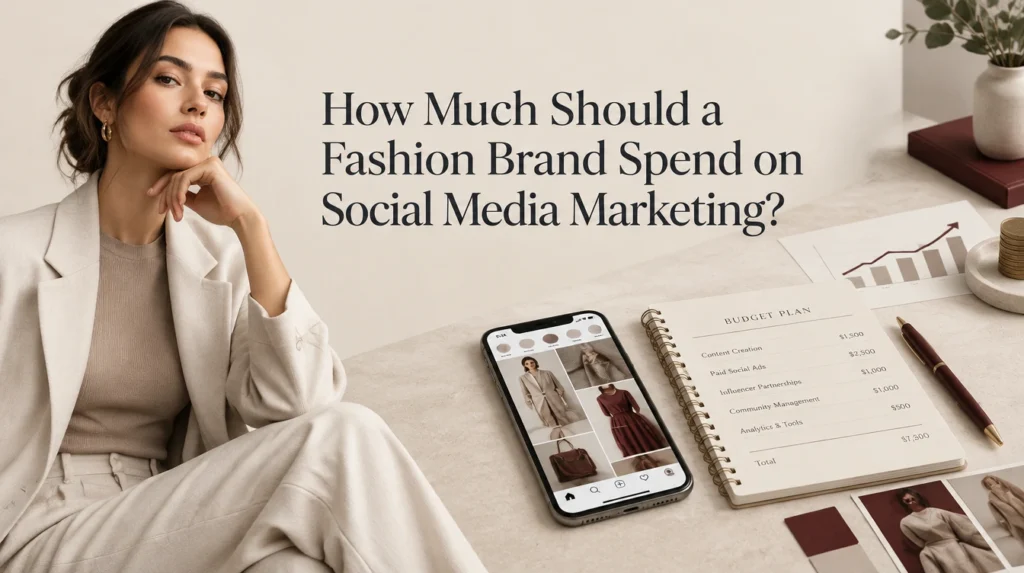
How much should a fashion brand spend on social media marketing?

Fashion model and digital marketing workspace illustrating social media budget planning for fashion brands.

Most Indian DTC fashion brands should allocate 25 to 45 percent of their total marketing budget to social media (organic content, creator partnerships, paid-social amplification). US brands often run higher (30 to 50 percent) because social is the dominant acquisition channel for US fashion DTC in 2026.

Practical starting bands:

  • Early-stage DTC under ₹1Cr: ₹40K to ₹1.5L per month, 60% paid-social, 25% creator seeding, 15% content production.
  • Growth-stage ₹1Cr to ₹10Cr: ₹1.5L to ₹8L per month, 55% paid-social, 25% creator partnerships, 20% content production and community.
  • Scaling ₹10Cr+: ₹8L to ₹40L+ per month, broader mix with always-on creator program and dedicated in-house content team.

Spend under ₹500 per day on paid-social rarely produces enough signal for Meta’s Advantage+ to optimize well. First month is data collection, not scale.

Which platforms matter most for fashion brands in India and the US?

Instagram carries most of the weight for both Indian and US fashion DTC. TikTok dominates the US market and is growing fast in India (post-ban-rollback). Pinterest matters more than most brands realize because it drives high-intent, long-session discovery for aesthetic and occasion-driven buyers. YouTube Shorts and Snapchat sit in secondary layers.

PlatformPrimary role for fashionBest content formatIndia weightUS weight
InstagramPrimary discovery + commerceReels, carousels, StoriesPrimaryPrimary
TikTokTrend discovery + social commerceShort-form video, livesGrowingPrimary
PinterestHigh-intent discovery, lookbooksPins, Idea Pins, product tagsSecondaryStrong secondary
YouTube ShortsDiscovery via creator contentShort-form videoSecondarySecondary

Pick two primary platforms, two secondary, and ignore the rest. Fashion brands trying to be on everything spread content thin and win nowhere.

How should fashion brands use Pinterest in 2026?

Pinterest is the most under-used discovery channel in fashion. Buyers on Pinterest search with intent (occasionwear, capsule wardrobes, seasonal styling) and sessions last 3 to 5x longer than Instagram scrolls. For fashion brands building long-tail discovery and evergreen traffic, Pinterest compounds in a way Instagram does not.

Four moves carry the Pinterest weight for fashion:

Build lookbooks around search terms, not collections. Pinners search “winter outfits India”, “office wear for women”, “wedding guest dresses”. Build boards and Idea Pins around search intent, not seasonal drops. One lookbook per theme, updated monthly.

Enable Pinterest Shopping and tag products in every Pin. Pinterest Shopping syncs your Shopify catalog and makes every Pin shoppable. Tagged Pins show pricing and in-stock status inline, which lifts click-through to product pages by 30 to 60 percent.

Repurpose Reels as Idea Pins. Vertical video performs well on Pinterest Idea Pins. One Reels shoot can feed Instagram, TikTok, YouTube Shorts and Pinterest without new production.

Target occasion-driven keywords. “Diwali outfit ideas”, “resort wear”, “bridesmaid dresses”, “work from home outfits”. Pinterest rewards specific occasion language the way Google rewards long-tail keywords.

What mistakes do fashion brands make on social media?

Six mistakes account for most of the preventable damage in fashion social media marketing.

Posting daily without a content hit rate target. Mediocre content trained to hit a schedule teaches the algorithm to deprioritize your reach. Track hit rate; adjust cadence to the volume of strong content you can actually produce.

Running only studio-shot content. UGC and creator content outperform polished studio production on cold paid-social. Keep studio for the grid aesthetic but let real-wear content do the acquisition work.

Ignoring DMs and comments. Response time is both an algorithm signal and a conversion driver. Setting up Quick Replies in Instagram takes 10 minutes and recovers hours per week.

Skipping product tags. Every Reel, carousel, and story with a visible product should be tagged. Untagged content loses discovery through Instagram Shop and in-platform checkout opportunities.

Chasing celebrities before product-market fit. One celebrity post costs more than 50 micro-creator seeded shoots. Micro-creators produce measurable sales. Celebrities buy awareness that rarely converts for mid-tier fashion brands.

Measuring followers instead of revenue. Follower growth is a vanity metric. Social-attributed revenue, saves per post, and DM-to-order conversion rate tell you what’s actually working.

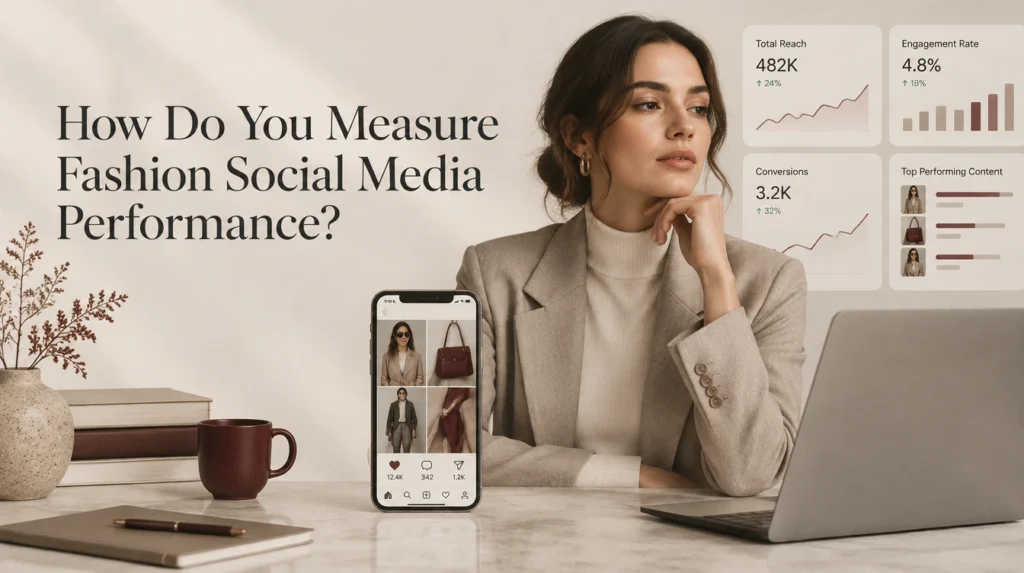
How do you measure fashion social media performance?

Fashion model and social media analytics dashboard illustrating how fashion brands measure engagement, reach, and conversions.

Measure fashion social media across three tiers: engagement signals (saves, shares, comment quality), discovery signals (reach to non-followers, follow conversion rate), and revenue signals (social-attributed revenue, social commerce orders, DM-to-order conversion). Running weekly on all three catches problems before they compound.

Three numbers deserve weekly review. Content hit rate (percentage of posts above account average). Social-attributed revenue trailing 30 days. Follow-to-order conversion rate. The first catches creative problems. The second catches funnel problems. The third catches targeting problems.

Most fashion brands measure follower count and like count. Both are useless. Shift to saves (highest-intent engagement for fashion), shares (algorithmic amplification), and social-attributed revenue (what the business actually cares about).

What should a fashion brand do this week?

If your fashion brand is posting without a clear strategy, start with a diagnostic before changing anything else. Morphiaas runs a Fashion Social Media Diagnostic for Indian and US DTC fashion operators. It covers a content audit of your last 90 days, platform mix review, creator partnership assessment, Instagram Shop and TikTok Shop setup check, and a prioritised list of the three fixes that will move engagement and sales fastest.

Book your diagnostic and we’ll deliver the walkthrough within 5 working days.

Frequently asked questions

What social media formats are growing fastest for fashion brands in 2026?

Styling videos (one piece worn multiple ways), behind-the-scenes production content, trend-reactive Reels with original audio, and UGC-style phone-shot content are outperforming studio editorial for fashion brands in late 2026. Short-form vertical video now drives roughly 70 percent of fashion discovery on Instagram and TikTok. Static carousels still earn saves for styling guides and capsule breakdowns, but video carries acquisition weight.

How do you run social media promotions for fashion products?

Lead the creative with styling, not the discount. Use scarcity windows under 72 hours. Reserve the strongest discounts for DM subscribers and close-friends lists. Bundle over flat percentage-off to protect margin and brand positioning. Stack UGC and creator content with the promo during the window for social proof. For brands under ₹2Cr revenue, run one major promotion per quarter and leave the rest of the calendar to full-price community content.

What’s working for fashion brands trying to grow without heavy paid spend?

Four moves produce measurable growth at low paid budgets: founder-led content (2 Reels per week with the founder on camera), seeding 20 to 40 micro-creators per quarter with no mandatory post requirement, replying to every comment and DM for the first 500 followers, and pinning the highest-saving Reel to the top of the profile. Brands under ₹50L revenue can reach ₹1 to ₹2Cr on organic-first strategy if aesthetic, cadence, and creator pipeline are tight.

Should Indian fashion brands prioritise Instagram Reels or TikTok?

Instagram Reels for now. TikTok is growing in India post-rollback but Reels still carries the majority of fashion discovery weight for Indian DTC in 2026. Build TikTok as a secondary channel if your audience skews under 25 and you have content capacity to repurpose. For brands under ₹5Cr revenue, focus production energy on Reels first and cross-post the strongest performers to TikTok without new shoots.

How often should a fashion brand post on Instagram?

3 to 5 posts per week across formats (Reels, carousels, stories) with a content hit rate target above 30 percent beats posting daily with mediocre content. The algorithm rewards performance, not frequency. If you can’t produce 5 strong posts per week, drop to 3 and make them hit.

What’s the minimum monthly social media budget for a growing fashion brand?

Practical floor for Indian fashion DTC is ₹40K to ₹60K per month covering paid-social (₹25K to ₹35K), creator seeding product costs (₹10K to ₹15K), and basic content production (₹5K to ₹10K). Below ₹500 per day on paid-social, Meta’s Advantage+ struggles to gather enough signal to optimise. US fashion DTC baseline runs $1,500 to $2,500 per month on the same split. Under these floors, organic-first strategy produces more growth per rupee than underfunded paid campaigns.

How much should a fashion brand spend on creators versus paid-social?

A workable split for most growth-stage fashion brands: 55 to 60 percent paid-social, 20 to 25 percent creator partnerships, 15 to 20 percent content production and community management. The ratio shifts as creator-produced content starts feeding paid-social campaigns, which blurs the line between the two budgets.

Should fashion brands run social media in-house or hire an agency?

Depends on scale. Fashion brands under ₹2Cr revenue often do better with a hybrid (founder-led content, agency-supported paid and creator partnerships). Between ₹2Cr and ₹20Cr, a dedicated in-house social lead plus agency execution tends to work. Above ₹20Cr, in-house makes economic sense with specialist agency support on creator strategy and paid-social scaling.

Is TikTok Shop worth setting up for Indian fashion brands in 2026?

Worth setting up only if TikTok itself is already a meaningful channel for your brand. TikTok Shop is in limited rollout in India as of late 2026 with native checkout and product tagging live for approved merchants. For brands whose audience skews under 25 and who already produce 5+ TikTok videos per month, enabling Shop lifts in-platform conversion because it removes the website redirect friction. For brands still building TikTok presence, prioritise Instagram Shop first and layer TikTok Shop once TikTok drives more than 20 percent of social traffic.

Share
Prev
Next

© 2021 — Ewebot by GT3Themes. All Rights Reserved.