

SEO for fashion brands is the practice of making your product pages, category pages, and content retrievable in Google and AI search for the queries your buyers actually type. For DTC fashion brands, it covers technical foundations, Product schema, category-page optimization, link building, and content built around aesthetic and style queries that paid social can’t economically target.
Key takeaways
- Fashion SEO is less about blog content and more about product and category page optimization. That’s where the buyer-intent traffic lives.
- Technical foundations (mobile speed under 2.5 seconds, Product schema, crawlable architecture) are the floor. Everything else fails without them.
- Long-tail style and occasion queries convert 3 to 5x better than head terms. “Linen co-ord set for women under 3000” beats “women’s clothing” every time.
- SEO compounds while paid media doesn’t. Year 2 is when the economics flip in SEO’s favor for most fashion brands.
- Google Shopping, SEO, and AI search optimization need to run together, not separately. One site serves all three.
What is SEO for fashion brands?
SEO for fashion brands is the full set of technical, on-page, content, and off-page work that gets a fashion brand’s product and category pages ranking in Google organic results and AI search for buyer-intent queries. It covers Product and CollectionPage schema, Core Web Vitals performance, keyword mapping to catalog structure, backlink building, and content clusters around styling and buying occasions.
The discipline sits apart from fashion content marketing. Content marketing targets top-of-funnel awareness. SEO targets middle and bottom-of-funnel buyers already searching with intent. Both matter, but for a growing fashion brand under ₹10Cr revenue, the SEO work on product and category pages produces faster ROI than blog content.
Why does SEO matter for fashion brands in 2026?

SEO matters because Meta CPMs keep climbing while fashion margins stay thin. Brands that depend only on paid social run on borrowed traffic. SEO builds owned traffic that compounds. A fashion brand with 50 well-optimized product pages ranking for long-tail queries can save ₹2L to ₹10L per month in equivalent paid acquisition spend by year 2.
Two shifts matter most this year. Google’s Core Web Vitals have become a stronger ranking signal, which punishes slow Shopify themes with heavy apps. And AI search (ChatGPT, Perplexity, Gemini, Google AI Overviews) now carries a measurable share of fashion research queries. Brands optimized for both Google organic and AI retrieval capture traffic that single-channel-optimized competitors miss.
Morphiaas, a performance marketing agency serving India and the US, works with fashion DTC brands where the gap between well-run and poorly-run SEO shows up in year 2 contribution margin. Paid-only brands plateau. SEO-plus-paid brands keep growing with falling blended CAC.
What are the 7 proven strategies to increase organic traffic for a fashion brand?

Seven strategies carry the organic growth weight for most fashion brands in India and the US. Each one maps to a measurable outcome: indexed pages, keyword rankings, click-through rate, or conversion. Technical first, content last. Everything in between stacks on those two.
1. Fix the technical foundation before anything else
The technical foundation decides whether Google can crawl, render, and index your fashion site efficiently. Mobile load time under 2.5 seconds, Core Web Vitals in the green, clean URL architecture, and no indexing bloat from faceted filters. Fashion sites fail here because Shopify apps stack weight and filters create thousands of thin pages.
Google’s Core Web Vitals guidance covers the thresholds. Audit app weight quarterly, noindex faceted filter URLs, compress hero images under 150KB. Those three moves recover indexability on most fashion Shopify sites.
2. Optimize product pages with Product schema and buyer-intent copy
Product pages are the highest-converting pages on a fashion site. They should carry Product schema (name, image, description, offers, aggregateRating, review), unique product descriptions written for buyer intent, inline reviews visible on-page, and clear sizing information. Thin product pages with manufacturer-copy descriptions never rank.
Every product page needs a target long-tail query mapped to it. A linen midi dress product page shouldn’t try to rank for “women’s dresses.” It should rank for “beige linen midi dress with pockets” and similar specific queries. See Google’s Product structured data documentation for the exact schema fields that matter.
3. Build category and collection pages as SEO assets, not just filters
Category and collection pages carry more SEO weight than most fashion brands realize. They target the mid-funnel queries (“women’s co-ord sets”, “cotton kurtas”, “men’s athleisure joggers”) that convert well because the buyer has narrowed intent but not committed to a specific product.
The high-leverage moves: write 150 to 300 words of unique category copy above or below the product grid, add CollectionPage schema, link to subcategories through descriptive anchor text, and avoid empty collection pages. Most Shopify themes skip these by default, which is why they’re the fastest wins.
4. Target long-tail style, occasion, and aesthetic queries
Long-tail queries convert 3 to 5x better than head terms in fashion. Buyers searching “white co-ord set for brunch” or “ethical cashmere sweater for men” are closer to purchase than buyers searching “women’s clothes” or “sweaters.” They also face less competition from mass retailers.
Map long-tail queries to specific pages. Style queries (“boho maxi dress for beach vacation”) map to product or collection pages. Occasion queries (“wedding guest outfit under 5000”) map to collection pages with mixed inventory. Aesthetic queries (“quiet luxury pieces for women”) map to editorial content.
5. Create aesthetic-led content hubs that earn links and rank
Content hubs for fashion aren’t blog archives. They’re editorial collections built around aesthetics, trends, or buying occasions. Lookbooks, style guides, trend reports, and gift guides earn backlinks from fashion publications and creators, and rank for high-volume aspirational queries that product pages can’t target.
Build 2 to 4 cornerstone content pieces per quarter around themes your brand actually owns. A minimalist womenswear brand runs a quiet luxury trend report. A premium menswear brand runs an occasion guide for weddings. A sustainable fashion brand runs ingredient and sourcing explainers. Each piece earns links and feeds internal linking back to product pages.
6. Build backlinks through editorial coverage, creator partnerships, and digital PR
Backlinks remain one of the top ranking signals in Google. Fashion brands earn them through editorial coverage in fashion publications, creator collaborations that produce linked press, digital PR campaigns tied to data releases, and brand partnerships. Buying links from directories still doesn’t work and risks penalties.
The underrated tactic is creator-produced blog content on their own sites, where creators link back to your brand page as part of a review or styled shoot. Mid-tier creators (50K to 500K) often have websites with real domain authority, and a dozen such links beats one celebrity Instagram post for SEO value.
7. Optimize for AI search alongside Google
AI search optimization makes your brand retrievable and citable by ChatGPT, Perplexity, Gemini, and Google AI Overviews. The core moves are structured data (Product, FAQPage), entity clarity through consistent naming across the web, direct-answer paragraphs AI engines can lift verbatim, and third-party mentions that give AI engines verifiable signals.
For fashion specifically, AI engines carry a growing share of discovery queries like “best sustainable denim brands India” or “ethical cashmere brands USA.” Fashion brands that get cited in these answers capture high-intent traffic their competitors never see.
How much should a fashion brand invest in SEO?
Most Indian DTC fashion brands should allocate 10 to 20 percent of their total marketing budget to SEO (technical, content, link building, measurement). US brands often run higher (15 to 25 percent) because the long-term CAC savings compound further. The specific number depends on growth stage.
Practical starting bands:
- Early-stage DTC under ₹1Cr: ₹20K to ₹60K per month on SEO fundamentals (technical cleanup, product-page optimization, 2 to 3 content pieces monthly).
- Growth-stage ₹1Cr to ₹10Cr: ₹75K to ₹2L per month on full SEO ops (technical, content, link building, AI search optimization).
- Scaling ₹10Cr+: ₹2L to ₹8L+ per month including digital PR, international SEO if expanding, and dedicated content team.
SEO investment pays back slower than paid media. First meaningful results show up in month 4 to 6. The compounding advantage appears in year 2 when organic traffic covers a growing share of total acquisition at zero marginal cost.
How is SEO for fashion brands different from SEO for other verticals?
Fashion SEO differs from other verticals in three ways. The catalog is larger and changes faster, which creates indexation and content-freshness challenges. Buyer queries are more aesthetic and occasion-driven than purely functional. And visual search (Google Lens, Pinterest) carries meaningful discovery weight that other verticals rarely need to optimize for.
| Dimension | Fashion SEO | General e-commerce SEO |
|---|---|---|
| Catalog size | 500 to 5,000+ SKUs, changes seasonally | 50 to 500 SKUs, stable |
| Primary content type | Category and lookbook pages | Product pages and comparison blogs |
| Target query type | Aesthetic, occasion, style long-tail | Feature, use-case, model-number queries |
| Visual search importance | High (Google Lens, Pinterest) | Low to medium |
| Content freshness pressure | High (trend cycles, seasons) | Medium |
For a broader framework that connects SEO to the rest of your marketing stack, see our pillar on fashion digital marketing strategy. For a deeper look at how SEO and social media work together, our fashion marketing SEO and social media guide covers the overlap specifically.
What SEO mistakes do fashion brands commonly make?
Six mistakes account for most of the preventable damage in fashion SEO.
Using manufacturer-copy product descriptions. Rewriting 500 products takes effort but is the single highest-ROI SEO move for most fashion brands. Duplicate copy kills indexation.
Ignoring category pages. Shopify themes ship empty category pages. Add 150 to 300 words of unique copy and watch rankings move inside 60 days.
Letting faceted filters create thin pages. Color + size + price filters generate near-duplicate URLs Google treats as low-quality. Noindex them or canonical to the parent collection.
Chasing head terms instead of long-tail. Trying to rank for “women’s clothing” against marketplaces wastes months. Dozens of long-tail wins beat one impossible head term.
Treating SEO and paid search as separate silos. SEO and Google Shopping share product-data signals. Clean Product schema improves both.
Skipping link building entirely. On-page SEO without backlinks caps growth. A brand with 20 editorial mentions and 50 creator links outranks competitors with twice the content and zero links.
How do you measure fashion SEO performance?
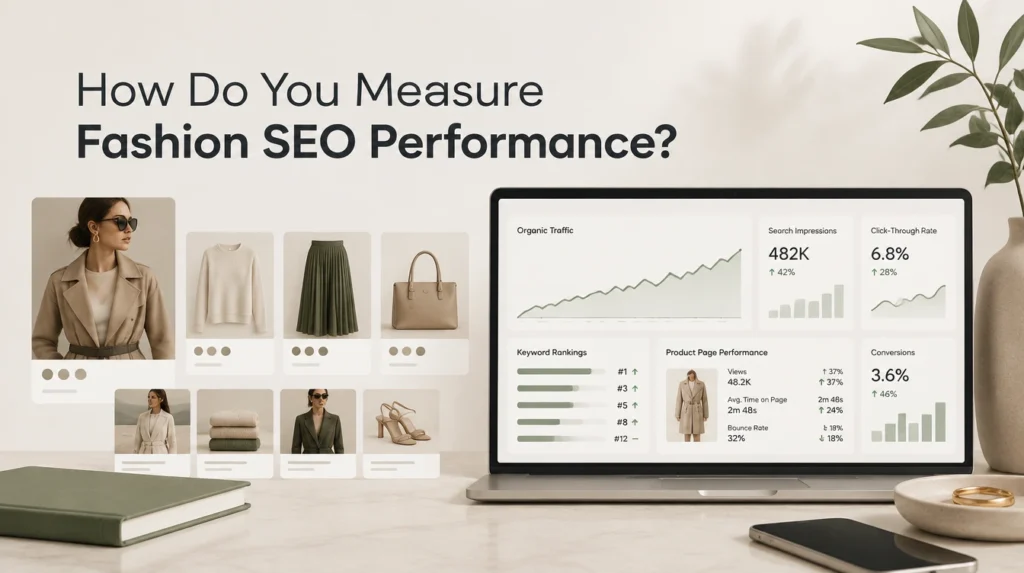
Measure fashion SEO across four tiers: indexation health (indexed pages, crawl errors), ranking visibility (keyword rankings by category), traffic and engagement (organic sessions, bounce rate), and revenue (organic-attributed revenue, SEO CAC vs paid CAC).
Three numbers deserve weekly review: organic sessions trailing 7 days versus previous period, top 20 priority keywords with position change, and organic-attributed revenue trailing 30 days. Search Console gives the first two; GA4 with ecommerce tracking gives the third.
Most fashion brands measure organic sessions alone and miss SEO’s compounding advantage. The right metric is SEO-attributed revenue divided by SEO cost, tracked over 18 months. The curve bends upward around month 9 to 12 for brands running the full playbook.
What should a fashion brand do this week?
If your fashion brand hasn’t audited its SEO foundations, start there before writing any new content. Morphiaas runs a Fashion SEO Diagnostic for Indian and US DTC fashion operators. It covers a technical audit of your top 20 pages, a product-page SEO review, Core Web Vitals assessment, Product schema validation, and a prioritised list of the three fixes that will move rankings fastest.
Book your diagnostic and we’ll deliver the walkthrough within 5 working days. For the broader marketing picture around SEO, our digital marketing for fashion brands page lays out the connected stack.
Frequently asked questions
How long does SEO take to show results for a fashion brand?
Technical fixes often show indexation changes within 2 to 4 weeks. Product and category-page optimization produces ranking shifts in 60 to 120 days. Content and link building compound slower, with meaningful organic traffic lift typically visible in month 4 to 6. Full SEO economics (organic contribution to revenue) peak in year 2.
Is SEO still worth it for fashion brands in 2026 with AI search growing?
Yes. AI search optimization extends traditional SEO rather than replacing it. Google Search still carries most fashion research traffic, and AI engines (ChatGPT, Perplexity, Gemini) weight pages that already rank well in Google. The brands winning in AI search are the ones that invested in SEO foundations first.
Should fashion brands focus on product pages or blog content for SEO?
Product and category pages first, blog content second. Product pages carry buyer-intent traffic that converts. Blog content earns backlinks and ranks for top-of-funnel queries, but conversion rates sit much lower. For a fashion brand under ₹10Cr revenue, fixing product pages produces faster revenue impact than content marketing.
How many backlinks does a fashion brand need?
Quality beats quantity. 50 editorial links from relevant fashion publications and mid-tier creator blogs often outperform 500 directory links. Focus on earning mentions through PR campaigns, creator collaborations, and digital partnerships rather than bulk link acquisition.
Can small fashion brands outrank large marketplaces?
Not on head terms. Yes on specific long-tail queries where marketplaces have thin content. A small Indian brand ranking for “handwoven cotton saree with contrast border” beats marketplaces regularly because the brand has concentrated authority on that specific product space. Marketplaces win breadth. Small brands win depth.