


Fashion e-commerce marketing works when brands run high-volume creative on Meta, cut returns before scaling ad spend, build lifecycle flows across email and WhatsApp, and treat the product page as the real conversion moment. Seven tactics below cover the exact structure Morphiaas uses on its fashion e-commerce accounts in India and the US, with real budget numbers and the sequencing that matters most.
Key Takeaways
- Fashion Meta creative fatigues in 3 to 5 days, so weekly refreshes are the floor, not the ceiling
- A 25 to 40 percent return rate destroys more margin than ad inefficiency does, so fix fit before scaling spend
- Email and WhatsApp lifecycle flows should drive 25 to 35 percent of total revenue by month 6
- UGC and micro-influencer content convert roughly 2x better than brand-shot creative on cold Meta audiences
- Mobile page load under 2.5 seconds is a pricing-tier decision for fashion, because every additional second costs 7 to 10 percent of conversions
Why does fashion e-commerce need its own marketing playbook?

Fashion sells on emotion, fit, and visual newness, which means marketing has to produce new creative weekly, not quarterly. Add returns of 25 to 40 percent, wafer-thin margins after discounts, and a buyer who shops Instagram, Pinterest, and Google in the same session, and the generic DTC playbook breaks fast.
Fashion buyers behave differently from the rest of DTC. They scroll 30 to 50 pieces before buying one, compare across three or four tabs, and often make the final call based on a single Reel or a friend’s WhatsApp forward. The window between discovery and purchase is short, often under 48 hours during launches, which rewards brands that show up in multiple places at once with consistent visual signatures.
Morphiaas, a performance marketing agency serving India and the US, built this seven-tactic framework from running fashion accounts across occasion wear, modest fashion, and premium streetwear verticals. The sequencing matters more than any single tactic.
1. How should a fashion brand structure its Meta ads budget?
Split Meta budget roughly 60 percent cold prospecting, 25 percent retargeting warm audiences, 15 percent lookalike expansion. Run Advantage+ Shopping campaigns for most prospecting creative. The learning phase needs 50 conversions per ad set per week minimum, which puts a Rs 2 lakh (around $2,500) monthly floor on any serious fashion account.
Advantage+ is Meta’s AI-driven campaign type that consolidates targeting and placements into a single simplified setup. Meta’s own case studies, published through their Advantage+ Shopping documentation, show Advantage+ outperforming traditional campaigns on ROAS by 12 to 17 percent for e-commerce advertisers, which matches what we see across fashion accounts.
- Prospecting: Advantage+ Shopping, broad audience, 3 to 5 ad sets running in parallel
- Retargeting: 7-day and 30-day website visitors, abandoned cart, Instagram engagers
- Lookalike: 1 to 3 percent purchase LAL, running separately to cold creative
Budget too far below Rs 2L per month and the algorithm never exits learning. That means wild performance swings and unreliable scaling. It’s the number to plan around before anything else.
2. What role does creative volume play in fashion ad performance?
Creative volume is the single highest-leverage input for fashion Meta ads. Expect to ship 15 to 25 new creatives per week on a scaling account, with roughly 70 percent being minor variations of winning hooks. Brands that refresh monthly see CPM climb 40 to 60 percent over 8 weeks as frequency saturates the audience.
We learned this the expensive way on a Jaipur-based occasion wear account. Their best-performing creative turned out to be a single hand-shot Reel filmed in the founder’s living room that cost Rs 800 to produce. The Rs 40,000 studio shoot sitting next to it in the ad account never beat it on CPA. Not once in six weeks of testing.
Boosted posts are a donation to Meta. Run proper campaigns in Ads Manager with a structured creative testing framework: three hooks, two formats (Reel and static), two offers, every week. Winners move to a scaling campaign. Losers die on day five. Build a library of 200+ pieces over 90 days and the compounding effect on CPA shows up by month three.
3. How do you reduce returns before scaling ad spend?
Returns above 30 percent in fashion signal fit, quality, or expectation problems. Fix the product detail page first with real size charts, measurement guides, model height disclosures, and buyer reviews that mention fit. Scaling ads on a brand with a 40 percent return rate burns 40 percent of your ad spend before it converts to kept revenue.
The math is unforgiving. On a brand doing Rs 10 lakh monthly revenue with 35 percent returns, you’re keeping Rs 6.5 lakh. If each return costs Rs 400 in reverse logistics plus 15 percent of margin on a resell, true kept margin after return handling drops another Rs 1 lakh. Cut returns to 20 percent and that same Rs 10 lakh turnover converts to Rs 7.6 lakh kept, with Rs 80,000 less in reverse-logistics bleed. A 15-point return rate reduction is worth more than a 30 percent ad spend increase at the same CPA.
A proper fashion PDP has nine elements that collectively cut return rates by 8 to 15 percentage points when implemented together.
- Model height, weight, and size worn, stated plainly above the image gallery
- Fabric composition and GSM (grams per square meter) as a weight signal
- Actual garment measurements in a table, not just size labels like S, M, L
- A sitting-down or movement shot alongside the hero image
- Minimum 10 reviews that specifically mention fit
- Size recommendation widget or a “runs small / true / large” indicator pulled from reviews
- Return and exchange policy stated above the fold, not buried in the footer
- Fabric care instructions visible before checkout
- A 6 to 15 second product video showing drape on a moving body
The Baymard Institute finds that fit uncertainty is the single largest cause of apparel cart abandonment and post-purchase returns. The Nielsen Norman Group’s e-commerce PDP research reinforces this: their usability studies show shoppers abandon product pages missing clear sizing information within 10 to 15 seconds. Most Shopify themes ship with a generic PDP that fails fashion specifically.
4. Is SEO worth the effort for a fashion store?
SEO matters for fashion, but not the way most agencies sell it. Collection pages built around buying-intent queries (black lehenga under 10000, cotton kurti plus size, ivory bridal lehenga) rank fast and convert cold traffic at 2 to 4 percent. Blog content for top-funnel fashion queries rarely pays back in 12 months.
The real fashion SEO play is collection-page architecture. Every intersection of attribute and intent (occasion, fabric, color, price band, size range) gets its own URL with a canonical tag, a 150-word intro paragraph, filtered products, and internal links to adjacent collections. That’s it. Most fashion stores miss this entirely and run vanity blogs about “top 10 wedding outfits” that bring zero revenue.
A worked example: for an Indian ethnic wear brand, the collection URL tree should read like /collections/lehengas/, then intent-split into /collections/lehengas/bridal-lehengas-under-25000/, /collections/lehengas/ivory-lehengas/, and /collections/lehengas/plus-size-lehengas/. Each URL carries a canonical to itself, a 150-word intro paragraph seeded with the target query, the filtered product grid, and internal links to 3 to 5 adjacent collections. Shopify handles this through smart collections plus URL rewrites. WooCommerce needs Yoast SEO Premium and a canonical plugin to behave. We’ve seen this exact structure move an Indian occasion wear brand from 400 to 14,000 monthly organic sessions in 7 months.
For Indian fashion brands specifically, long-tail commercial queries are where the volume hides. Search Console data from our fashion accounts consistently shows 60 to 75 percent of organic revenue coming from queries with four or more words. Head-term rankings look good on reports and make no money.
5. What email and WhatsApp flows actually move revenue?
Nine flows do 90 percent of the work: welcome series, abandoned cart, abandoned checkout, post-purchase, back-in-stock, winback, VIP, replenishment, and birthday. Built right in Klaviyo and WhatsApp (through WATI or Interakt), lifecycle revenue reaches 25 to 35 percent of total store revenue by month 6 and stays there.
Flow | Trigger | Timing | Revenue share |
|---|---|---|---|
Welcome series | Signup | Day 0, 1, 3, 5 | 8 to 12% |
Abandoned cart | Add-to-cart, no checkout | 1h, 24h, 72h | 15 to 22% |
Abandoned checkout | Checkout started, no purchase | 30 min, 24h | 10 to 15% |
Post-purchase | Order placed | D+2, D+7, D+30 | 5 to 8% |
Back-in-stock | Stock replenished | Immediate | 3 to 6% |
Winback | 60 days inactive | D+60, D+90 | 4 to 7% |
Klaviyo’s 2025 e-commerce benchmark report puts fashion and apparel abandoned cart flows at 2.8 percent conversion on average, with top-decile brands pushing 5.5 percent. Those numbers aren’t a ceiling. They’re what proper segmentation buys you.
Ready to build out a lifecycle system that actually ships on time? Talk to the Morphiaas team about a 30-day flow build.
6. How should fashion brands use UGC and micro-influencers without burning budget?
Pay micro-influencers (10K to 100K followers) with 3 to 7 percent engagement for 30 to 60 second Reels featuring the product in natural use, then license the content for paid ads. Skip macro-influencers under 500K followers unless the goal is pure brand lift. UGC converts roughly 2x better than brand-shot creative on cold Meta audiences.
The deal structure matters more than the influencer choice. A standard micro-influencer brief for fashion looks like this: one 30 to 60 second Reel, two still photos, 90-day usage rights for paid ads across Meta and YouTube, barter plus Rs 5,000 to 15,000 cash depending on audience quality and geography. Macro-influencer deals follow the same template at Rs 50,000 to 2 lakh per deliverable, which rarely clears on ROAS alone.
Shortlist by engagement rate and audience geography, not follower count. We’ve seen 15K-follower creators out-convert 500K-follower names six out of ten times across fashion accounts. The numbers aren’t vanity. They’re audience quality.
7. What tech stack and site setup does a scaling fashion brand need?
Shopify or Shopify Plus for the storefront, Klaviyo for email, WATI or Interakt for WhatsApp, Judge.me or Loox for reviews, PageFly for landing pages, and Shopify Analytics or Glew for cohort data. Mobile load time needs to sit under 2.5 seconds, because every additional second above that costs roughly 7 to 10 percent of conversions.
On platform choice, Shopify versus WooCommerce for a scaling fashion brand isn’t really a debate anymore. Shopify handles Indian payment rails (Razorpay, Cashfree, UPI), ships Shop Pay for checkout speed, scales to 40+ markets without a replatform, and the Plus tier adds Launchpad for drops and Flow for lifecycle automation. WooCommerce stays cheaper on paper but costs 40 to 60 hours per month in maintenance, hosting optimization, and plugin conflicts once you cross 5,000 orders per month. For a fashion brand doing more than Rs 15 lakh monthly revenue, Shopify pays itself back inside the first quarter.
Google’s research on mobile page speed, published through their Core Web Vitals documentation, puts the conversion cliff between 1 and 3 seconds of load time. For fashion specifically, where buyers browse 30 to 50 products per session, cumulative slow loads compound into real revenue loss by the fifth tap.
The tech stack decision that trips up most founders is review software choice. Judge.me ships faster and costs less. Loox has better photo review flows. The right choice depends on whether your creative team can produce the photo requests reliably. If not, Judge.me wins by default.
Fashion buyers behave differently from the rest of DTC. They scroll 30 to 50 pieces before buying one, compare across three or four tabs, and often make the final call based on a single Reel or a friend’s WhatsApp forward. The window between discovery and purchase is short, often under 48 hours during launches, which rewards brands that show up in multiple places at once with consistent visual signatures.
Morphiaas, a performance marketing agency serving India and the US, built this seven-tactic framework from running fashion accounts across occasion wear, modest fashion, and premium streetwear verticals. The sequencing matters more than any single tactic.
Fashion vs non-fashion DTC marketing at a glance
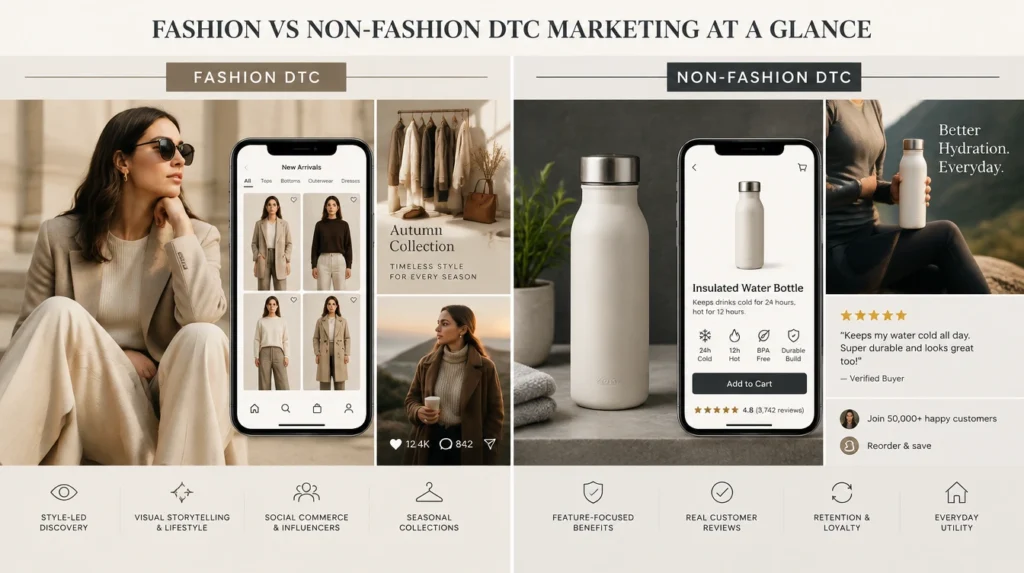
Factor | Fashion DTC | Other DTC (consumables, home) |
Creative refresh | Weekly, 15 to 25 new per week | Monthly, 4 to 8 per month |
Return rate | 25 to 40% | 5 to 10% |
Discovery to purchase | Under 48 hours (launch) / 7 days (evergreen) | 14 to 30 days |
Best creative format | Reels, UGC, carousel try-ons | Explainer video, review carousels |
Key retention flow | New arrivals plus VIP early access | Replenishment plus subscribe-and-save |
Hero channel | Instagram and Meta | Google Shopping and Meta |
Frequently Asked Questions
How much should a fashion brand spend on Meta ads per month?
The floor for a scaling fashion account is Rs 2 lakh (around $2,500) per month. Below that, Meta’s learning phase never completes and ad sets swing wildly week to week. Serious scale starts at Rs 5 to 8 lakh monthly, with the top-performing accounts in our India book running Rs 15 to 40 lakh per month.
Which platform drives more fashion e-commerce revenue, Meta or Google?
Meta wins for cold acquisition in fashion by a wide margin, typically 65 to 80 percent of paid revenue. Google Shopping becomes significant once brand searches cross 2,000 queries per month, at which point Performance Max campaigns capture branded demand efficiently. Pinterest is worth testing for occasion wear and bridal.
How long does fashion SEO take to generate meaningful revenue?
Collection pages built around buying-intent queries typically start generating revenue in 60 to 120 days. Full organic channel share of 15 to 25 percent of total revenue takes 9 to 18 months of consistent collection-page architecture, product-page optimization, and internal linking work. Blog content delivers slower and less predictably.
Do influencer campaigns actually work for small fashion brands?
Yes, when run as content generation rather than reach plays. A Rs 50,000 monthly micro-influencer budget covers 5 to 8 creators producing 10 to 15 licensable creatives. Those creatives, run through Meta ads, routinely outperform brand-shot content on CPA. The campaign isn’t the ad. The content is.
What’s the fastest way to lower return rates in fashion?
Fix the size chart first. Add actual garment measurements, model height, and a “runs small / true to size / runs large” indicator pulled from reviews. That single change typically cuts fit-related returns by 4 to 8 percentage points within 60 days.
Do WhatsApp flows replace email for Indian fashion brands?
No, they complement each other. WhatsApp wins on open rates (85 to 95 percent) but costs more per message and has stricter promotional rules through the WABA framework. Email handles bulk sends and promotional cycles cheaply. The right split in India is roughly 60 percent email volume, 40 percent WhatsApp for high-intent moments like abandoned checkout.
Where to start
Run the audit in this order: PDP and returns first, then creative volume, then lifecycle flows, then budget scaling. Brands that skip the PDP step and jump to spending more on ads generally learn why eight weeks later when the math stops working.
If you’re running a fashion brand in India and want a second set of eyes on where the growth is leaking, the Morphiaas e-commerce agency team in India will map the seven levers above against your current setup and show you the sequencing that fits your margin and inventory shape. Book a free 30-minute strategy call to get started.