

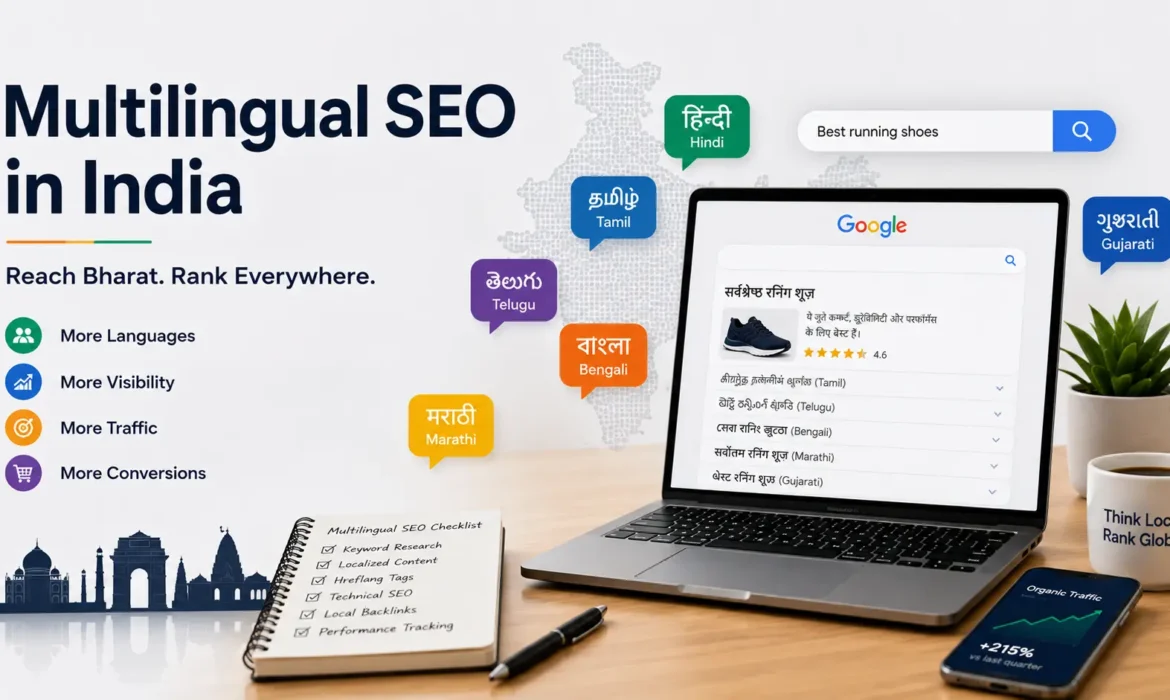
Multilingual SEO in India is now one of the highest-leverage growth channels most Indian brands still ignore. For every English keyword you rank for, there are Hindi, Tamil, Telugu, Bengali, Marathi, and Gujarati queries that carry the same buying intent, with a fraction of the competition. This guide covers why Bharat’s internet demands multilingual SEO, which languages to prioritize, and the practical steps to actually rank in them.
Key takeaways
- Per the KPMG-Google “Indian Languages: Defining India’s Internet” study, nine out of ten new Indian internet users prefer content in an Indian language rather than English.
- Per the IAMAI-KANTAR 2024 report, roughly 98% of Indian users access content in Indic languages and 57% of even urban users prefer regional-language content.
- Google’s 2026 expansion of Search Live and Gemini Live to Marathi, Tamil, Telugu, Bengali, Gujarati, Kannada, and Malayalam has made Indian-language AI search a mainstream input to product discovery.
- Multilingual SEO is not translation. It is discovering the queries your buyers actually use in their language, then structuring your site so both Google and AI systems can serve them.
- Start with two languages, not twelve. Depth in Hindi plus one regional language beats shallow coverage across ten.
What Is Multilingual SEO and Why Does Bharat's Internet Demand It?
Multilingual SEO is the practice of optimizing your website and content to rank on search engines and AI-powered search tools across multiple languages. For India specifically, that means treating Hindi, Tamil, Telugu, Bengali, Marathi, Kannada, Malayalam, and Gujarati as first-class ranking targets, not as translation projects tacked onto an English-first site.
The commercial case is straightforward. India has 22 officially recognized languages and hundreds of dialects. According to the IAMAI-KANTAR 2024 report, 98% of Indian internet users access content in Indic languages, and 57% of even urban users prefer regional-language content. English-only SEO addresses a shrinking share of Indian search demand every quarter, while multilingual SEO opens rankings in queries where competition is often thin to nonexistent.
How Big Is the Vernacular Internet Opportunity in India?
Large enough that Bharat’s internet users now outnumber India’s English-first internet users by several times. Per the KPMG-Google projection, India crossed 500 million-plus non-English internet users well before 2025. The next several hundred million users coming online through cheaper smartphones and expanding rural connectivity will overwhelmingly consume the internet in an Indian language, not English.
Two 2026 shifts have accelerated the opportunity. First, Google expanded its AI Search Live feature to seven additional Indian languages (Marathi, Tamil, Telugu, Bengali, Gujarati, Kannada, and Malayalam) on top of the earlier English and Hindi foundation, per Google’s own product announcements at the 2024 and 2025 Google for India events. That means voice-first, multi-turn search in a user’s mother tongue is now a mainstream product feature, not an experiment.
Second, Gemini Live now supports Hindi plus eight regional Indian languages, and platform-side vernacular content on ShareChat, Josh, Dailyhunt, and MX TakaTak has trained hundreds of millions of users to expect their internet in their language. Brands still publishing only in English are increasingly invisible to how a majority of Indians actually search.
Which Indian Languages Should You Prioritize for Multilingual SEO?
Start with Hindi plus one to two regional languages chosen by your buyer geography, not by list-order prestige. Hindi covers the largest single non-English internet population. Beyond Hindi, prioritize Tamil for Tamil Nadu, Bengali for West Bengal and eastern India, Marathi for Maharashtra outside Mumbai, Telugu for Andhra Pradesh and Telangana, and Malayalam for Kerala. Kannada and Gujarati follow.
A practical prioritization approach:
- Check your own analytics first. Google Search Console and GA4 show which states and cities send you traffic. If 40% of your traffic already comes from Tamil Nadu, Tamil comes before Bengali regardless of national market size.
- Match language to buyer region. Publish in the language your paying customers actually speak, not the language you assume covers “most of India.”
- Depth beats breadth. A well-executed Hindi + Tamil program will outrank a shallow eight-language coverage every time. Two languages done properly compound. Ten languages done as afterthoughts do not.
What Are the 7 Steps to Actually Do Multilingual SEO for the Indian Market?
Seven practical moves separate a working multilingual SEO program from a directory of poorly translated pages. In our own SEO work with Indian brands at Morphiaas, a performance marketing and creative agency serving India and the US, these are the steps we prioritize when helping clients build multilingual SEO the right way.
1. Do keyword research inside each target language, not from English translation
Google Keyword Planner set to a specific language and region reveals commercial queries in Hindi, Tamil, or Bengali that often have no direct English equivalent. Buyers phrase questions differently in their mother tongue. Never translate an English keyword list into Hindi and call it research. Do the discovery natively in each language, treating the phrasing patterns as data.
2. Use hreflang tags correctly, not just for translated pages
Implement hreflang across every language and region variant so Google serves the right page to the right user. For India, that usually means variants like hi-IN for Hindi India, ta-IN for Tamil India, bn-IN for Bengali India, and so on. Get hreflang wrong and Google may serve English users your Hindi page or leave translated pages unclaimed. This is technical work but decisive for whether your multilingual SEO program compounds or leaks.
3. Localize, do not translate
A page translated by a plugin reads as translated. A page localized by a native speaker uses the buying vocabulary customers actually use, references local price points in INR, mentions the specific festivals and occasions that matter, and skips English idioms that make no sense in translation. Localization costs more than machine translation. It ranks and converts many times better.
4. Structure URLs and site architecture for multilingual clarity
Choose one clean structure and apply it site-wide. The two workable options are language subdirectories (yoursite.com/hi/ for Hindi, yoursite.com/ta/ for Tamil) or language subdomains (hi.yoursite.com). Avoid inconsistent structures across languages, and never mix multiple languages on the same URL without clear signals. Google’s official multi-regional and multilingual documentation covers the technical rules.
5. Optimize for voice search and AI search in Indian languages
Voice queries in Hindi, Tamil, and other Indian languages are longer and more conversational than typed English queries. Structure content with question-form headings that match spoken-language phrasing, and use natural, spoken sentence patterns in your body copy. Since Google’s Search Live and Gemini Live now support multiple Indian languages, well-written vernacular content has genuine visibility inside AI-powered answers, though no formatting choice guarantees an AI citation.
6. Build regional-language backlinks and local mentions
Backlinks from credible regional-language publications carry weight for ranking in that language. Regional business directories, Hindi and Tamil trade publications, local news sites, and category-specific vernacular platforms all contribute. So do consistent business information (NAP: name, address, phone) across Justdial, Sulekha, IndiaMART, and language-specific directories. Entity signals matter as much for multilingual SEO as they do for English SEO.
7. Publish native regional content, not just translated blog posts
Original Hindi videos, Tamil buying guides written from scratch, Bengali market explainers, Marathi festival content. Native regional content outranks translated content because it reads native, and because AI systems prefer sources with unique information over sources that recycle content across languages. Native content also earns social shares and organic backlinks that translated pages rarely do.
How Do You Measure Multilingual SEO Performance?
Measure multilingual SEO on rankings and traffic per language, conversions per language, and business outcomes by region. Traffic that does not convert in a language is a signal you are ranking on the wrong queries or serving the wrong intent. Judge quarterly. Multilingual SEO compounds slowly and results tend to show after the fourth or fifth month.
A workable stack: Google Search Console filtered by language and country for query and page performance, GA4 segmented by user language for conversion attribution, Rank Math or Ahrefs for keyword rank tracking in each language, and a monthly manual check of Perplexity and Google AI Overviews responses to your top vernacular queries.
If you can state your Hindi organic traffic, your Tamil conversion rate, and your top-ranked queries in each active language over the last quarter, your measurement is working. If you cannot separate performance by language, you cannot separate what is working from what is wasting effort.
Common Multilingual SEO Mistakes Indian Brands Make
- Auto-translating pages with a plugin. Machine-translated pages rank briefly if at all, read as artificial, and hurt brand credibility with the buyers you were trying to reach.
- Skipping hreflang or implementing it incorrectly. Missing hreflang tags leave translated pages competing with each other, or worse, invisible to the right audience.
- Publishing in eight languages before nailing one. Depth in Hindi plus one regional language builds authority. Shallow coverage in eight languages builds nothing.
- Doing keyword research only in English, then translating. The queries your Tamil buyers use often have no direct English equivalent. Skipping native research leaves the highest-intent keywords unclaimed.
- Ignoring voice and AI search patterns. Vernacular internet users lean heavily on voice and AI tools. Content structured only for typed English queries misses them entirely.
- No regional-language backlink strategy. Links from English publications do not carry the same weight for ranking in Hindi or Tamil. Build language-appropriate authority.
- Weak or duplicate metadata across languages. Meta titles and descriptions must be written natively in each language, not translated. Google reads them differently for different-language audiences.
- Giving up after 90 days. Multilingual SEO takes 4 to 8 months to compound meaningfully. Judging results too early is why most Indian brands abandon vernacular programs before they pay off.
Turn Bharat's Internet Into a Ranking Channel
If you want multilingual SEO to work as a measurable growth channel that reaches Bharat’s actual internet users, not just the 15% who search in English, that is the kind of program we design and run at Morphiaas. We combine technical and content SEO with multi-language website architecture, tailored for Indian retail brands and D2C businesses expanding beyond metro-English audiences. Get on a call and we will map the right two-language starting point for your business.
Frequently Asked Questions
What is the difference between multilingual SEO and international SEO?
Multilingual SEO targets multiple languages within one or more countries. International SEO targets multiple countries, which usually but not always involves multiple languages. For Indian brands publishing in Hindi, Tamil, and Bengali for Indian audiences, the correct term is multilingual SEO, not international SEO.
Which Indian languages should a brand target first for multilingual SEO?
Start with Hindi plus one regional language chosen by your existing customer base. If your sales geography is South India, that regional language is Tamil, Telugu, Kannada, or Malayalam. If it is western India, Marathi or Gujarati. If eastern India, Bengali. Match language to where your buyers actually come from, verified in Google Search Console and GA4.
Does Google actually rank Hindi and regional-language content well in India?
Yes. Google has invested heavily in Indian-language search over the last five years, including AI Search Live and Gemini Live now supporting Marathi, Tamil, Telugu, Bengali, Gujarati, Kannada, and Malayalam. Well-executed vernacular content ranks, and often faces far less competition than English content in the same category.
How long does multilingual SEO take to show results in India?
Expect 4 to 8 months for Hindi and major regional languages to reach meaningful traffic and conversion levels. Faster on lower-competition long-tail queries, slower on high-volume commercial queries. Judge quarterly and stay committed for at least a year before deciding whether to expand or narrow language coverage.
Is machine-translated content acceptable for multilingual SEO?
No, at least not as a standalone. Machine translation as a first draft is fine, but publish-ready content must be edited or rewritten by a native speaker who understands your category. Google’s guidance and observable rankings both consistently favor genuinely localized content over machine-translated pages.