

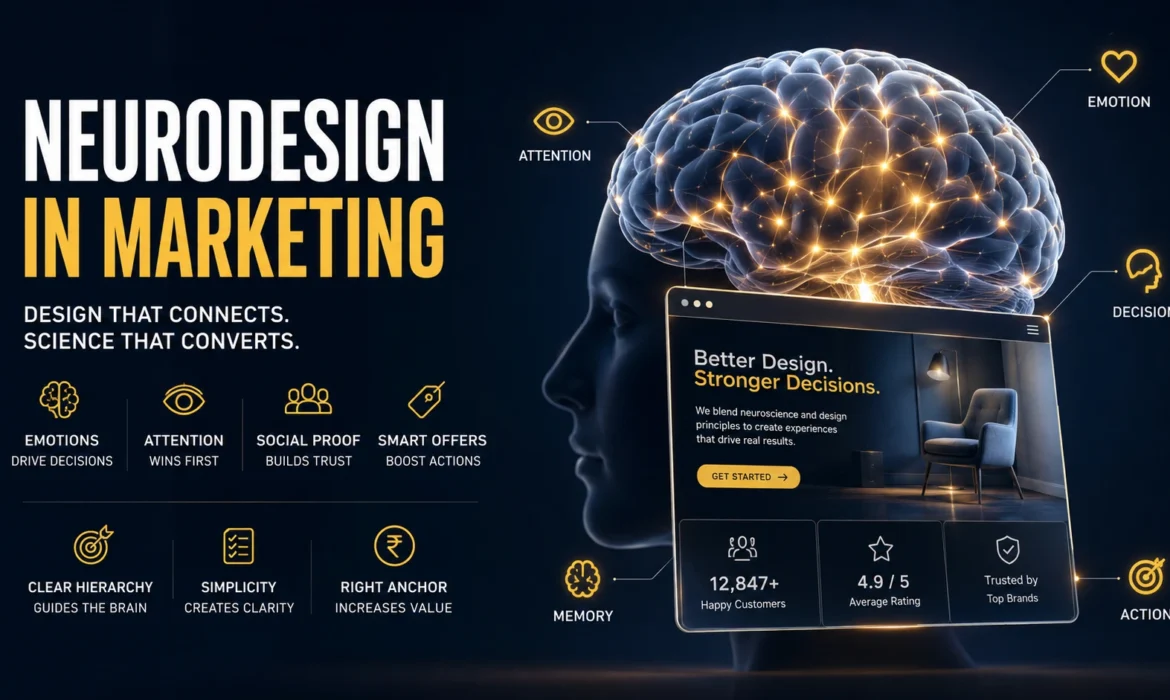
Neurodesign in marketing applies well-established neuroscience and behavioural research on attention, emotion, memory, and decision-making to the creative choices marketers actually make: ad layout, headline framing, colour, imagery, pricing display, and calls to action. Done well, it lifts conversions measurably. Done badly, it becomes another layer of pseudoscientific overclaim. This guide covers seven neurodesign principles that have genuine research backing and how Indian brands can apply them to ads and landing pages in 2026, plus the common overclaims to avoid.
Key takeaways
- Neurodesign in marketing has genuine foundations in behavioural economics (Kahneman and Tversky), influence psychology (Cialdini), and neuroscience (Damasio, Nielsen Norman Group). It also carries a lot of marketing folklore that does not survive scrutiny.
- Kahneman and Tversky’s loss aversion research, confirmed across decades of studies including 2023 MEG neuroimaging, shows the brain values loss roughly twice as strongly as equivalent gain. That single insight reshapes how ad copy should be framed.
- Nielsen Norman Group eye-tracking research consistently shows faces in imagery capture attention before headlines, F-pattern scanning dominates content reading, and above-the-fold placement carries decisive weight for CTA visibility.
- Emotional response to ads has been shown to influence purchase intent measurably more than rational appeals, per multiple neuromarketing meta-analyses and Damasio’s foundational neuroscience research on emotion in decision-making.
- For Indian brands, cultural context reshapes some neurodesign defaults. Red signals auspiciousness in India, not just urgency. Family and collective decision-making patterns require different social proof formats than individualist Western markets.
What Is Neurodesign in Marketing?
Neurodesign in marketing is the practice of designing marketing creative (ads, landing pages, product pages, brand identity, packaging) using well-established principles from neuroscience, behavioural economics, and cognitive psychology to align design decisions with how the human brain actually processes attention, emotion, and choice. It sits at the intersection of design and psychology, and its aim is straightforward: reduce friction, increase attention, and improve the probability that a viewer takes the intended action.
Some of what gets sold as “neuromarketing” is genuine science (Kahneman and Tversky’s Prospect Theory, Cialdini’s influence research, Damasio’s work on emotion and decision-making, decades of Nielsen Norman Group UX studies). Some of it is marketing folklore dressed up in neuroscience language. Distinguishing between the two is where most brands go wrong.
Why Does Neurodesign in Marketing Matter for Indian Brands in 2026?
Because Indian buyers now face more marketing messages, more brands, and more decision fatigue than at any prior point. Attention has become the scarcest resource marketers compete for. Neurodesign in marketing is one of the few disciplines that gives brands a structured way to compete for attention on the same evidence base that Kahneman won a Nobel Prize for.
The commercial case is straightforward. Better creative converts higher on the same ad spend. A landing page that respects how the brain scans (F-pattern reading, faces-before-headlines, above-the-fold weight) converts higher than one that does not. Ad copy framed around loss aversion typically outperforms ad copy framed around gain by measurable margins. These are not opinions. They are effects replicated across hundreds of peer-reviewed studies over four decades.
What Are the 7 Neurodesign Principles That Actually Move Conversions?
Seven neurodesign principles have strong research backing and consistently move conversion rates when applied thoughtfully to ads, landing pages, and brand design. In our own creative and paid media work at Morphiaas, a performance marketing and creative agency serving India and the US, these are the principles we use as the foundation for high-converting creative for Indian brands.
1. Emotional cues before rational arguments
Antonio Damasio’s foundational neuroscience research showed that patients with damage to emotional processing centres of the brain (specifically the ventromedial prefrontal cortex) struggled to make even simple decisions despite intact reasoning. Emotion is not a decoration on top of rational choice. It is a necessary input to choice itself. Lead your ad or landing page with the emotional benefit (relief, pride, security, belonging, freedom) and use rational features as supporting evidence rather than the primary appeal.
2. Faces and eye direction to guide attention
Nielsen Norman Group eye-tracking research consistently shows human faces in imagery capture attention faster and hold it longer than any other single visual element. Even more useful: the direction the face is looking guides the viewer’s own gaze. A model looking at the product or at the headline directs attention there. A model looking straight at the camera commands attention to the face itself, useful for building emotional connection but weaker for driving action to a CTA. Cast, art-direct, and shot-select with this in mind.
3. Loss aversion in ad copy and offers
Kahneman and Tversky’s Prospect Theory, confirmed across four decades of research including 2023 MEG neuroimaging studies, established that the brain values loss roughly twice as strongly as equivalent gain. “Don’t miss out on 20% off” typically outperforms “Save 20%” on the same offer. “Only 3 seats left” outperforms “3 seats available.” Frame ad copy around what the buyer stands to lose by not acting, in addition to what they gain by acting. Use this honestly, not to fabricate false scarcity.
4. Social proof with real numbers, not vague claims
Robert Cialdini’s foundational work on influence identified social proof as one of the six most reliable psychological drivers of decision-making. Specific numbers outperform vague social proof by significant margins: “Join 12,847 Indian small businesses using our platform” beats “Join thousands of businesses.” Verified reviews with real names outperform anonymous testimonials. Recognisable client logos outperform unnamed case studies. In India specifically, family and community endorsement carries additional weight, which is why WhatsApp forwarding remains one of the most powerful social proof mechanisms for Indian brands.
5. Visual hierarchy through contrast and Fitts’s Law
The brain scans before it reads. Strong visual hierarchy (one dominant headline, one clear CTA, one hero image, generous whitespace around key elements) guides attention efficiently and reduces cognitive load. Fitts’s Law from HCI research shows CTAs that are larger and closer to natural gaze paths are clicked more often, an effect that has been replicated in every serious UX study for six decades. Make the primary CTA visually dominant, larger than surrounding buttons, and placed where the user’s eye naturally lands, not where the design “looks balanced.”
6. Cognitive fluency: simplicity outperforms cleverness
Cognitive fluency research consistently shows that information which is easier to process feels more trustworthy, more true, and more likely to lead to action. Complex layouts, dense copy, ambiguous CTAs, and clever wordplay create cognitive load that depresses conversion. Simple, direct, concrete language outperforms sophisticated or metaphorical language on landing pages and ads. This is not about dumbing down. It is about respecting the reader’s attention. A headline that reads clearly in one second beats a clever one that takes three seconds to parse, every time.
7. Anchoring in pricing and comparison
Also from Kahneman and Tversky, anchoring shows that the first price a buyer sees becomes the reference point against which all subsequent prices are judged. Show the most expensive option first when comparison-shopping is expected. Strike through an original price when displaying a discount. Show the annual price of a subscription before breaking it down to monthly cost when the annual price justifies the value more clearly. Anchoring is not manipulation. It is the acknowledgement that context shapes every buyer’s sense of what a fair price is.
How Should Indian Brands Adapt Neurodesign for Local Buyer Psychology?
Most neurodesign research was conducted with Western (largely North American and European) samples. Some findings translate cleanly to India. Others need adaptation. Four Indian-specific shifts matter for most brands: cultural colour meaning, family and collective decision-making patterns, trust signals rooted in Indian institutions, and vernacular language processing.
Colour: red signals auspiciousness, prosperity, and celebration in Indian culture (weddings, festivals, saffron symbolism), not just urgency or warning as in Western defaults. Green often carries stronger positive associations in Indian design. White in some Indian regional contexts carries mourning associations that Western minimalism does not. Test colour choices with your specific buyer segment rather than applying Western neurodesign defaults uncritically.
Decision-making: Indian purchase decisions, particularly for high-consideration categories (home, car, insurance, education, wedding), often involve extended family consultation. Social proof formats should reflect this. Testimonials from families rather than individuals, WhatsApp-forwardable summary graphics, and family-oriented imagery outperform Western individualist framings for these categories.
Trust signals: RERA registration for real estate, ISI marks for manufactured goods, FSSAI for food, MSME certification for B2B credibility, government scheme affiliations, and celebrity endorsements from culturally-recognised figures all carry more weight in India than in Western markets. Include them prominently where relevant.
How Do You Test Neurodesign Applications in Your Own Marketing?
Every neurodesign principle in this list should be validated in your own creative way through structured A/B testing, not assumed to work universally. Test one variable at a time (headline framing, image choice, CTA colour, price anchor position), keep everything else constant, run each test long enough to reach statistical significance, and document what worked for your specific buyer and category.
A practical stack: Google Ads and Meta Ads Manager for creative A/B testing at ad-level, Optimizely, VWO, or Google Optimize’s successor for landing-page testing, Hotjar or Microsoft Clarity for heatmaps and session recordings that show where attention actually goes on your pages, and a spreadsheet log of every test result to build institutional knowledge over time. Neurodesign principles give you the hypothesis. A/B testing gives you the evidence for your specific business.
Common Neurodesign Mistakes and Overclaims to Avoid
- Believing “95% of decisions are subconscious” as literal fact. This widely-cited figure from Harvard professor Gerald Zaltman is contested and has been softened in subsequent research. Emotion and unconscious processing matter, but the specific 95% number should not be treated as a hard scientific claim.
- Treating fMRI-based neuromarketing studies as causal proof. Most fMRI neuromarketing research is correlational and sample-size limited. Directional useful, definitive proof usually not.
- Applying Western neurodesign defaults uncritically in India. Colour meanings, decision-making dynamics, and trust signals differ enough that verbatim Western neurodesign templates often underperform localised ones.
- Using loss aversion or scarcity dishonestly. Fake “only 3 left” or fake countdown timers work briefly and destroy brand trust permanently once buyers notice. Use scarcity only when it is genuine.
- Over-designing landing pages. Complexity kills conversion. Cognitive fluency research consistently favours simpler layouts, shorter copy, and clearer visual hierarchy over sophisticated design.
- Ignoring accessibility in the name of “attention-grabbing” design. High contrast that ignores colour blindness, tiny CTAs that fail Fitts’s Law, and animations that trigger motion sensitivity all destroy conversion for real segments of your audience.
- Treating a single neuromarketing study as a rule. The strongest neurodesign principles are ones replicated across many studies, not one viral finding. Look for replicated meta-analyses, not novelty results.
- Framing neurodesign as manipulation rather than clarity. The best application of neurodesign is helping buyers understand your offer faster and evaluate it more accurately, not tricking them into decisions they will regret. The latter always costs more than it earns over time.
Build Ads and Landing Pages Grounded in Real Neurodesign Principles
If you want your creative and conversion work to be grounded in real neurodesign principles rather than marketing folklore, that is exactly the discipline we apply across our client programs at Morphiaas. We combine brand and creative direction with conversion-optimized website builds and paid media creative work for Indian brands, all backed by structured A/B testing rather than assumption. Book a call and we will audit where your current creative and landing pages stand against these seven principles.
Frequently Asked Questions
Is neurodesign in marketing actually backed by science?
Parts of it are, and parts of it are not. Kahneman and Tversky’s behavioural economics, Cialdini’s influence psychology, Damasio’s neuroscience of emotion, and Nielsen Norman Group’s UX research are all rigorously validated. Many pop-neuromarketing claims, particularly ones tied to fMRI studies with small sample sizes, are less reliable. Distinguish between the two.
Do neurodesign principles work differently in India than in Western markets?
Core principles (loss aversion, social proof, cognitive fluency, visual hierarchy) apply broadly. Surface applications (colour meaning, social proof format, trust signals, decision-making dynamics) require India-specific adaptation. Red as auspicious, family-based decision-making, and Indian institutional trust signals all reshape how these principles should show up in creative.
Can small Indian businesses apply neurodesign without a research budget?
Yes. The seven principles in this guide require no research budget to apply. Loss aversion in headlines, faces guiding attention, social proof with real numbers, visual hierarchy through contrast, simple copy, and honest price anchoring can be implemented in any landing page or ad. Structured A/B testing at ad-level in Meta and Google is available to any business.
Is neurodesign the same as neuromarketing?
Related but distinct. Neuromarketing is the broader field of applying neuroscience research to marketing decisions, often using measurement tools like EEG, fMRI, or eye-tracking. Neurodesign is specifically the application of that research to the design of marketing creative and interfaces. Neurodesign is a practical, execution-focused subset of the broader neuromarketing discipline.
How long does it take to see conversion lift from neurodesign changes?
Most neurodesign changes to ads or landing pages can be A/B tested and validated within 2 to 6 weeks, depending on traffic volume. Higher-traffic pages produce statistically significant results faster. Sustained conversion lift over multiple months usually requires testing many small changes rather than one large redesign.