

Key takeaways
- A small business SEO strategy works best when you fix the basics before you publish more content.
- Each page should target one primary keyword and a few closely related terms.
- Local signals, real expertise, and named authors build the trust that search engines and AI tools look for.
- Short, direct answers near the top of a page help you appear in featured snippets and AI summaries.
- Most SEO gains compound over three to six months, so monthly measurement beats daily checking.
What is a small business SEO strategy?
A small business SEO strategy is a written plan that tells you which searches to target, which pages to build, and how to measure progress. It focuses limited time and budget on the terms most likely to bring paying customers.
Unlike a large brand, you cannot outspend competitors on every keyword. You win by choosing narrower searches, answering them better, and proving that real people stand behind your business.
Start by checking what your site already earns
Open Google Search Console and Google Analytics before you change anything. Note which pages get impressions, which get clicks, and which queries already bring visitors.
Then list your five best-selling products or services and search for each one yourself. Record who ranks, what format their pages use, and which questions appear under People Also Ask.
Teams that skip this audit often rewrite pages that already perform and ignore pages that sit one edit away from page one.
Choose keywords your buyers really type
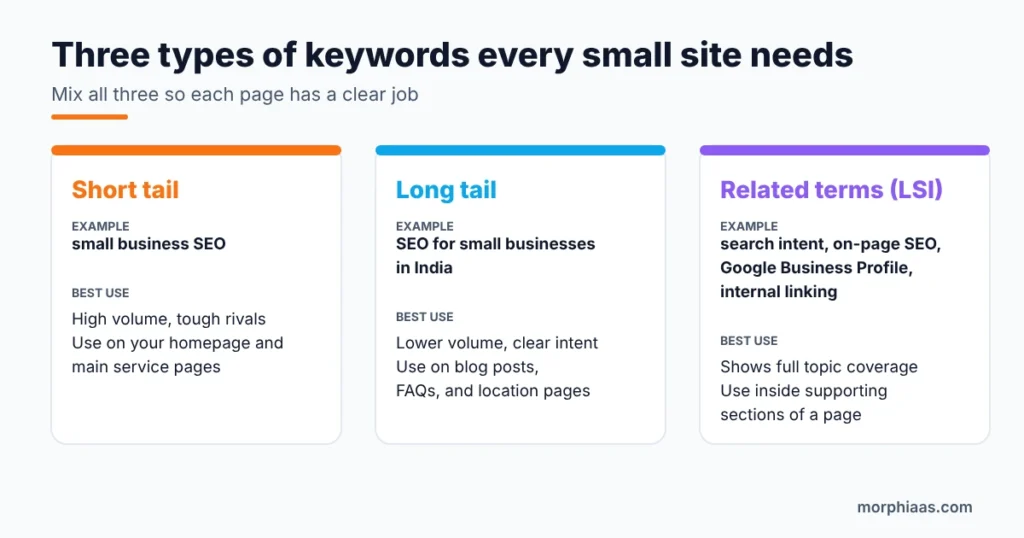
Keywords fall into three groups, and a small site needs all of them.
Keyword type | Examples | Best use |
Short tail | SEO strategy, small business SEO, local SEO | Homepage and main service pages. Volume is high and competition is tough. |
Long tail | how to build an SEO strategy for a small business website, SEO checklist for a local service business, SEO for small businesses in India | Blog posts, FAQs, and location pages. Volume is lower and intent is clearer. |
Related terms (often called LSI keywords) | keyword research, search intent, on-page SEO, Google Business Profile, meta descriptions, internal linking, backlinks, organic traffic | Supporting sections that show your page covers the whole topic. |
Start with long tail searches because they are easier to win and usually come from buyers closer to a decision. A plumber in Gurugram has a better chance with a phrase like emergency geyser repair in Gurugram than with the single word plumber.
Free tools such as Google Keyword Planner, Search Console, and the autocomplete suggestions in Google give you plenty of ideas without a paid subscription.
Match every page to one search intent
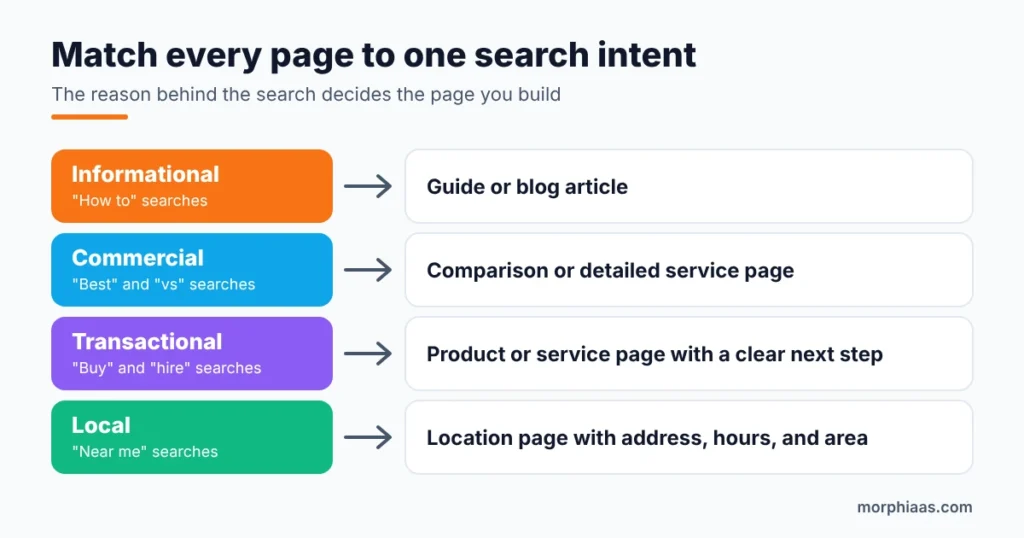
Search intent is the reason behind a query, and it decides which page type can rank. Someone searching how to wants a guide, while someone searching near me wants a local service page.
Give each page one main intent and one primary keyword. Two pages that target the same term compete against each other and split your ranking signals.
- Informational searches need a guide or an article that answers the question fully.
- Commercial searches need a comparison, a review page, or a detailed service page.
- Transactional searches need a product or service page with a clear next step.
- Local searches need a location page with your address, hours, and service area.
Check the top results for your target query and match their format before you add your own angle.
Fix the technical basics before you write more
A site that loads slowly or hides pages from crawlers wastes every hour you spend on content. Work through this short list first.
- Make sure pages load quickly on a phone, since many Indian shoppers search from mobile devices.
- Use HTTPS and repair any broken links or redirect chains.
- Submit an XML sitemap in Search Console and confirm your important pages are indexed.
- Write a unique title tag and meta description for every page.
- Use one H1 per page, with H2 headings that match real questions.
- Add descriptive alt text to every image that carries meaning.
Google publishes a free SEO starter guide that explains these basics in plain language.
Build local SEO if customers find you by location
If customers find you by location, local SEO deserves its own track.
Claim and complete your Google Business Profile with accurate hours, categories, services, and photos. Keep your business name, address, and phone number identical across every directory, including Indian listings such as Justdial.
Ask happy customers for reviews and reply to each one, since reviews shape both rankings and buyer confidence. Create a separate page for each city or service area, such as Delhi, Faridabad, or Gurugram, with details that are truly local rather than copied text with the city name swapped. If your customers search in Hindi or a regional language, publish your key pages in that language too.
Show real experience, expertise, authority, and trust
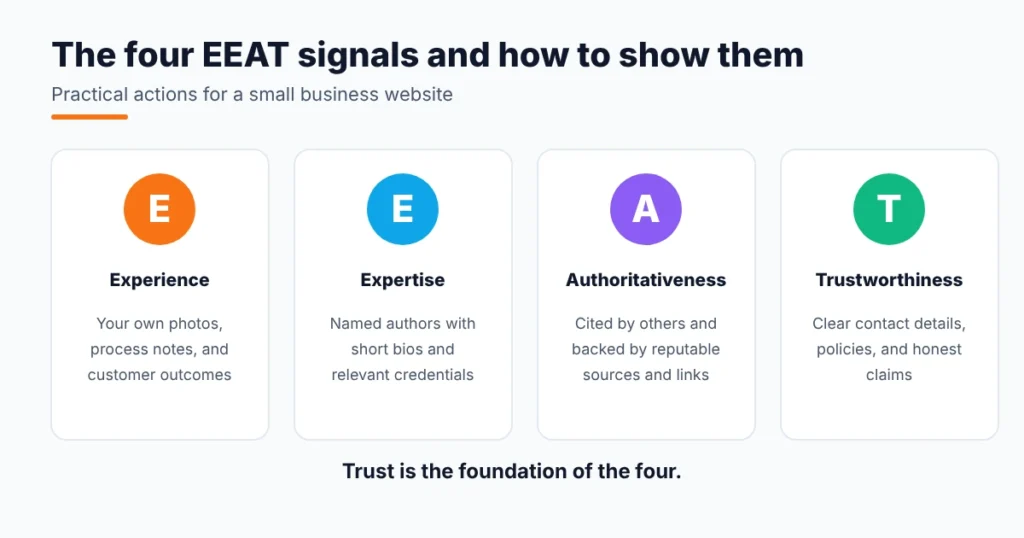
EEAT stands for experience, expertise, authoritativeness, and trustworthiness. Google’s guidance on creating helpful, people-first content asks whether a page shows first-hand knowledge and a clear purpose.
You can show these signals in practical ways.
- Add an author name, a short bio, and relevant credentials to every article.
- Share first-hand evidence such as your own photos, process notes, and customer outcomes.
- Publish an About page, contact details, a physical address, and clear policies.
- Cite reputable sources for facts and statistics, and update pages when the facts change.
- Display real customer reviews and case studies, with permission from each customer.
Trust is the foundation of the four, so a small business should never exaggerate results or hide who runs the site.
Group your content into topic clusters
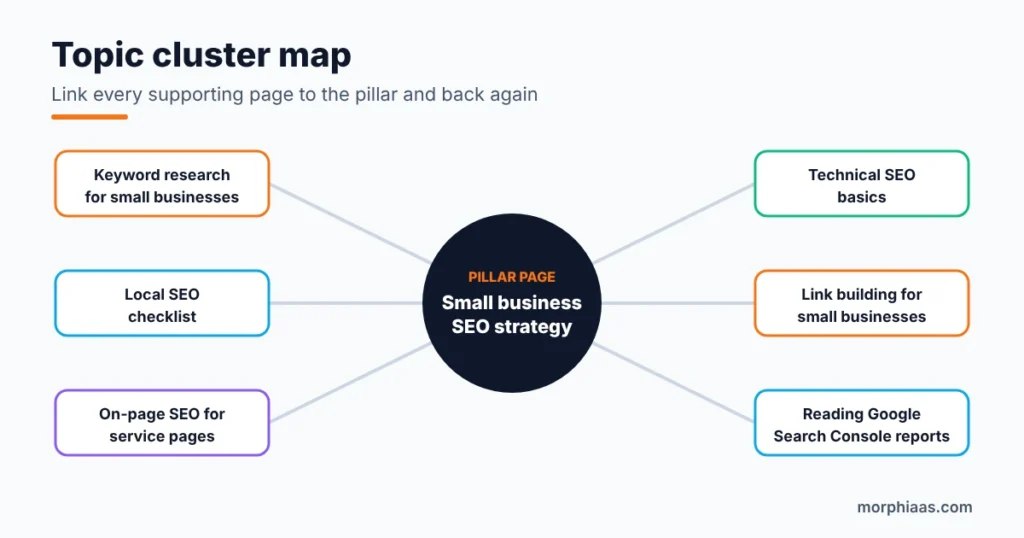
A topic cluster is a pillar page that covers a broad subject, linked to supporting pages that each answer one narrow question. This structure shows search engines that your site covers a subject in depth.
Role | Example page for this topic |
Pillar page | Small business SEO strategy (this guide) |
Supporting page | Keyword research for a small business website |
Supporting page | Local SEO checklist for service businesses |
Supporting page | On-page SEO for service and product pages |
Supporting page | Technical SEO basics for non-developers |
Supporting page | Link building for small businesses |
Supporting page | How to read Google Search Console reports |
Link every supporting page to the pillar and back again, using descriptive anchor text. Publish the pillar first, then add one supporting article at a steady pace so the cluster grows without hurting quality.
Write so AI search tools can quote you
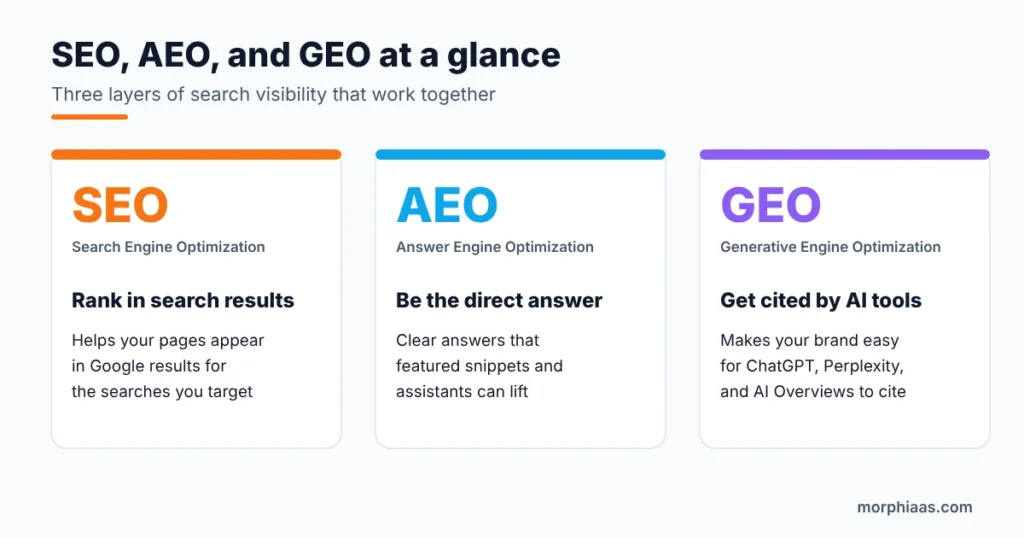
Answer engine optimization (AEO) means writing pages so that search features and AI assistants can lift a clear answer. Generative engine optimization (GEO) extends the same idea to tools such as ChatGPT, Perplexity, and Google AI Overviews.
- Place a direct answer of roughly 40 to 60 words under each question heading.
- Write headings in the same way people phrase questions out loud.
- Define each technical term in one clear sentence the first time it appears.
- Use short lists and tables for steps and comparisons, since they are easy to extract.
- Describe your business name, location, and services consistently so AI tools connect them to one entity.
- Date and source your facts so that every claim is easy to verify.
No tactic guarantees a citation. Clear, accurate, well-sourced pages simply give you the best chance of being quoted.
Earn links and mentions without a big budget
Start with links that cost time rather than money. Claim local directory listings, join industry associations, speak at local events, and ask suppliers or partners to link to your site.
Publish original data or a useful free tool that other sites want to cite. Avoid purchased links, because they risk a penalty and rarely bring real customers.
Measure what matters every month
Track five numbers each month in Search Console and your analytics tool: impressions, clicks, average position for target keywords, organic leads, and conversion rate.
Tie organic traffic to leads and sales rather than rankings alone. Morphiaas builds reporting around margin, and the same idea applies to a small business, where revenue matters more than position.
Give SEO 90 to 180 days before you judge it, because search results compound over that period.
A 90-day plan you can start this week
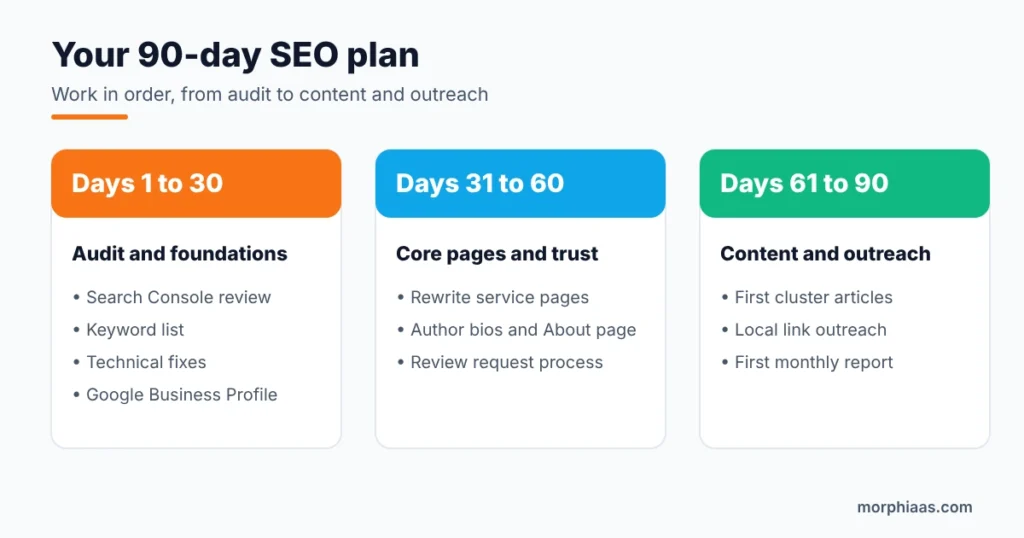
Days | Focus | What you finish |
1 to 30 | Audit and foundations | Search Console review, keyword list, technical fixes, Google Business Profile |
31 to 60 | Core pages and trust | Rewritten service pages, author bios, About page, review process |
61 to 90 | Content and outreach | First cluster articles, local link outreach, first monthly report |
Why choose Morphiaas for your SEO
Small business owners need a partner who treats their budget like it matters. Morphiaas builds SEO around revenue and margin instead of vanity metrics, and the numbers below come from the Morphiaas retail page.
- A local team in India. Morphiaas works from New Delhi and Faridabad, with an additional office in Houston, Texas, and serves clients across the US, UAE, UK, and Southeast Asia.
- Proven experience. Morphiaas has scaled 40+ retail brands, managed ₹500Cr+ in ad spend, and keeps a 96% client retention rate.
- Search that covers AI too. Morphiaas runs SEO, AEO and GEO so your brand can rank on Google and be cited by ChatGPT, Perplexity, and AI Overviews.
- A fast first look. The audit surfaces your top three revenue leaks in week one, and engagements begin with a 90-day sprint.
- No pressure to start. The strategy call lasts 30 minutes, with no pitch deck, and you leave with a clear picture of what to fix first.
Retail and ecommerce owners can also see how this approach works across fashion, beauty, home, and food brands on the Morphiaas retail marketing page.
Frequently asked questions
What is the first step in an SEO strategy for a small business?
The first step is an audit of what your site already earns. Review Search Console to see which pages and queries bring visitors, then fix technical problems before you create new content. This keeps your effort focused on the pages closest to results.
How long does small business SEO take to show results?
Most small sites need 90 to 180 days to see steady gains, because search engines must crawl, test, and trust your changes. Quick wins such as title tag fixes and Google Business Profile updates can show movement sooner. Track progress monthly instead of daily.
How is local SEO different from regular SEO?
Local SEO targets searches tied to a place, such as services near me. It relies on your Google Business Profile, reviews, consistent business details, and location pages. Regular SEO focuses more on website content and links, so most small businesses need both.
What is the difference between SEO, AEO, and GEO?
SEO helps your pages rank in search results. AEO shapes your content so search features and assistants can pull a direct answer from it. GEO goes further by making your brand easy for generative tools like ChatGPT and Perplexity to understand and cite.
Can a small business do SEO without an agency?
Yes, many owners handle the basics themselves with free tools and a steady routine. An agency helps when you lack time, need technical fixes, or want faster growth through a clear plan. Start with the 90-day plan above and add expert help where you feel stuck.