

AI search optimization for food and drink businesses makes your menu, product pages, and brand content retrievable and citable by generative engines like ChatGPT, Perplexity, Gemini, and Google AI Overviews. It covers structured data, entity clarity, FAQ formatting, outbound citations, and content density that AI systems can lift verbatim without rewriting.
Key takeaways
- AI search traffic now carries a measurable share of food and drink research queries. Brands optimized for retrieval get cited; competitors stay invisible.
- Four moves do most of the work: Restaurant and Product schema, FAQ formatting, entity clarity through Google Business Profile and third-party mentions, and outbound citations.
- Local F&B (restaurants, cafes, cloud kitchens) and packaged F&B (DTC food, beverages) optimize differently. Local wins through location signals. Packaged wins through product-level structured data.
- Direct-answer paragraphs of 40 to 60 words under question-based H2 headings are what AI engines lift verbatim.
- Monitor monthly: ChatGPT, Perplexity, and Gemini citations for your brand and category queries. The absence of citations is the signal to act.
What is AI search optimization for food and drink businesses?
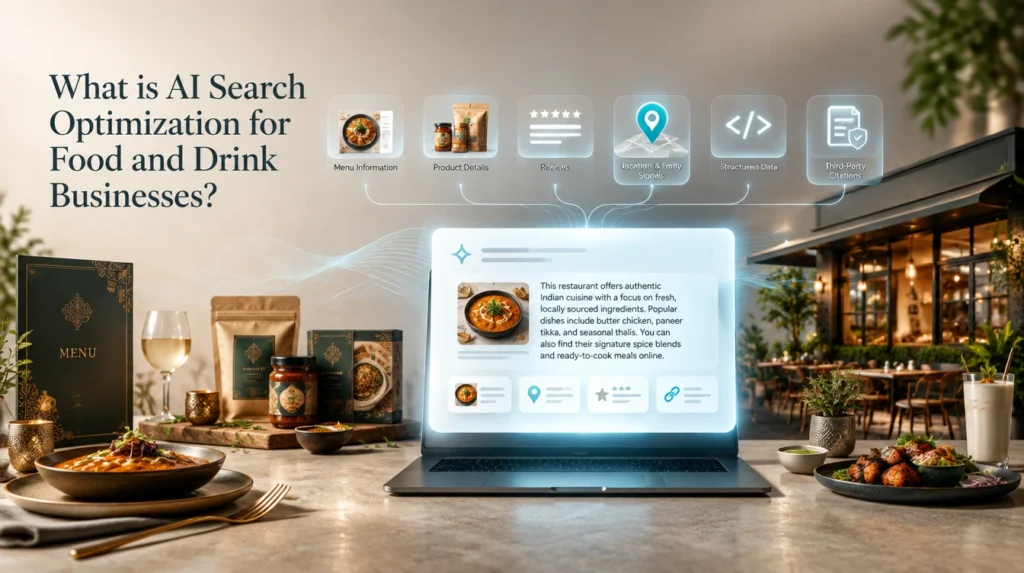
AI search optimization for food and drink businesses is the practice of structuring content and metadata so generative AI engines retrieve and cite your brand when customers ask about restaurants, cafes, menus, recipes, or packaged food products. It extends traditional SEO with structured data, entity clarity, and direct-answer formatting that AI systems can quote without rewriting.
AI engines don’t crawl the open web the way Google does. They synthesize answers from sources they already trust, often through retrieval-augmented generation (RAG), a process where the model fetches relevant documents before answering. A page not retrievable at query time doesn’t exist as far as the AI is concerned. The optimization work covers two gates: getting into those retrieval indexes and surviving the ranking inside them.
Why does AI search optimization matter for food and drink businesses in 2026?
It matters because food and drink research queries have shifted to AI assistants. Diners ask ChatGPT for restaurant recommendations. Consumers ask Perplexity for product comparisons. Shoppers see AI Overviews on Google for “best X” searches. Brands that are retrievable capture this traffic. Brands that aren’t become invisible to a growing share of buyers.
The behavioral shift is category-specific. Food and drink discovery queries (“best Italian restaurant in Mumbai”, “protein bars under 150 calories”, “cold-pressed juice brands in Bangalore”) sit among the fastest-growing AI search use cases. Google’s own AI Overviews documentation covers how structured content gets surfaced in generative results.
Morphiaas, a performance marketing agency serving India and the US, works with F&B brands where the citation gap between well-optimized and poorly-optimized sites shows up within 90 days. The difference isn’t content volume. It’s whether the content is formatted for AI retrieval.
How do you optimize a restaurant website for ChatGPT and Perplexity?
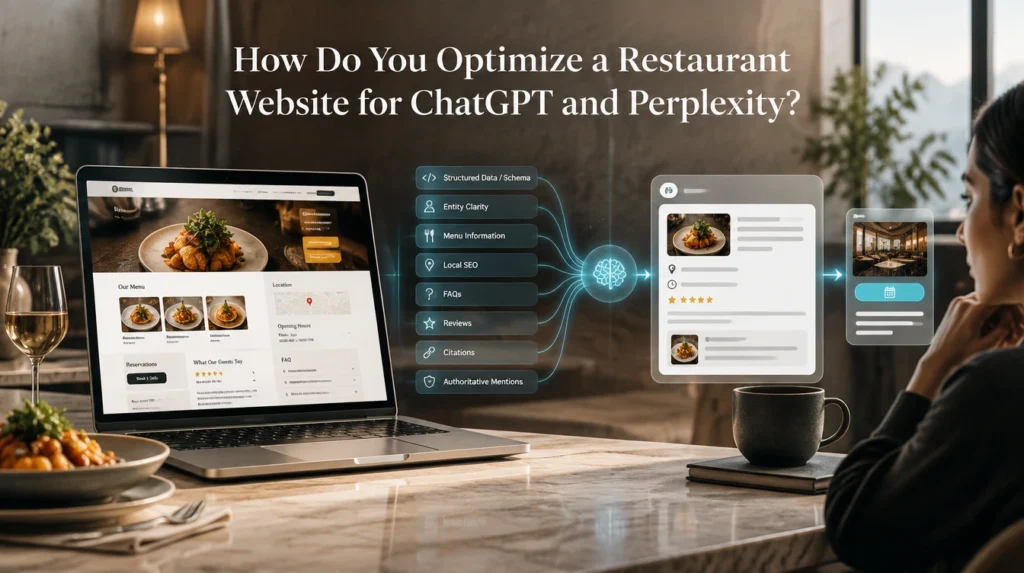
You optimize a restaurant website by combining schema markup (Restaurant, MenuItem, FAQPage), direct-answer formatting under question-based headings, Google Business Profile alignment, and third-party citations that give AI engines verifiable signals about your brand. Add outbound links to authoritative sources so AI reads your content as evidence-backed, not just marketing copy.
The tactical stack for restaurants, cafes, and cloud kitchens:
- Implement Restaurant, Menu, MenuItem, and FAQPage schema at the HTML level, not through generic WordPress plugins that often output invalid markup.
- Fill Google Business Profile completely. Hours, menu URL, photos, categories, Q&A section, reviews with responses. Incomplete GBP data is the single biggest reason restaurants don’t appear in AI location queries.
- Write FAQ sections that answer the exact questions diners ask AI assistants. “What time does X open on Sundays?” “Does X have vegetarian options?” “Is X good for groups?”
- Get mentioned in local food blogs, review sites, and travel guides. AI engines weight third-party mentions as independent verification.
- Use direct-answer paragraphs of 40 to 60 words under conversational H2 questions on your blog and FAQ pages.
We learned on a Mumbai cafe account that getting into Perplexity’s citation set took 90 days of consistent FAQ work and three third-party mentions, not a schema-only sprint. Schema matters, but it’s the floor, not the ceiling.
How does AI search optimization work for packaged food and drink brands?
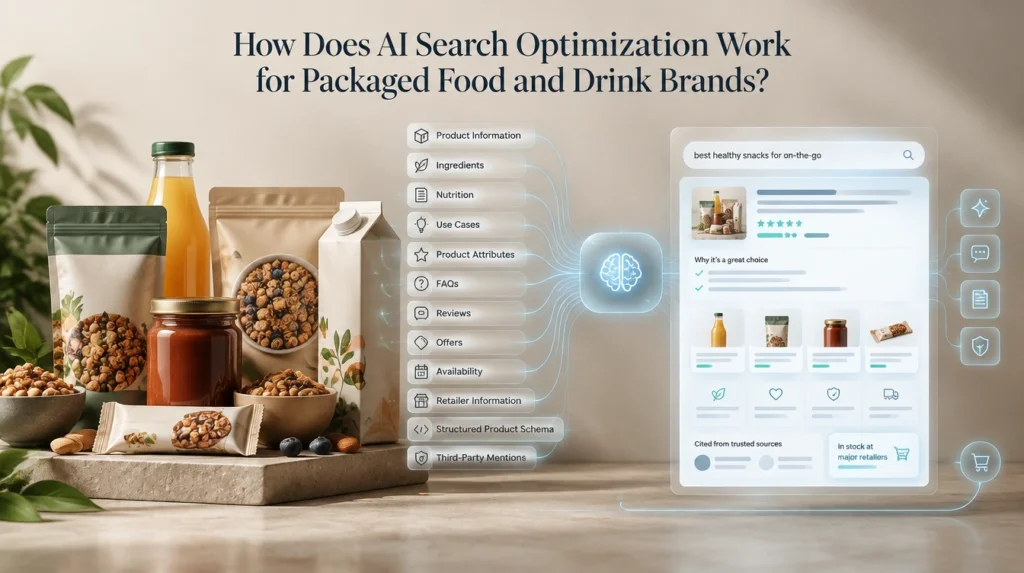
Packaged F&B brands optimize for AI search through product-level structured data (Product, Offer, Review schemas), ingredient and nutrition pages built as self-contained content, and third-party mentions in industry publications. Direct-to-consumer brands also benefit from Wikipedia-style neutral mentions and comparison content that AI engines reference when answering purchase-intent queries.
The packaged F&B retrieval stack looks different from a restaurant’s:
- Product schema with full attributes: nutrition facts, ingredients, allergens, certifications, serving size, country of origin.
- Separate URL per SKU so AI retrieval can target the right product variant without ambiguity.
- Review schema populated with real customer reviews, not generic aggregate stars.
- Third-party mentions in food publications, dietician blogs, product comparison sites, and recipe content.
- Ingredient-level content pages (“What is MCT oil?”, “How is cold-pressed olive oil different from refined?”) that AI assistants cite in educational contexts.
Packaged F&B brands often skip the ingredient-education content layer and lose on it. Educational queries sit upstream of purchase queries, and the brands that own the education get cited when the purchase question arrives.
Which schema types should food and drink businesses implement?
Restaurants need Restaurant, Menu, MenuItem, FAQPage, and LocalBusiness schemas. Packaged food and drink brands need Product, Offer, Review, FAQPage, and Organization schemas. Both benefit from BreadcrumbList on navigation and Article schema on blog content. All schema types are documented at schema.org and should be implemented inline as JSON-LD.
| Schema type | Restaurants and cafes | Packaged F&B brands |
|---|---|---|
| Restaurant | Required | Not applicable |
| Menu + MenuItem | Required | Not applicable |
| LocalBusiness | Required | Physical store only |
| Product + Offer | Retail products only | Required per SKU |
| Review + AggregateRating | Highly recommended | Highly recommended |
| FAQPage | Required | Required |
| Article | Blog content | Blog content |
| BreadcrumbList | Required | Required |
| Organization | Required | Required |
One rule holds across every schema type: the markup must match visible text on the page. AI engines (and Google) ignore schema that contradicts the rendered content. If your FAQPage schema lists 10 Q&As and the page shows 3, the schema gets discarded entirely.
If you want a deeper look at how our team approaches schema and AI search optimization as a service line, the SEO page covers the full scope.
How do you measure AI search visibility for food and drink businesses?
You measure AI search visibility by running your brand name and category queries through ChatGPT, Perplexity, Gemini, and Google AI Overviews on a regular cadence, logging citations and competitor mentions. Dedicated AI visibility tools (Peec.ai, Profound, Scrunch AI, AthenaHQ) automate this tracking for brands under consistent monitoring across 20 to 100 queries.
The practical monitoring cadence:
- Weekly manual check. 5 to 10 brand and category queries across ChatGPT, Perplexity, Gemini. Log whether you were cited, which competitor was cited, and what context the citation sat in.
- Monthly tool run. Dedicated AI visibility tool run on top 20 to 50 category queries. Share of voice tracked over time.
- Quarterly audit. Full review of citations gained, citations lost, and the specific content or signals that caused each shift.
Perplexity shows source citations inline, which makes it the easiest engine to audit manually. ChatGPT often summarizes without naming sources even when it used them, which is why dedicated tools matter for enterprise tracking.
What are the biggest mistakes food and drink brands make with AI search optimization?
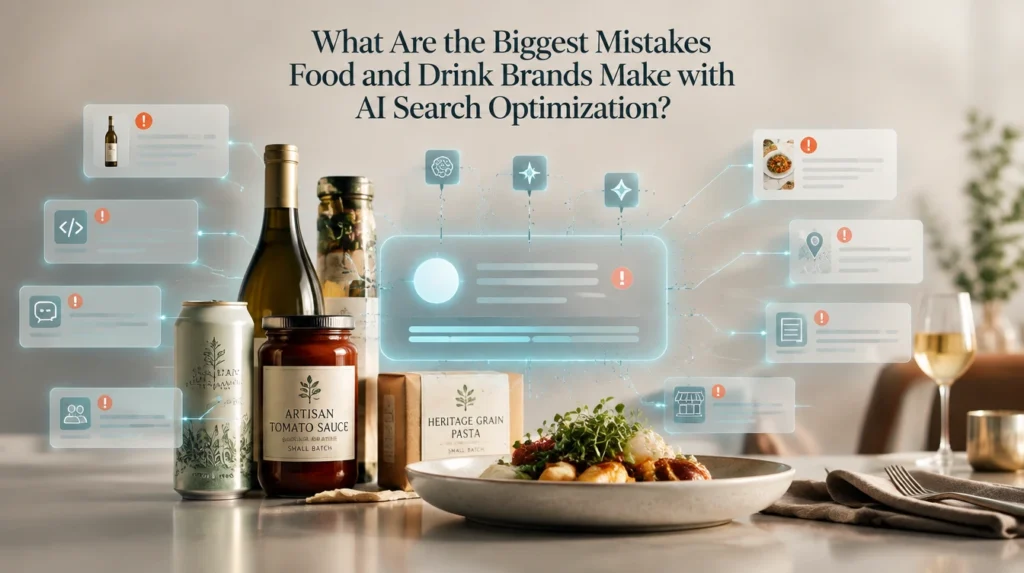
The biggest mistakes are treating AI search optimization as a separate project from SEO instead of an extension of it, implementing schema without verifying it matches visible content, writing marketing copy where direct-answer paragraphs belong, and ignoring Google Business Profile for restaurants and cafes. Each mistake creates retrieval gaps that cost citations over 90 to 180 day windows.
Six specific mistakes to fix first:
Marketing copy where direct-answer paragraphs belong. AI engines lift self-contained 40 to 60 word paragraphs that answer a specific question. Flowery brand copy doesn’t get cited because it doesn’t answer anything specific.
Schema markup that doesn’t match visible text. FAQ schema with 10 Q&As while the page shows 3. Review schema with aggregate ratings but no visible reviews. Menu schema with items the page doesn’t display. All get ignored.
Ignoring Google Business Profile completeness. For restaurants and cafes, GBP is the single highest-leverage AI search signal. Incomplete hours, missing menu link, no photos, no Q&A section responses. All of this costs visibility.
No FAQ sections, or FAQ sections stuffed with keywords. AI engines need genuine Q&A format to extract answers. “Why is our chicken the best in the world?” isn’t a question anyone asks AI. “Does X serve halal chicken?” is.
Thin product pages for packaged F&B. Product pages without ingredient breakdowns, nutrition data, allergen notes, and real reviews don’t get retrieved for ingredient or dietary queries.
No third-party mentions. AI engines treat mentions in independent publications, blogs, directories, and comparison content as evidence. Zero external mentions means AI engines have nothing but your own site to work with, which lowers citation confidence.
Most AI search optimization guides sell panic. “Be first before everyone else.” That framing’s wrong. AI search rewards the same signals Google rewards: credible content, matched schema, real third-party trust. The order of operations matters more than any clever hack.
What should a food and drink brand do this week?
f your F&B brand hasn’t been audited for AI search visibility, start with a diagnostic before changing content. Morphiaas runs an AI Search Visibility Diagnostic for Indian and US food and drink businesses. It covers 20 brand and category queries across ChatGPT, Perplexity, Gemini, and Google AI Overviews, a schema audit of your top 5 pages, and a prioritised list of the three fixes that will move citations fastest.
Book your diagnostic and we’ll deliver the walkthrough within 5 working days. For the broader picture on how our team approaches F&B marketing, our food and drink industry page lays out the full stack. For a related tactical read, our food and drink e-commerce marketing guide covers the acquisition and retention layer that sits alongside AI search work.
Frequently asked questions
How long does AI search optimization take to show results for food and drink brands?
Schema and on-page fixes often show indexing changes within 2 to 4 weeks. Citation lift in AI engines typically takes 60 to 120 days because retrieval indexes update on their own schedules and third-party mentions take time to accumulate. Restaurants with strong Google Business Profile signals tend to see faster movement than packaged F&B brands relying on third-party review ecosystems.
Can small food and drink businesses compete with large brands in AI search?
Yes, in specific categories. Local restaurants and cafes have an inherent advantage because AI engines weight location signals heavily for “near me” and city-based queries. Small packaged F&B brands can compete in niche categories where their content depth, ingredient transparency, and third-party mentions outweigh brand size. Large brands win generic category queries. Small brands win specific ones.
Is AI search optimization different from traditional SEO?
AI search optimization extends traditional SEO rather than replacing it. The foundations (crawlable site, matching schema, authoritative links, real content) stay the same. The additions are direct-answer formatting, question-based H2 headings, entity clarity through consistent naming across the web, and third-party mentions AI engines treat as independent verification. Think of it as SEO plus retrieval design.
Which AI search engines matter most for food and drink businesses?
Google AI Overviews matters most because it sits inside existing Google search traffic, where most food research still happens. ChatGPT and Perplexity carry increasing share of recommendation queries (“best X in Y city”). Gemini matters where users have switched to it. Priority stack: Google AI Overviews first, Perplexity second (because it’s easiest to audit and influence), ChatGPT third, Gemini fourth.
Do I need a separate strategy for ChatGPT, Perplexity, and Google AI Overviews?
No. The same foundational work (schema, direct-answer formatting, entity clarity, third-party mentions) feeds all four engines. Tactical differences exist at the edges, like Perplexity’s higher weight on recent content versus ChatGPT’s stronger reliance on Bing’s index, but the core content strategy stays unified. One well-optimized site serves all four. The alternative, running separate strategies per engine, scales poorly and doesn’t produce meaningfully better outcomes.