

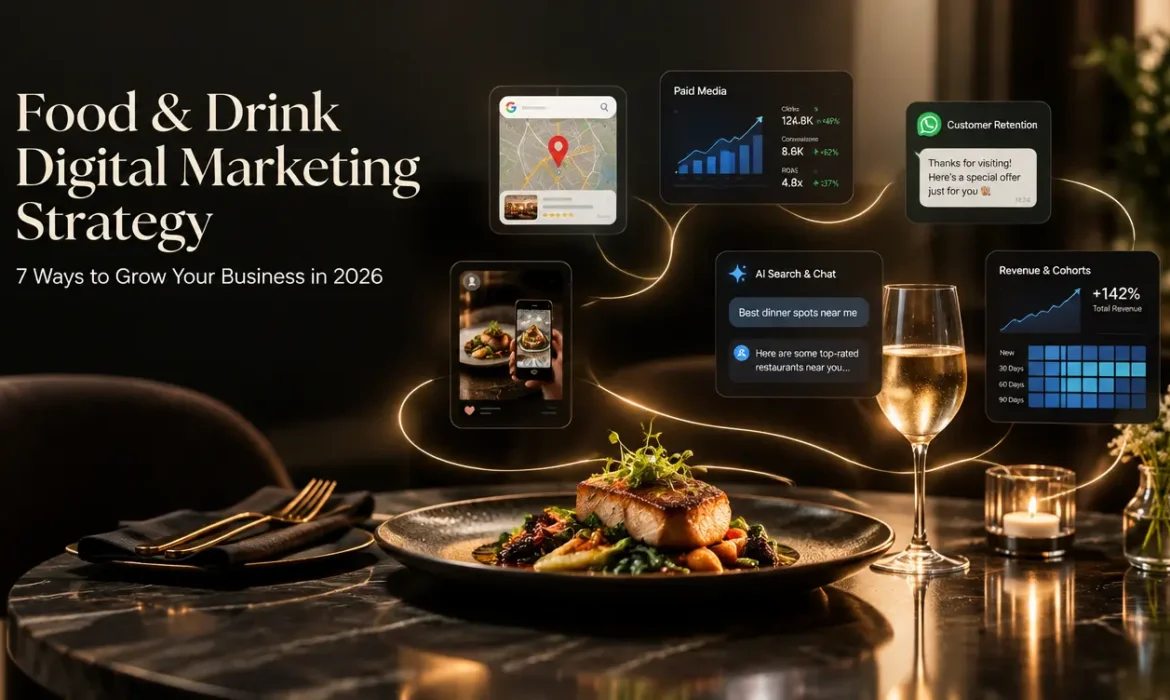
Food and drink digital marketing strategy is the system that moves F&B brands from scattered tactics to a connected funnel across SEO, paid media, retention, content, and conversion. Seven moves do the heavy lifting: positioning, Google Business Profile and local SEO, paid search and social, retention channels, UGC, AI search optimization, and measurement that separates new from returning customers.
Key takeaways
- F&B digital marketing wins on sequence, not stack size. Positioning and GBP come before any paid spend.
- Repeat rate and Google Business Profile strength are the two leading indicators that predict whether paid media will pay back.
- Channel mix shifts by format: restaurants and cafes lean into local search and WhatsApp, cloud kitchens into aggregators and paid social, packaged F&B into DTC retention and UGC.
- Budget bands in INR for most Indian F&B brands: ₹30,000 to ₹1,50,000 per month at launch, scaling to ₹2L to ₹10L as retention compounds.
- Measurement that separates new-customer revenue from returning-customer revenue changes every budget decision for the better.
What is food and drink digital marketing strategy?
Food and drink digital marketing strategy is the connected set of decisions that governs how an F&B brand (restaurant, cafe, cloud kitchen, packaged food, or beverage) acquires customers online, retains them, and measures the economics across both. It covers channel mix, budget allocation, conversion tracking, creative direction, and the sequencing that decides what gets resourced first.
Strategy differs from tactics in one specific way. Tactics answer “what Meta ad do we run this month.” Strategy answers “which channels earn the right to our budget, in what order, against which outcomes.” Most F&B brands skip strategy and jump straight into tactics, which is why their marketing spend produces inconsistent results.
Why does food and drink digital marketing strategy matter in 2026?
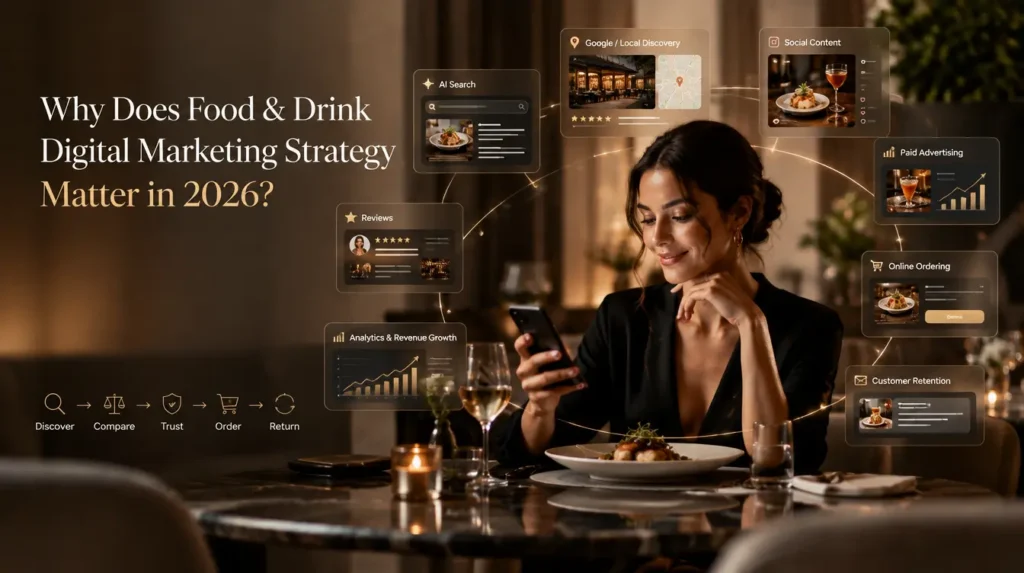
It matters because F&B margins have thinned while CAC has climbed. Aggregator commissions sit at 18 to 25 percent. Paid social CPMs have risen year over year. Brands that treat marketing as connected strategy rather than channel-by-channel bets outperform competitors with similar products on the same spend.
The shift that matters most in 2026 is the move toward AI-assisted discovery. Diners ask ChatGPT for recommendations. Consumers ask Perplexity for comparisons. Google AI Overviews sits above organic results on a measurable share of food queries. Brands optimized for retrieval across Google and AI engines capture traffic others don’t see.
Morphiaas, a performance marketing agency serving India and the US, works with F&B operators where strategy fixes often produce bigger gains than new channel launches. A ₹2L paid media budget that previously produced inconsistent results tends to compound differently once positioning, measurement, and retention are set.
What are the 7 proven ways to grow a food and drink business?
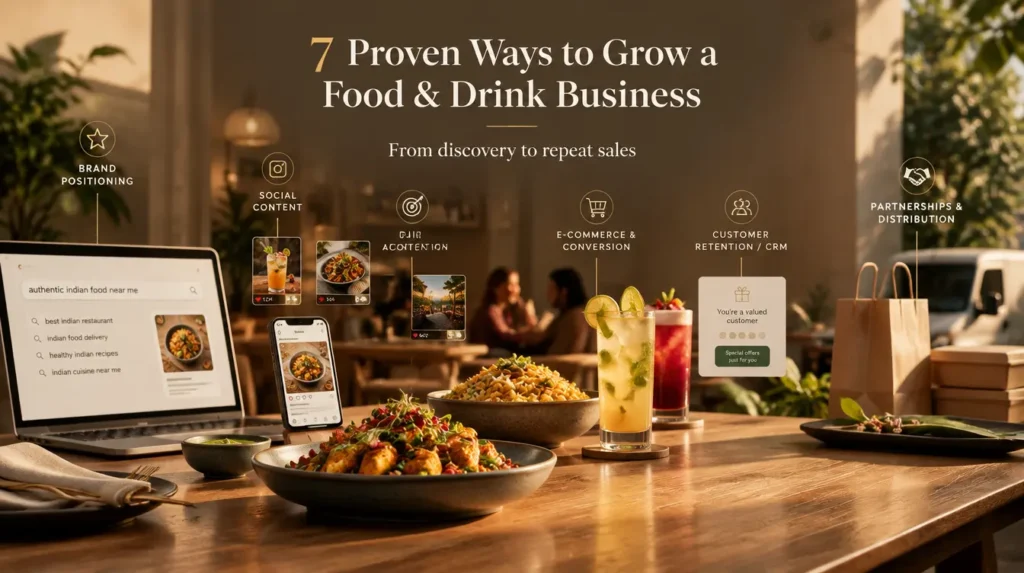
Seven moves carry the growth weight for most F&B brands in India and the US. Each maps to a measurable outcome: new customer CAC, repeat rate, average order value, or contribution margin. Order matters. Positioning first, measurement last. Everything in between stacks on those two.
1. Lock positioning before spending on any channel
Positioning decides what you narrow to and what you deliberately walk away from. One owned space (ingredient transparency, cultural rootedness, functional outcome, category discipline) beats three claimed at once. Brands with sharp positioning command 15 to 30 percent price premiums over category average and lower paid-media CPLs because the message fits.
The quick test: write down what your brand is not for. If the list is empty, positioning isn’t sharp yet. See our deeper breakdown on food and drink branding strategies for the full positioning framework.
2. Fix Google Business Profile and local SEO before anything else
For restaurants, cafes, and cloud kitchens, Google Business Profile is the single highest-leverage asset. Diners search “restaurants near me open now” and the top GBP results capture the booking. Fill it completely: hours, categories, menu URL, 20+ photos, Q&A responses, review replies.
Google’s own Business Profile documentation covers what belongs in a complete profile. Most restaurants fill 50 to 60 percent of the fields and wonder why Local Pack rankings don’t move.
3. Run paid search and paid social against new-customer cohorts, not blended ROAS
Blended ROAS (Return on Ad Spend, revenue divided by ad cost) hides which campaigns bring repeat buyers versus one-time coupon users. Set up a new-vs-returning view in Google Analytics 4 or your platform, tag every campaign with intent, and judge campaigns by 90-day customer value rather than first-click purchase.
Google Ads for restaurants typically runs CPL at ₹40 to ₹120 for Indian casual dine-in. Meta ads for packaged F&B run CPAs that make sense only against 90-day cohort LTV. We cover the Google Ads playbook in detail in Google Ads for restaurants that fill tables.
4. Build retention channels that compound past month 6
Email, SMS, and WhatsApp Business carry the retention weight for F&B brands. Email handles educational and seasonal flows. SMS handles time-sensitive drops. WhatsApp handles conversational retention, especially for Indian restaurants where 70 to 80 percent of reservations happen through it. Retention economics beat acquisition economics after month 6 in most F&B categories.
5. Make UGC the primary creative engine
User-generated content outperforms studio-shot creative on cold paid social for most F&B categories. Diners want real plates, real pours, real reactions before they commit. Creator partnerships and permission-licensed customer content systematically produce the raw material.
And UGC pays back twice. Once as paid-social creative with better CTR and lower CPM. Again as organic social and product-page content that lifts conversion rate. Same shoot, two channels.
6. Optimize for AI search alongside Google search
AI search optimization makes your brand retrievable and citable by ChatGPT, Perplexity, Gemini, and Google AI Overviews. The core moves are structured data (Restaurant, Product, FAQPage schemas), entity clarity through consistent naming, and direct-answer paragraphs AI engines can lift verbatim.
AI search traffic now carries a measurable share of food research queries. See our deeper piece on AI search optimization for food and drink businesses for the full technical breakdown.
7. Set up measurement that connects every spend to new or returning revenue
Measurement is the strategy move that makes every other one pay back. Without a new-vs-returning revenue split at the channel level, every budget decision is a guess. Set up GA4 properly, tag every campaign, and review three numbers weekly: blended CAC trailing 30 days, repeat rate for the 90-day cohort, and contribution margin per order.
Measurement sits last because the other six need to be running first. But once it’s live, it reshapes decisions on the other six retroactively. Campaigns that looked bad start looking good. The budget flows differently inside a week.
How much should a food and drink business spend on digital marketing?
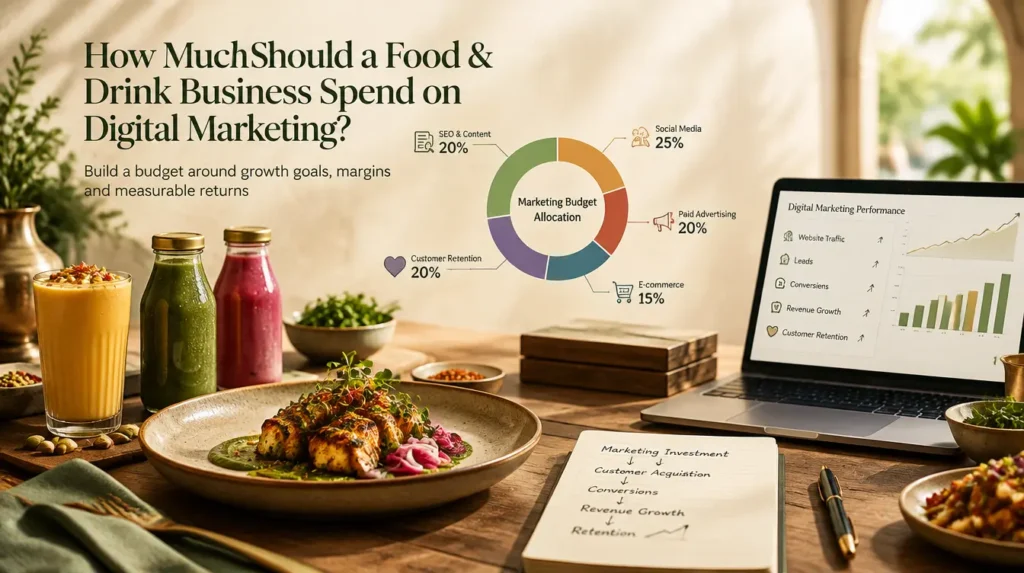
Most Indian F&B brands should budget 15 to 30 percent of gross revenue on digital marketing in year 1, trending down to 10 to 18 percent as retention compounds. US brands often start higher (20 to 35 percent) because CAC sits higher. The number depends on format and growth stage.
Practical starting bands:
- Single-location restaurant or cafe: ₹30,000 to ₹1,00,000 per month across GBP, Google Ads, retention.
- Multi-outlet chain (3 to 5 locations): ₹1,50,000 to ₹5,00,000 per month across local SEO, paid search, paid social, retention.
- Cloud kitchen brand: ₹1,00,000 to ₹4,00,000 per month, 60%+ on paid social and aggregator optimization.
- Packaged F&B DTC under ₹10Cr revenue: ₹2,00,000 to ₹10,00,000 per month, heavy weight on paid social and retention.
Spend under ₹500 per day rarely produces enough conversion data for Smart Bidding to optimize well. First month is data collection, not scale.
How is restaurant digital marketing different from packaged food digital marketing?
Restaurant digital marketing optimizes for local discovery and immediate conversion (reservations, orders, calls, walk-ins). Packaged food digital marketing optimizes for brand recall, repeat purchase, and shelf velocity across owned and third-party channels. Both share foundational work (positioning, measurement, UGC) but diverge sharply on channel priorities.
| Priority | Restaurants and cafes | Cloud kitchens | Packaged F&B |
|---|---|---|---|
| Top channel | Google Business Profile + local SEO | Aggregators + paid social | Paid social + retention email |
| Primary conversion | WhatsApp / phone / walk-in | App order / direct site order | DTC site order / quick commerce |
| Retention stack | WhatsApp Business + Google reviews | App push + SMS + loyalty | Email + SMS + subscription |
| Measurement focus | Covers per week, GBP calls | Orders per day, repeat rate | 90-day cohort LTV, repeat rate |
How do you measure food and drink digital marketing performance?
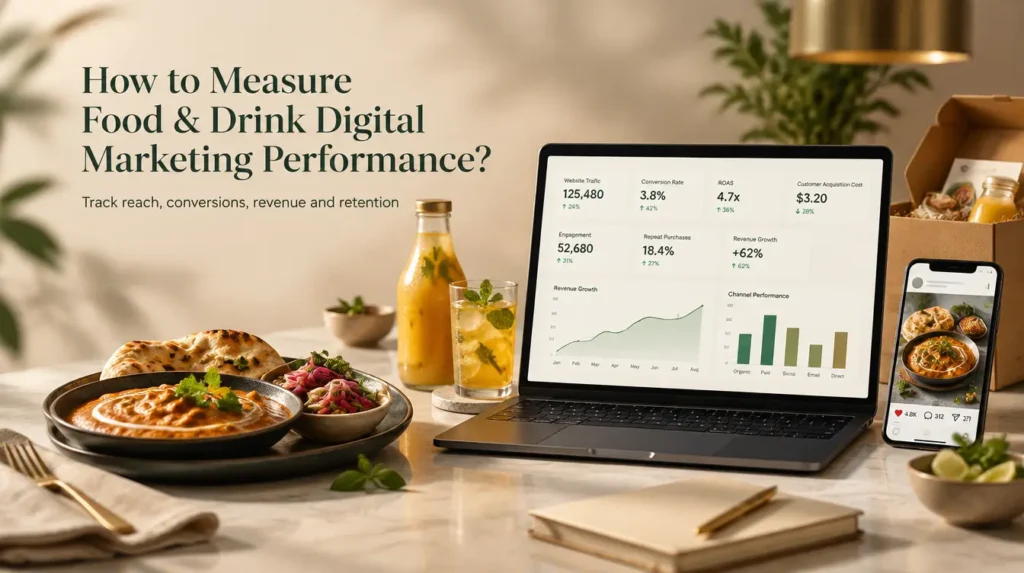
Measure performance by splitting revenue into new-customer and returning-customer streams, then tracking the metrics that matter in each. For restaurants: covers per service, Google Business Profile calls, average bill size, return-visit rate. For packaged F&B: 90-day cohort LTV, repeat purchase rate, contribution margin per order after shipping and ad cost.
Three numbers deserve weekly review regardless of format. Blended CAC trailing 30 days. Repeat rate for the cohort acquired 90 days ago. Contribution margin per order. Those three predict business health better than any dashboard with 40 widgets.
Google’s GA4 documentation covers the audience and acquisition reports needed to run this cohort view properly. Most F&B brands get blended ROAS, miss the cohort layer, and over-invest in channels that acquire the wrong buyer.
What are the biggest mistakes food and drink brands make with digital marketing?
Five mistakes account for most of the preventable damage in F&B digital marketing. Each compounds quietly over 90 to 180 days before showing up in the P&L.
Spending on paid media before fixing GBP and positioning. Paid traffic lands on a weak profile or muddled brand message. CPL climbs and the ad budget looks broken when the real problem sits upstream.
Measuring blended ROAS only. Hides which campaigns bring repeat buyers versus coupon hunters. The cohort split takes 15 minutes to set up in GA4 and changes decisions immediately.
Treating retention as a nice-to-have. Email and WhatsApp get set up in month 1 and ignored for 11 months. Flows don’t update, segmentation stays flat, retention revenue leaks.
Chasing new channels before mastering current ones. F&B brands jump into Pinterest, Threads, Reddit before they’ve maxed out GBP, Google Ads, and email. New channels earn their place after existing ones hit diminishing returns.
Copying global playbooks without India adaptation. US-anchored tactics (OpenTable, Shopify Plus, heavy Klaviyo flows) often don’t match Indian F&B reality (WhatsApp primacy, aggregator dynamics, FSSAI trust signals, GST-inclusive pricing).
What should a food and drink brand do this week?
If your F&B brand is running digital marketing without a connected strategy, start with a diagnostic before changing spend. Morphiaas runs a Food & Drink Digital Marketing Diagnostic for Indian and US F&B operators. It covers a 60-minute Loom walkthrough of your current channel mix, GBP health, measurement setup, retention stack, and paid media accounts. The output is a prioritised list of the three fixes that will move revenue fastest.
Book your diagnostic and we’ll deliver the walkthrough within 5 working days. For the broader picture on how our team approaches F&B work, our food and drink industry page lays out the full stack. For deeper dives on specific channels, our tactical reads on restaurant website design and food and drink e-commerce marketing go wider on individual plays.
Frequently asked questions
How long does it take to see results from food and drink digital marketing?
Local SEO and GBP fixes often show ranking changes within 4 to 8 weeks. Paid media produces conversion data from week 1 but needs 30 to 60 days to let Smart Bidding optimize. Retention flows show meaningful contribution from month 2. The compounded effect of a connected strategy typically shows up in month 3 to 6.
What’s the single highest-leverage move for a new food and drink brand?
For restaurants and cafes, GBP completeness combined with review generation. For packaged F&B, product-page conversion rate and the first retention flow (welcome email with content, not discount). Both are cheaper than any paid media campaign and compound longer.
Should a food and drink brand hire an agency or build an in-house team?
Depends on scale. F&B brands under ₹2Cr revenue do better with a specialist agency because a full in-house team doesn’t justify at that revenue. Between ₹2Cr and ₹20Cr, a hybrid (one in-house lead plus agency execution) works. Above ₹20Cr, in-house makes economic sense if hired well.
How much of a food and drink marketing budget should go to paid media versus retention?
Year 1 brands often split 70% acquisition / 30% retention. By month 12 to 18, the split should shift closer to 50/50. Mature brands with strong repeat rates sometimes run 40/60. The ratio follows the repeat rate curve: higher repeat means more retention investment is justified.
Which channel delivers the best ROI for food and drink businesses?
No single channel wins across all F&B formats. For restaurants and cafes, GBP and local SEO consistently produce the lowest cost per acquisition because the traffic is purchase-intent. For packaged F&B DTC, email marketing delivers the highest ROAS because it operates on first-party data without platform rent.