

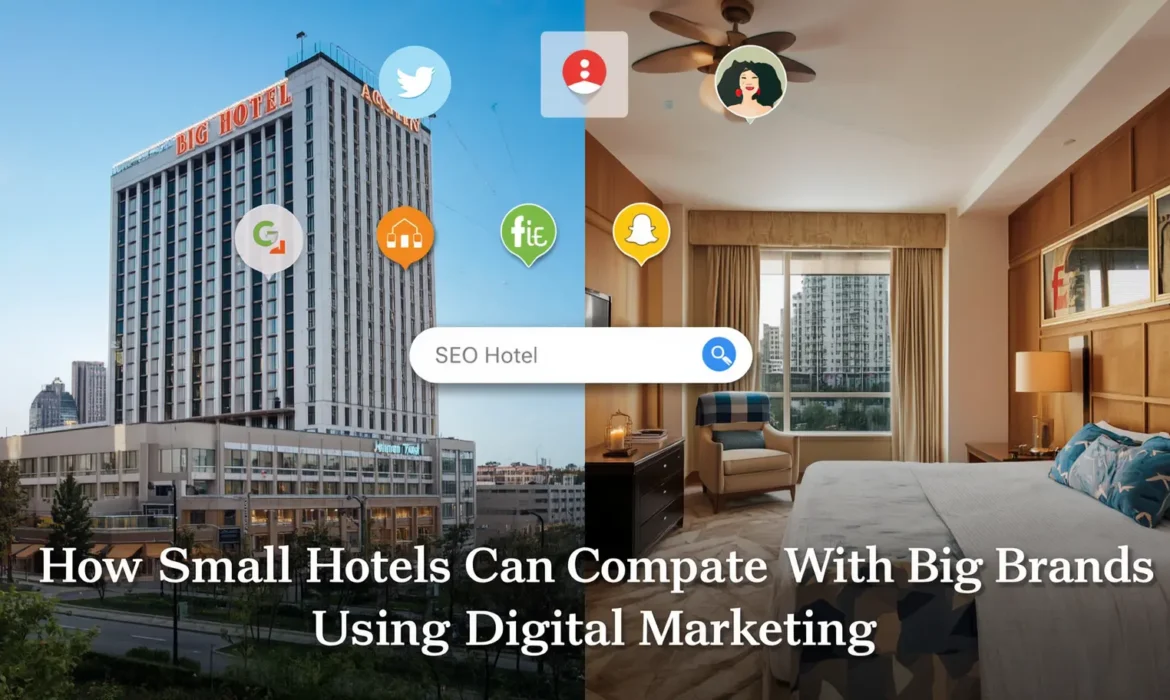
Introduction: The Playing Field Has Changed
When you walk into any city in India today you will see a Marriott, an OYO or a Taj. These big hotels are usually close to a family-run guesthouse or a pretty boutique property. The big difference is that these large hotels have a lot of money to spend on marketing. Small hotel owners do not have much money for marketing. But what small hotel owners need to know is that digital marketing has changed everything for hotels like theirs. Digital marketing for hotels revolutionizes the industry.
Major hotel chains invest crores in television advertising, OTA fees, and loyalty initiatives Small hotels cannot match that spend. Small businesses can definitely compete with big brands in the areas that count the most nowadays: being seen online making a personal connection with people and getting bookings directly.
This guide will show you exactly how small businesses can do this.
Reasons Small Hotels Face Online Challenges (And Why They Aren't to Blame)
Most small hotel owners are really good at making guests feel welcome. They know how to make someone feel at home.. They often didn’t learn how to get more online bookings for their small hotels.
The common mistakes they make are :
1. Relying entirely on OTAs like MakeMyTrip and Booking.com incurs a commission of 15-25% for every booking.
2. Having a website that looks dated and has sluggish loading speeds on mobile device
3. Absence on Google Maps or conflicting details across platforms
4. Zero social media strategy beyond occasional posts
5. No understanding of hotel website conversion optimization
The result? Big brands are over the search results and the listings, on online travel agencies. This makes it tough for independent hotels to get noticed. They usually have to settle for what’s left.. This does not have to be the story of your independent hotel.
1. Begin With Your Most Powerful Asset Your Narrative

Big hotel chains are all about being the same. Every Marriott hotel is, like every Marriott hotel. This is what makes them good. Also what makes them bad.
Your small hotel has something no chain can manufacture: authenticity.
Hotel branding strategies for small properties should lead with story. Who started the hotel? What is the neighbourhood like at 6am? What do your guests feel when they leave? This human story is your most powerful marketing asset and it costs nothing to tell.
Build your brand around:
1. An authentic, transparent character friendly, daring, serene, unusual
2. A visual identity that appears cohesive throughout your website and social platforms.
3. A speaking style that resembles an actual person, rather than a corporate manual.
When someone is deciding whether to stay at your hotel or a big chain hotel the story of your hotel is what makes them choose you over the other place. Your hotel has a story. This is what makes people want to stay with you instead of the big chain hotel.
2. SEO for Small Hotel Websites Get Found Without Paying for Every Click
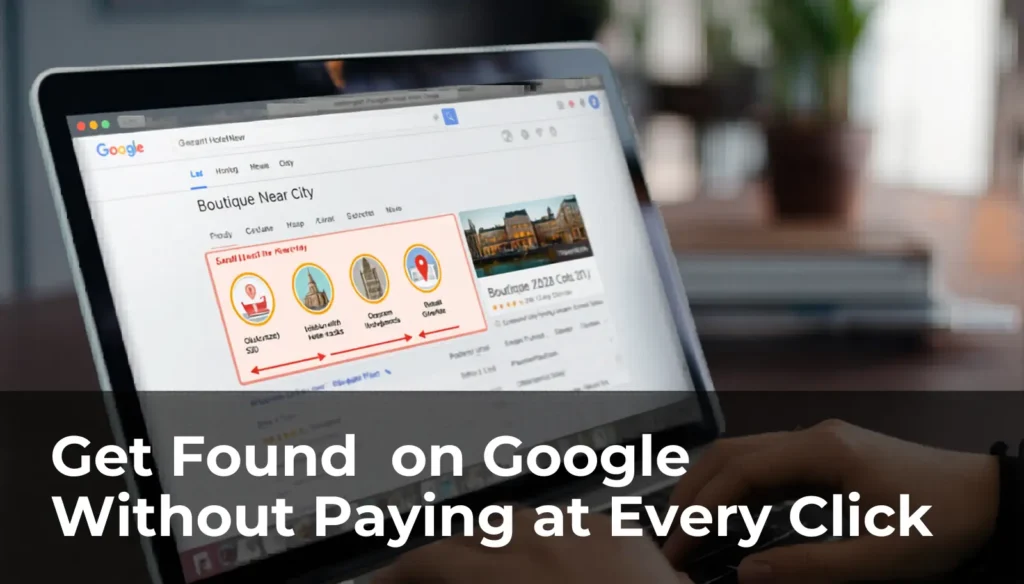
The most sustainable source of direct bookings is organic search. When someone types “boutique hotel near Udaipur old city” or “affordable heritage hotel in Jaipur” into Google — your hotel needs to appear.
SEO for small hotel websites is not as complicated as it sounds. Here is where to begin:
Google Business Profile Claim and fully optimise your Google Business Profile. Add real photos, accurate check-in times, your phone number, and respond to every review — good and bad. This forms the basis of local SEO for hotels and it comes at no cost
When you are making your website you should use words that tell people where you are. For example you can say “our boutique hotel is in New York City” or “we have a heritage stay near the Eiffel Tower”. You can also say “we are a small hotel in Soho”.
Do not put many keywords on your website. Instead write what your guests want to know. Search engines are important. Your guests are more important. Write for your guests first. Then think about search engines.
Blog Content Write helpful articles about your destination. “Top 5 attractions near [your hotel]” or “Best regional cuisines in [your city]” draws in travelers preparing for their trip. When they find your blog, they find your hotel.
Done consistently over 6 months, SEO for small hotel websites will reduce your dependence on OTAs and bring guests directly to your booking page.
3. Social Media Marketing for Hotels Show, Do Not Just Tell
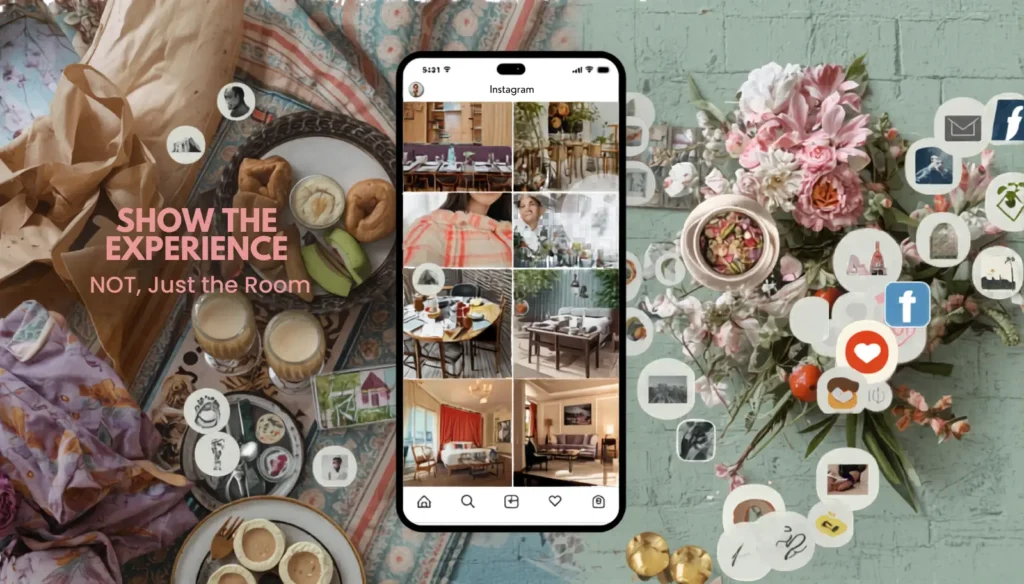
Using media to market your hotel is a really good idea because it does not cost a lot of money. You do not have to hire a photographer or a company that makes content for you to get started with social media marketing for hotels. What you really need to do is be consistent and be real when you are using media marketing, for hotels.
What works on Instagram and Facebook for small hotels:
1. Room and property photos taken in good natural light
2. Behind the scenes content — your chef preparing breakfast, your garden in the morning, your staff setting up for a wedding
3. Guest moments — with permission, share happy guest photos and tag them
4. Local area content — festivals, sunsets, nearby attractions
5. Short Reels and videos — a 30-second tour of your best room gets more reach than any static post
When it comes to marketing for boutique hotels on social media there is one important thing to remember. You need to demonstrate to people how they will experience their stay at your hotel, not merely focus on the hotel’s appearance. Individuals seeking accommodation do not simply reserve a room; they reserve an experience. The things you post online should make people feel happy or excited or something. When you see posts from boutique hotels on the internet they should make you feel something. You should want to go and stay at the boutique hotel. Boutique hotels need to show people what it is like to be at the boutique hotel. They should not just show pictures of the rooms and things you can do at the boutique hotel. Boutique hotels should make you feel like you are really there so you will want to stay at the boutique hotel.
Share content a minimum of 4 times each week. Reply to every comment and direct message within 24 hours. Maintaining consistency for six months will cultivate an audience that serves as a reliable source of bookings
4. Boost Direct Reservations Cease Diverting Your Income to OTAs
Every booking that comes through an OTA costs you 15-25% in commission. On a ₹3,000 nightly room that costs ₹450-₹750 per reservation eliminated. When you take that into account for 100 bookings per month, you are facing a loss of ₹45,000 to ₹75,000 each month
The marketing strategy for every small hotel should focus on steadily increasing direct bookings over time. Here’s the method:
Your site needs a straightforward, mobile-optimized booking engine; otherwise, you’re missing out on guests daily. Platforms such as Little Hotelier, Cloudbeds, or a straightforward connection with Google Hotel Search enable this to be reachable and cost-effective.
When people book a room directly with you they should get something. This is called a Direct Booking Incentive. You can give them things like early check-in. You can also give them breakfast. If you have a room available you can upgrade them to that room. Giving them something extra can save you a lot of money that you would have given to the online travel agency or OTA as a commission. This is because the Direct Booking Incentive is usually smaller than the OTA commission.
Gather email addresses from visitors and dispatch a simple monthly newsletter to them. Share updates about local events, seasonal offers, and a note from the owner. Previous guests represent your most receptive audience and are the least expensive to convert for return reservations.
Hotel website conversion optimization is really important. It does not matter how many people visit your Hotel website. What matters is that people who visit your Hotel website actually make reservations at your Hotel. You should make sure that your booking button is easy to see on every page of your Hotel website. The pictures of your Hotel rooms should be very clear and nice to look at. Your Hotel room rates should be easy to understand. Your Hotel website should also load quickly on phones and other mobile devices. It should take less, than 3 seconds to load.
5. Google Ads for Hotels Effective Targeted Spending
When you use Google Ads for hotels the way they can be really good for small hotels. The main thing to remember is to use them
Do not make your ads show up for everyone who is searching for hotels in your city. Your budget will disappear in hours. Instead:
1. Aim for very precise queries such as “exclusive hotel close to [your landmark]” or “historic hotel [your city] featuring pool.”
2. Utilize Google Hotel Ads that display directly in Google Search along with your pricing and availability
3. Establish a small daily budget between ₹500 and ₹1,500 and closely track the cost per booking
4. Reconnect with users who visited your site but did not book — they are your most valuable prospects
For hotels that do not have a lot of money to spend Google Ads are really good when you use them with strong organic SEO. This way you do not have to pay for every click on Google Ads. You can get people to visit your website for free, with SEO and then you can use Google Ads to get even more people to visit. This is a way for small hotels to get more visitors without spending too much money on Google Ads.
6. Local SEO for Hotels Own Your Neighbourhood Online
Local SEO for hotels is different from general SEO. It is specifically about appearing when someone nearby — or someone searching for your specific area — is looking for accommodation.
Key actions:
1. Ensure your business is listed on Google Maps, TripAdvisor, and Justdial with consistent name, address, and phone number on every platform
2. Actively collect Google Reviews send every guest a polite follow-up message asking for a review
3. Reply to each review in a professional manner, particularly to the unfavorable ones
4. Develop location-targeted pages on your site for various guest categories “couples retreat in [city]”, “family-friendly hotel close to [attraction]”, “business lodging in [city]”
A hotel that has 200 reviews on Google and a Google Business Profile that is complete will always be higher in the search results than a big chain hotel that does not have a good local presence. This is true even if the chain hotel has a lot of money to spend. The hotel with the reviews and complete profile will be the one that people see first when they search for a place to stay. A hotel with a lot of Google reviews and a fully complete Google Business Profile will do better in search results than a chain hotel, with a poor local presence.
Integrating Everything A Practical 90-Day Strategy
You don’t need to achieve everything at once. Here is a simple basic framework:
Month 1 — Establish and enhance Google Business Profile. Improve your site’s loading speed on mobile. Establish a direct reservation system. Establish uniform profiles on Instagram and Facebook.
Month 2 — Content and Visibility Begin sharing posts on social media four times a week. Create 2 articles for your site. Start gathering email addresses from guests. Request a Google review from each guest at checkout.
Month 3 — Payment and Optimization Initiate a small Google Ads campaign focused on particular keywords. Examine your website analytics to identify where users disengage. Enhance your reservation page utilizing actual data
In three months you will have a website and other things online that will work for you all the time even when you are sleeping. This means you will get bookings directly from people who want to stay with you and you will not have to rely much on Online Travel Agencies like Booking.com or Expedia. You will have your digital presence that brings in bookings. Your digital presence will work for you bringing in bookings and reducing your need for Online Travel Agencies.
FAQ
Q1. Are independent hotels really able to compete with large hotel chains online?
Yes. Often they do it better. Big hotel chains try to beat each other by being bigger. Small hotels on the hand compete by being unique and having a story to tell. They also focus on being truly local. Digital marketing is a game changer for hotels. It helps them reach the people that big brands are trying to reach but without spending a lot of money. Small hotels can now communicate directly with their audience, something that large brands invest heavily in.
Q2. What is the suitable budget for the digital marketing of a small hotel?
I think a sensible starting range is ₹15,000 to ₹30,000 per month. This will cover the cost of making content for media doing basic Google Ads and SEO. This is actually a part of what you are paying now for OTA commissions.. The good thing is that it will give you much better results in the long run.
Q3. What is the timeframe for SEO to yield results for a small hotel?
It usually takes about 3 to 6 months to see a difference in organic traffic.. If you use Local SEO with your Google Business Profile you can get results a lot sooner. Sometimes it only takes 4 to 6 weeks if you work on it all the time. Local SEO and Google Business Profile are really ways to get more traffic to your website. Google Business Profile is a tool for Local SEO and it can help you get more people to visit your website.
Q4. Should small hotels utilize every social media platform?
Let us focus on Instagram and Facebook first. These are the places where most people who travel for fun find out about hotels and learn more about hotels. Instagram and Facebook are really important for hotels.
After we have a presence on Instagram and Facebook we can think about using YouTube and Pinterest to tell people more about our hotel brand. Instagram and Facebook are where we need to start because most people use Instagram and Facebook to find hotels and learn about hotels.
Q5. What essential step can a small hotel take to boost direct bookings?
You must repair your website and incorporate a feature for individuals to make bookings directly on it. If your website is really slow, old or does not let people book things then everything you do to market it on the internet is basically a waste of time because it is sending people to a website that does not work well. Your website is like the place where people go to learn about your business and book things so it needs to be good. If your website is not good then people will just. Go somewhere else. Fixing your website and adding a booking engine is a very important thing to do.
Q6. Do minor hotels require a specialist marketing firm?
This is about what your hotel can handle. When you are just starting out you can do a lot of things yourself if you have the help. As your hotel gets bigger it is an idea to work with a company, like Morphiaas that knows how to market small hotels. This can really help your hotel do well.
Conclusion
The time when people thought that having a lot of money to spend on advertising meant you would get good results is gone. Now small hotels can use marketing to get people to like them and come back and they do not have to rely so much on online travel agencies. They can even compete with hotel chains that have a lot more money to spend on advertising.
The hotels that will do well in the ten years are not the ones with the most rooms or the ones that spend the most money on ads. They are the hotels that’re honest and tell good stories about themselves that are always online and easy to find, that listen to what their guests have to say and use that to make things better and that spend their money wisely on digital marketing.
Your small hotel already has what it needs to compete with the hotels. You already have a story to tell and your guests already have a wonderful experience when they stay with you. Now you just need to make sure that the right people can find you on the internet before they find another hotel.